
The new Toyota Hilux - timely changes in Vietnam.
The Hilux is equipped with a new engine and transmission, a significant step forward in its move to penetrate deeper into the pickup truck segment, currently dominated by the Ford Ranger.
The Hilux is equipped with a new engine and transmission, a significant step forward in its move to penetrate deeper into the pickup truck segment, currently dominated by the Ford Ranger.
Never before have Vietnamese customers seen so many changes to Toyota as in 2016. The Vios got a new engine, a new transmission, and an additional variant; the new generation Innova was a complete transformation. The Camry added more airbags; and the Hilux also got a new engine and transmission. These core upgrades are not typical of the Japanese automaker.
The old 3.0 and 2.5 engines have been replaced with 2.8 and 2.4 engines. The turbocharged 2.8 engine in the Hilux G delivers 174 horsepower and 450 Nm of torque, while the old 3.0 engine had 161 horsepower and 360 Nm. This increase of 13 horsepower and 90 Nm results in a significantly different driving performance for the pickup truck.
The new 2.4 turbocharged version boasts 147 horsepower and 400 Nm of torque, compared to the old 2.5 version's 142 horsepower and 343 Nm, meaning the new version offers an increase of 5 horsepower and 57 Nm. Toyota is aiming to create a different image for the Hilux in this segment.
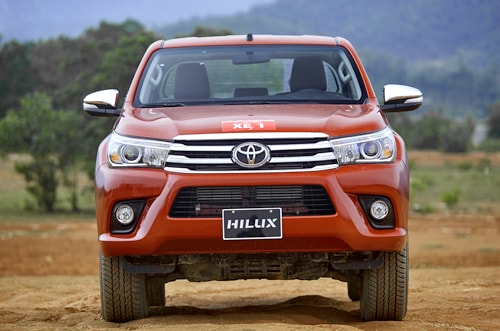 |
| The new Toyota Hilux no longer has air vents on the hood. |
The new Hilux comes in three versions. While the 2.4L version is equipped with a 6-speed manual transmission, the 2.8G version offers either a 6-speed manual or a 6-speed automatic transmission, replacing the previous 5-speed automatic. Aside from the engine changes, the Hilux only receives minor design upgrades; the air vents on the hood are gone, resulting in a flatter, more urban-inspired look.
The pickup truck segment is the fastest-growing segment in the market, and the increasing pressure from the expanding Ford Ranger means the Hilux needs to adapt. Durability alone is not enough to convince Vietnamese customers to buy a pickup. They need more than that: engine power, safety technology, and interior comfort.
Toyota proves that not only the Ford Ranger but also the 2016 Hilux has similar features. On the 2.8 AT version, the interior includes a leather-wrapped steering wheel, leather seats, power-adjustable driver's seat, automatic climate control with rear air vents, a 6-speaker sound system, DVD player, AUX, USB and Bluetooth connectivity, push-button start, and one-touch windows.
The interior features are just comfortable enough for today's basic customer needs, but the performance is the most noteworthy aspect of the new Hilux. From the sluggish, slow, and noisy Hilux of the past, it has become a powerful, agile, and stable machine.
Toyota brought experts from Japan to Vietnam to create the most challenging terrain for the Hilux to test. They engaged the electronic differential lock in low-range (L4) mode to allow the Hilux to climb a steep incline, followed by plunging it into a pit approximately 8 meters deep with a similar slope. This test proved relatively easy, thanks to the 450 Nm torque of the 2.8G AT combined with the low-range gears, even on a slippery dirt road due to the rain.
Subsequent terrains, such as driving in circles around deep pits and traversing uneven surfaces, demonstrate the vehicle's stability thanks to the increased cross-sectional area of the side frame and the reinforcement of numerous welds.
To navigate inclines of around 10%, common in Vietnam, simply using the H2 mode (two-wheel drive) is sufficient. The hill-start assist technology is helpful because it automatically brakes for about 3 seconds when the driver takes their foot off the brake and moves it to the accelerator, especially useful on mountain roads and with heavy loads.
While challenging off-road conditions showcase the effectiveness of the four-wheel drive system and the vehicle's rigidity and stability, the power of the new engine and the agility of the 6-speed gearbox are demonstrated on the open road.
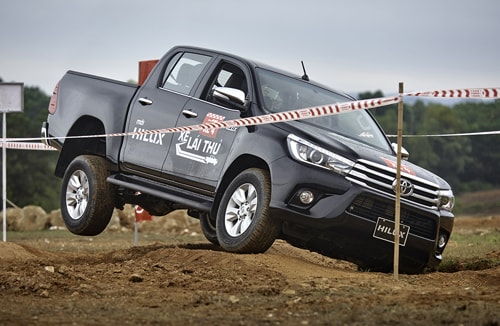 |
| The car body is more rigid. |
Starting on the same stretch of road, if the old Hilux reached a speed of around 90 km/h, the new Hilux reached 110 km/h. Immediately afterwards, slowing down to about 50-60 km/h and continuously steering to avoid cones, the Electronic Stability Control (ESC) technology came into play, preventing the rear end from sliding out like the previous version. Maintaining speed while cornering sharply at 90 degrees, the tires screeched but the sound was short and quiet, and there was no skidding or fishtailing. Both the brakes and accelerator were responsive and had good elasticity.
On the open road, the Hilux delivers quite a few surprises. The engine no longer roars but makes a steady "ooh" sound whenever acceleration is needed. A bulky pickup truck suddenly becomes a smooth glide. Of course, that's on good roads; on bad roads, the leaf spring suspension makes everything bounce around. The improvement of the Hilux lies in each press of the accelerator.6-speed gearbox. The car...The response is better, stronger, and more stable. The Power driving mode is quite impressive with its ability to channel all the energy into a sudden acceleration, but it's noisy and jerky, not suitable for family trips.
The Hilux's sound insulation is also better. But like other pickup trucks, the diesel engine noise isn't really pleasant to listen to for extended periods. The sound isn't loud, but its constant presence can easily make drivers think, "I wish this were a gasoline engine."
Safety technology on the Hilux 2.8G AT includes brakes with ABS, EBD, BA, additional features such as ESC vehicle stability control, TRC active traction control, hill start assist, emergency brake warning lights, a rearview camera, and 7 airbags.
Following significant changes, the Hilux showed promising signs with sales reaching 182 units in November, much higher than the previous months' sales hovering around 100 units. However, this sales volume is still a long way from the manufacturer's target of 300 units, and even further from the Ranger's nearly 1,200 units per month.
The Toyota Hilux is priced at 697 million VND for the 2.4 MT version, 806 million VND for the 2.8G MT version, and 870 million VND for the 2.8G AT version. This price range is narrower than that of the Ranger, which has 8 versions, ranging from 619 to 921 million VND.
According to VNE