

The journey of the World Cup's transformation: 100 years and 4 turning points.
Since its inception in 1930, the World Cup has undergone four major changes, increasing the number of teams from 13 to 48 by 2026.
 |
Formation and development
The idea of bringing together the strongest teams from various nations in a world championship match originated in the 1920s, proposed by a group of French football administrators, led by the then-current FIFA President, Jules Rimet.
The resolution to hold the FIFA World Cup regularly was adopted by the FIFA Congress in Amsterdam in 1928. The first World Cup was held in Uruguay in 1930.
Uruguay was chosen to host the 1930 World Cup for two reasons. First, the Uruguayan national team had won gold medals in football at two consecutive Olympic Games in 1924 and 1928. Second, in 1930, Uruguay celebrated its centenary of independence.
However, due to the difficult travel conditions at the time, only four European countries agreed to participate: France, Belgium, Romania, and Yugoslavia. Other countries that joined included Argentina, Chile, Bolivia, Brazil, Peru, Paraguay, Mexico, and the United States.
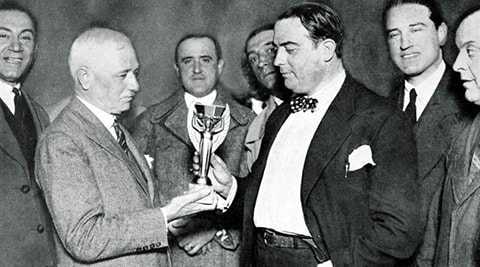 |
| Jules Rimet (in white shirt) - the father of the idea to create the World Cup. |
Following the resounding success of the first World Cup, four years later the second World Cup in history was held in Italy with the participation of 16 teams competing in a knockout format with a draw.
The World War II period meant that the World Cup, scheduled for 1942 and 1946, could not be held. It wasn't until 1950 that the world's biggest tournament resumed and has continued as a regular four-year event to this day.
The number of participating teams, at 16, was maintained from the 1934 to the 1978 World Cup, spanning 9 editions and witnessing 6 teams lift the trophy (Italy twice, Uruguay, Brazil three times, England, West Germany twice, and Argentina).
Elevating the tournament
Espana 82 (World Cup 1982 held in Spain) was the first time FIFA decided to increase the number of participating teams to 24, and also the first time a country on the Iberian Peninsula had the honor of hosting the tournament.
FIFA's decision to increase the number of participating countries aims to give more opportunities to national teams, increase competitiveness, and further elevate the tournament's status. This has received the support of the vast majority of countries worldwide.
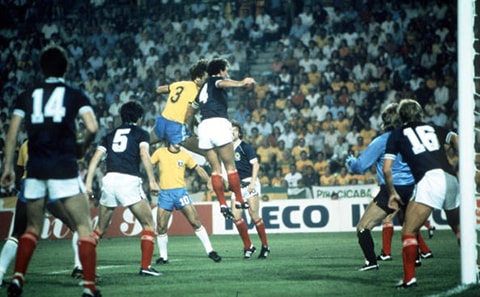 |
| The 1982 World Cup expanded to 24 teams, giving less-regarded teams like Scotland (in blue) a chance to participate. |
A total of 105 teams participated in the qualifying rounds, divided across five continents, to select 22 teams for the finals, along with host nation Spain and the reigning world champions.
Reform for development
In 1998, exactly 20 years and four World Cups later, FIFA once again made a change, increasing the number of participating teams from 24 to 32. Qualifying rounds were held over a three-year period prior to the tournament to determine which teams would qualify for the finals along with the host nation.
To date, across 20 editions (up to 2014), eight countries have lifted the trophy. Brazil is the only team to have participated in all 20 finals and holds the record with five titles. Following them are Italy and Germany with four titles each. Argentina and the first champion, Uruguay, each have two titles. Other champions include England, France, and Spain, each with one title.
Fourth change
At a recent FIFA meeting in Zurich, the FIFA council approved FIFA President Gianni Infantino's proposal to increase the number of teams participating in the World Cup finals from 32 to 48. This project will take effect from the 2026 World Cup.
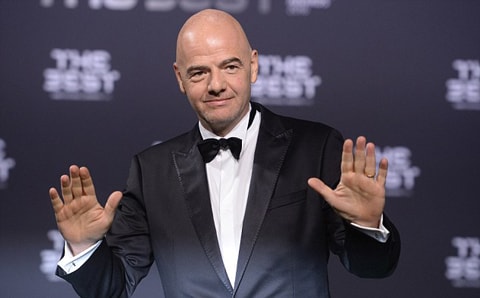 |
| FIFA President Infantino has kept his campaign promise to expand the World Cup. |
It is known that with 48 teams, the World Cup finals will be divided into 16 groups, with 3 teams in each group playing a single round-robin format. The top two teams in each group will qualify for the Round of 16, the first knockout stage.
Thus, the number of World Cup matches will increase from 64 to 80. However, FIFA anticipates that the biggest football event on the planet will still only last for 32 days.
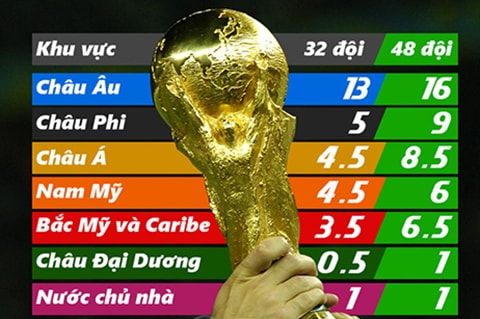
Increasing the number of teams participating in the World Cup to 48 means there will be 16 more World Cup qualifying spots, and FIFA has discussed very carefully how to allocate these 16 spots appropriately. One idea that has received considerable support is:
With this new allocation, teams in Asia and Africa will benefit the most, as their chances of participating in the World Cup will increase significantly. This is understandable, as during his campaign for the FIFA presidency, Gianni Infantino promised to expand the World Cup and give opportunities to countries outside of Europe. |
According to bongdaplus