

The people who sleep sitting up use pebbles to count their age.
(Baonghean.vn) - Before the invention of calendars, the Dan Lai people in western Nghe An province used pebbles placed in cloth bags to count the age of everyone in their family.
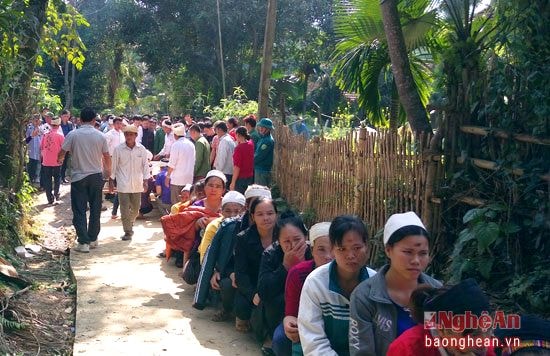 |
| A photograph from a Thai funeral in Nghe An. Photo: Huu Vi |
Cloth bags filled with stones used to be very important to Mr. La Van Lieu, a Dan Lai ethnic minority resident of Co Phat village, Mon Son commune, Con Cuong district (Nghe An province). He had more than a dozen bags. Every year, he would put a pebble in each one. That was how he kept track of each person's age in the family. The old man had 13 children and couldn't remember all their birth dates. He only knew their ages by the number of stones in the bags.
The Dan Lai are a famous ethnic group known for sleeping sitting up in western Nghe An province, living completely isolated from the outside world in the core of Pu Mat National Park. After being discovered and gradually brought out of the forest, the Dan Lai people came into contact with modern civilization. Mr. La Van Lieu said that only when calendars, birth certificates, and household registration documents became commonplace did he gradually abandon his stone bags. Recalling this now, the old man just smiles with relief. These ancient methods of calculating age are now a thing of the past.
 |
| Illustrative image - Source: Internet |
Not only for the Dan Lai people, but these seemingly inanimate pebbles have long been familiar to highland communities. Traditionally, when sending her son off to join the army, a Thai mother would put a small, clean pebble in his backpack. She would instruct him to carry it to ease his homesickness and to strengthen his resolve to fulfill his duty. The pebble was believed to help those far from home avoid waterborne illnesses and prevent illness in unfamiliar lands. Some children were also advised to put a small pebble in a kettle while boiling water, believing it was a good way to avoid waterborne illnesses in foreign lands.
In the highlands, when people return to their ancestors, their final resting place is the sacred forest near their village. Before sending someone to their final resting place, they choose two stones to bury at either end of the grave. The Thai people in Con Cuong call this "tang," while in Que Phong they call it "dieng." A Thai highland grave cannot be without these two stones buried at each end. No one is allowed to disturb them, as it would disturb the eternal sleep of the deceased.
In the old days, after burying the dead, the Thai people never returned to the grave and the sacred forest. When they left the village, the sacred forests were also forgotten. Only when someone came to clear land for farming and discovered the stone used to bury the head of the grave did they realize the resting place of the deceased. People told each other not to disturb the "burial" stone. The farmer would light incense and pray, asking the deceased to rest in peace and bless the living with prosperity.
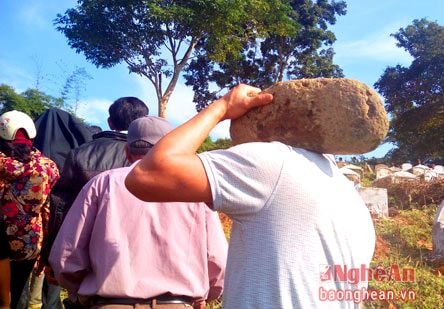 |
| The eldest son is usually the one who carries the burial stone to the grave. Photo: Huu Vi |
Mr. Lang Van Cuong, from Cam Muon commune, Que Phong district (a long-standing residential area of the Thai ethnic community), is fascinated by the customs of the community. He has diligently documented a considerable amount of information, including the funeral customs of the Thai people in the Cam Muon area.
“The ‘stunned’ stone is the most important part of the tomb,” said the old man, who was over sixty years old. When someone dies, the deceased's son or closest relative goes up the mountain to choose a stone to bury next to their loved one's grave. They perform a ritual to ask for the stone. Then they engrave information about the deceased onto a slab of stone in Thai script, just like when people engrave tombstones.
The stone to be buried next to the grave is carried away by the eldest son or the closest relative of the deceased. After the burial, a ceremony is held to bury the stone next to the grave before they return home.
Nowadays, Thais know to take care of the graves of their loved ones at the end of the year. The stone buried next to the grave is still carefully preserved.
Huu Vi