

Ngoc Hoi - Dong Da: A glorious chapter in the nation's history.
(Baonghean.vn) - 228 years ago, in the spring of 1789, the valiant Tay Son rebels, under the command of the national hero Quang Trung - Nguyen Hue, launched a swift and fierce attack, defeating tens of thousands of Manchu troops led by Sun Shi Yi, liberating Thang Long capital, and regaining independence and freedom for the nation.
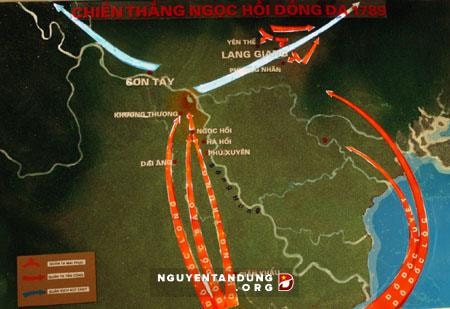 |
| In 1789, the Tay Son army defeated the Qing army at Ngoc Hoi - Dong Da, ending the resistance war against the Qing. |
Going back in history, the Qing Dynasty, from its establishment, harbored ambitions to invade our country, but lacked a pretext for aggression. Taking advantage of the "bringing the elephant to trample on the grave" actions of the reactionary feudal clique of Le Chieu Thong, the Qing army invaded our country with a large expeditionary force of 200,000 troops.
Faced with internal and external threats, and recognizing the primary danger as the invading feudal forces from the north, Nguyen Hue ascended the throne as Emperor, adopting the regnal name Quang Trung, and swiftly launched an offensive northward. On January 15, 1789, Nguyen Hue, along with his main army (after increasing its numbers to 100,000 men) and a large elephant corps consisting of several hundred war elephants, arrived at Tam Diep, joining forces with Grand Marshal Ngo Van So, to prepare for a counterattack against the Qing army.
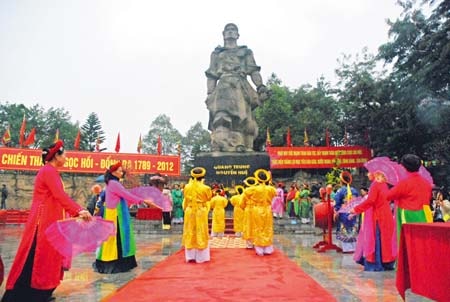 |
| The Dong Da Hill Festival is held annually in Hanoi. |
Having grasped the enemy's plans and troop deployments, Quang Trung divided the Tay Son army into five main divisions. On the eve of the Lunar New Year of the Year of the Rooster (January 25, 1789), the main army under Quang Trung's command crossed the Gian Thuy River, launching a major offensive against the Qing army. Enemy forward outposts such as Gian Khau, Thanh Quyet, Nhat Tao... were successively captured. Not a single soldier escaped.
At midnight on the third day of the Lunar New Year of the Year of the Rooster (January 28, 1789), the Tay Son army secretly surrounded the Ha Hoi fort (about 20 km from Thang Long), threatening the enemy and capturing tens of thousands of Qing soldiers. On the fourth day of the Lunar New Year (January 29, 1789), the Tay Son army approached Ngoc Hoi. At this time, the third army, commanded by Grand Admiral Bao, also assembled southwest of Ngoc Hoi, preparing for the attack.
On the morning of the 5th day of the Lunar New Year of the Year of the Rooster (January 30, 1789), the Tay Son army launched a surprise attack with a powerful force like a rising tide or a raging storm, destroying the fortifications and the entire southern defensive line of Ngoc Hoi fort…
The second army, commanded by Admiral Dang Tien Dong, simultaneously launched a surprise attack on the Dong Da fort. With overwhelming force, the Tay Son army, in their prepared formations, stormed the enemy fort, burning down the outer camps and quickly penetrating deep into the enemy's command post. In a short time, the number of Qing soldiers killed and wounded reached 5,000.
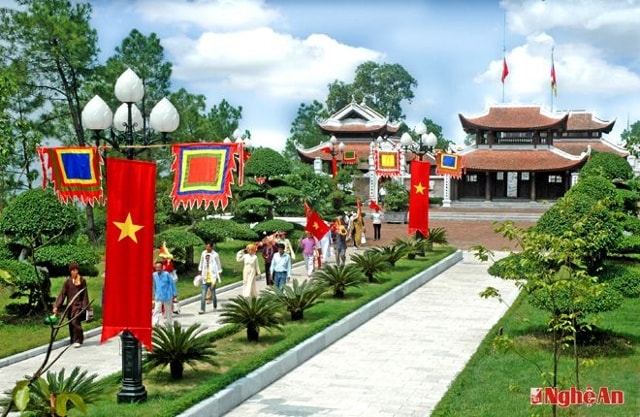 |
| Landscape of the Quang Trung King's temple (Dung Quyet mountain, Vinh City). Archival photo. |
Facing overwhelming odds and exhaustion, Sam Nghi Dong was forced to hang himself at his command post. Continuing their offensive, the Tay Son army capitalized on their victory, destroying the Yen Quyet and Nam Dong forts and quickly penetrating deep into Thang Long, simultaneously threatening Ton Si Nghi's main headquarters.
Quang Trung led his main army to continue attacking the Ngoc Hoi fort, dividing his war elephants into two wings, left and right, to attack the enemy's flanks. The Tay Son army surged forward, disregarding the enemy's cannons, arrows, and smoke screens, and completely destroyed the Ngoc Hoi fort. The remaining Qing troops fled towards Dam Muc but were completely annihilated by the third army commanded by Grand Admiral Bao.
At his headquarters located in the West Dragon Palace on the banks of the Nhi River, Ton Si Nghi hastily crossed the pontoon bridge, fleeing north. The Dai Nam Chinh Bien Liet Truyen (Official Chronicle of Dai Nam) writes, "Ton Si Nghi, encamped on the sandbank, upon hearing of the defeat, hastily rode his horse alone to flee north. Seeing this, the soldiers scrambled to cross the bridge to escape; the bridge broke, and tens of thousands fell into the river, causing the river to stop flowing."
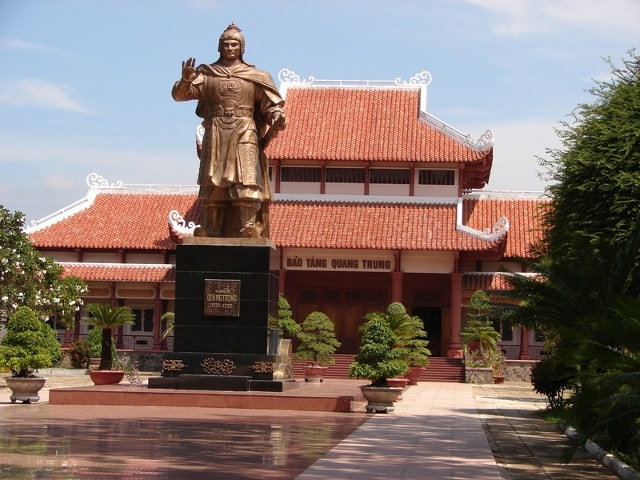 |
| The Quang Trung Museum is located in Binh Dinh province. |
The great victory at Ngoc Hoi - Dong Da demonstrated the superb military art of the Tay Son army. This included the art of rapid troop movement from Phu Xuan to the north; the art of strategic warfare, and the art of classic "orthodox and unconventional" tactics in each battle. With this great victory, our nation, under the leadership of Emperor Quang Trung Nguyen Hue, shattered the Qing army's invasion ambitions, completely liberated Thang Long (Hanoi), and preserved national independence.
This victory also marked the official replacement of the Later Le Dynasty by the Tay Son Dynasty in governing Northern Vietnam and in relations with the Qing Dynasty.
The Battle of Dong Da was a great achievement, of profound historical significance and a prime example in the history of Vietnam's resistance against foreign invaders.
Peace
(Synthetic)
| RELATED NEWS |
|---|