

The French President's final 'stage' in Africa.
(Baonghean) - French President François Hollande has firmly insisted that the 27th Africa-France Summit be held this weekend in Bamako, the capital of Mali.
This appears to be a formidable gamble on his final trip to the African continent as the occupant of the Élysée Palace.
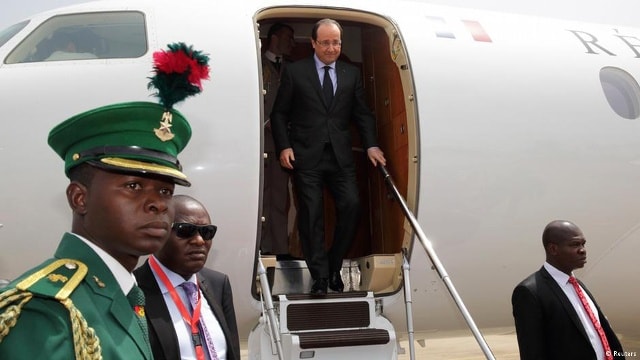 |
| French President François Hollande visits troops in the Central African Republic in February 2014. Photo: Reuters. |
Intentional choice
Compared to four years ago, when the jihadist/separatist uprising broke out in the north, Mali is now undeniably much more peaceful and stable. However, it is still too early to assume it is a completely safe destination.
When this location was chosen as the gathering place for approximately 60 delegations of officials, including 20 heads of state and leading businesspeople, many shuddered at the thought of the dangers involved, because just a year earlier, 20 victims had lost their lives when jihadists attacked the famous Radisson Blu hotel.
According to media reports, the French business federation Medef showed little enthusiasm for choosing Bamako as the venue for this year's conference. In fact, Medef actively lobbied to move the summit to Abidjan – the commercial hub of neighboring Ivory Coast, which is considered safer and more prosperous.
However, for Hollande, holding the summit in Bamako was of particular importance, serving as a backdrop to support his legacy. Back home in France, opinion polls had been rather unfavorable, his approval ratings had plummeted significantly, and last month he was forced to announce that he would not seek a second term in the upcoming April elections.
Therefore, the Bamako Conference was not only his final "performance" in Africa, but also a great opportunity to showcase the success of Hollande's biggest foreign policy initiative - Operation Serval (African Wildcat).
In January 2013, Hollande ordered the French military to intervene, halting and ultimately repelling the jihadist/separatist rebellion from northern Mali. The choice of location itself conveyed a message. Abdoullah Coulibaly, head of the conference organizing committee, told Jeune Afrique magazine that only by holding the leaders' meeting in Mali could the place truly return to normalcy.
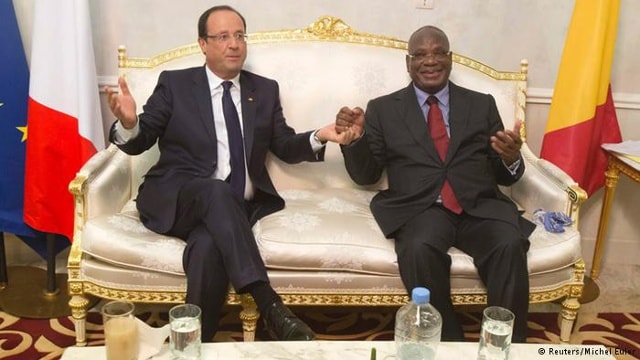 |
| François Hollande at the inauguration of Malian President Ibrahim Boubacar Keita in Bamako in September 2013. Photo: Reuters. |
An impeccable legacy?
First, the summit will be an opportunity to review France's African policy record under Hollande – which has been generally viewed quite positively. Hollande has taken steps to move away from Paris's infamous post-colonial "Francafrique" policy, which aimed at engaging in self-serving interests through military or other means on the African continent.
Hollande's center-right predecessor, Nicolas Sarkozy, launched military attacks in both Libya and Ivory Coast without international condemnation. However, Hollande has been careful to maintain the approval and support of both the United Nations and the African Union (AU) for France's military interventions in Mali and later in the Central African Republic.
In Mali, military intervention broke the jihadist control in the north and brought separatist rebels to the negotiating table with the government. Elections were held smoothly, but instability persisted, and Malian security forces, with French assistance, launched a major operation to ensure the security of the conference.
In the Central African Republic, France's Sangaris military operation also helped to reduce instability, but whether peace will last remains highly uncertain.
Hollande kept his promises made at the 2013 Africa-France Summit in Paris. France provided development assistance totaling €11.5 billion between 2014 and 2016, and plans to spend an additional €4 billion annually for the next two years to reach the €20 billion target set at the Paris summit.
From 2020 onwards, the aforementioned 4 billion euros will be increased to over 6 billion euros per year – and half of this will be dedicated to mitigating global warming.
However, it is still impossible to say that Hollande's African legacy is "flawless." Analysts see the persistence of elements of old African policy in Hollande's particular treatment of certain allies, such as Macky Sall of Senegal and Idriss Déby of Chad.
Stephanie Wolters, head of the Peace and Security Studies Program at the Institute for Security Studies (ISS), asserted that Déby received military and political support from France, regardless of his actions domestically and regionally – including the 2013 intervention in Central Africa, which was described as a "disaster".
According to Wolters, a broader explanation could be that he allowed the French to establish a large military base in Chad and was opposed to extremist movements. Chad also participated in peacekeeping operations in the region, notably in Mali.
In August 2014, Operation Serval was transformed into Operation Barkhane, taking on the larger mission of combating terrorism in the Sahel region, in alliance with the militaries of Chad, Burkina Faso, Mali, Mauritania, and Niger.
Critics note that Barkhane did not receive the overt support of the United Nations or the AU, and some suspect that one of its main purposes was to boost France's defense industry through the provision of military "aid" to participating nations. Ultimately, instability persists throughout the Sahel, and Operation Barkhane appears to have provided some of the coordination and impetus lacking in the region's militaries to counter this alarming situation.
Anticipate disagreements
The upcoming summit will not be all praise and accolades. Even without considering Barkhane, there is a high probability of disagreements due to the ongoing instability in Central Africa, Libya, and the Sahel. Given the situation in Libya and the Sahel, many African governments will likely blame the NATO-led, French-backed military offensive aimed at overthrowing Muammar Gaddafi.
Intense debate and conflict are inevitable when it comes to addressing the wave of migrants from Africa and elsewhere flooding into Europe. This is accelerating the growth of far-right, anti-immigrant, and nationalist political parties across Europe, and contributing to a political atmosphere that makes Hollande realize he has no chance in this year's election.
Objectively speaking, Hollande himself will still be confident of avoiding criticism at the conference, as he will highlight his relatively successful military interventions and increased aid.
However, on the economic front, French business leaders did not rate this conference highly. A senior official from Medef told the French daily Le Monde that members of the Federation leaned toward choosing Ivory Coast as the venue, complaining that "choosing Bamako was merely a political decision, not an economic one."
In summary, the summit is not only an opportunity to review French-African relations since the previous summit, but also to chart a course for the future. However, with Hollande gradually stepping back and strong conservative reactions emerging, it's difficult to predict much. It's clear, however, that regardless of who occupies the Élysée Palace, the continuity and inheritance of France's African policy remains quite evident.
Thu Giang
(According to ISS)