
Signs of a crisis?
(Baonghean) - As predicted, the United States has begun to experience the first disruptions following the executive orders of the new President Donald Trump.
(Baonghean) - As predicted, the United States has begun to experience the first disruptions following the executive orders of the new President Donald Trump.
The legal showdown surrounding the travel ban on citizens from seven Muslim-majority countries has now become a confrontation between the federal and state governments, and between the central government and the branches of the judiciary. It is not ruled out that this could become a constitutional crisis in the United States.
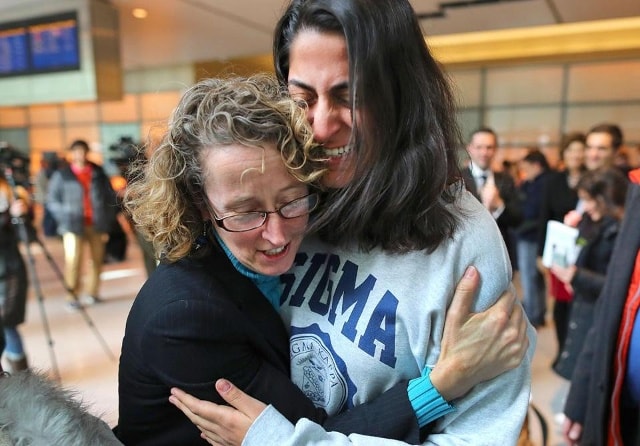 |
| Niki Rahmat, an Iranian student at the Massachusetts Institute of Technology (MIT), burst into tears upon landing at Logan Airport. Photo: Washington Post. |
Impossible and possible
The executive power of the US President is immense. That is undeniable. President Donald Trump was aware of this from the moment he made his campaign promises, and especially after entering the White House.
That's why he set a record by signing 14 executive orders in his first week as "captain" of the United States on January 20th. But now the "honeymoon period" is over. President Trump is beginning to understand the limits that the supreme executive representative cannot reach.
On February 3, U.S. federal judge James Robart in Seattle, Washington, ruled to halt the nationwide implementation of key provisions of the travel ban executive order signed by President Donald Trump after taking office. This order banned entry into the U.S. for 90 days and suspended the refugee program for 120 days.
The ruling came after Washington and Minnesota filed lawsuits, arguing that Trump's executive order targeted Muslims and violated the constitutional rights of immigrants and their families. Despite resistance from the executive branch, including an appeal from the U.S. Department of Justice, the ruling was reaffirmed by the Court of Appeals. One of President Trump's biggest commitments has yet to take effect again. He will have to wait for the Court of Appeals to consider additional information from Washington and Minnesota, as well as documents from the Department of Justice.
Judge James Robart was able to block Trump's executive order because the American government is designed on a model of separation of powers: Congress holds legislative power; the President holds executive power; and the Supreme Court and lower courts hold judicial power. The purpose of this separation of powers is to create a system of checks and balances. Each branch can limit the power of the others so that no single branch becomes too powerful, ensuring that power is balanced among the three.
In this case, the advantage is considered to be with President Trump, as he has the support of both houses of Congress, where the Republican Party holds a majority. Jon Michaels, a law professor at the University of California, Los Angeles, and author of "The Split of Power, All Forward," argues that President Trump's power is strong, demonstrated by his ability to overturn most of his predecessor Barack Obama's legacy without needing Congress.
But Professor Jon Michaels is not at all pessimistic about the prospect of this power being abused and going beyond its limits. That's because Trump will have to battle the bureaucracy and the judicial system. When implementing any presidential decision or law, "civil organizations must assess what its basis is," Michaels said. If they fail to do this, any federal order could face legal challenges.
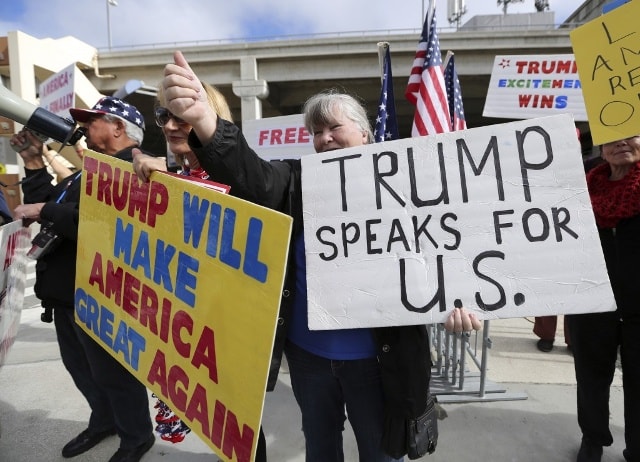 |
| Protesters supporting President Trump's immigration ban at Los Angeles International Airport. Photo: AP. |
The confrontation will be brought under control.
So what weaknesses allowed the travel ban on immigrants from seven Muslim-majority countries to be exploited and become a "scapegoat" in Seattle court? Marci Hamilton, a constitutional law expert and religious studies scholar at the University of Pennsylvania, argues that the uncertainty surrounding the legal basis of the order caused it significant problems.
“The US president believes that the order he issued targeting immigrants from these seven countries was to keep America safe from foreign terrorist threats,” expert Macri Hamilton explained in The Guardian. In reality, this is a matter within the White House’s jurisdiction. However, this authority is typically only exercised in emergencies, and Trump has failed to demonstrate a threat against the US from citizens of the seven Muslim-majority countries banned from entry.
"The president can disregard constitutional provisions by declaring a state of emergency. But it has to be a real, significant threat, not just a potential indication from a few people from a few countries," Hamilton said.
The US President has been accused of not providing sufficient evidence of terrorism from these countries targeting the United States. The CIA monitors these individuals continuously, and has a whole system in place to do so. The reality is that Trump should have waited before seeking a "state of emergency." The 9/11 terrorist attacks could be an example of an emergency where the head of state "could unilaterally close airports and prevent people from entering the US for a period of time."
So, has the back-and-forth legal process between the administration and the courts truly "exploded"? Most of the action from the executive branch still comes primarily from President Trump's statements on his personal Twitter account. The Department of Justice did not actually file any emergency stay of appeal against Judge Robart's decision on February 3rd, thus reducing the risk of a constitutional crisis erupting.
Until the Department of Justice issued an emergency stay of Judge Robart's ruling, the door to the U.S. reopened for refugees and citizens from the seven Muslim-majority countries banned by Trump. However, the issue remains, as numerous other lawsuits related to Trump's travel ban are pending. A disadvantage is that, under current precedent, review of this executive order in other federal courts would likely be unfavorable to the White House.
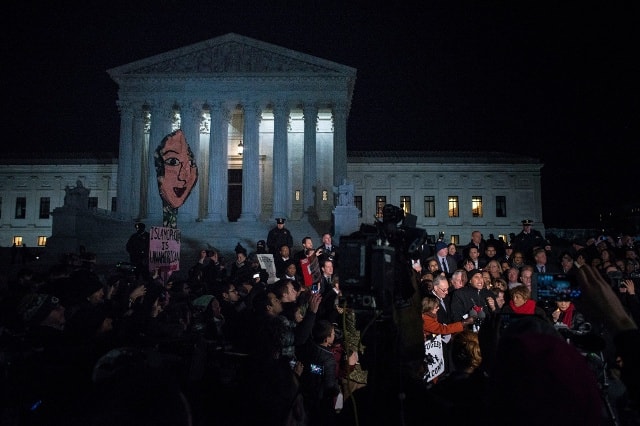 |
| 3. New Jersey Senator Cory Booker speaks against President Trump's immigration ban outside the Supreme Court. Photo: New York Times. |
Pragmatism will decide.
The world is still trying to figure out what President Trump will and won't do as Commander-in-Chief of the United States. It's all just speculation. But one thing is fairly certain: Trump doesn't necessarily need to accomplish everything he's stated. As everyone knows, as a businessman, President Trump is very pragmatic and willing to reverse his campaign promises if necessary.
For example, consider the allegations against Hillary Clinton and withdraw from the Paris Agreement on climate change. Therefore, it's reasonable to believe that after doing everything to win, billionaire Trump may also do everything to maintain his power. Opinion polls will be the basis for the US President to adjust his stance. And certainly, American voters will pay more attention to jobs and economic growth than to the Muslim ban. Trump will have four years to consider this before the 2020 election tests his credibility.
Phan Tung
| RELATED NEWS |
|---|