

Legend of Nam Hat
(Baonghean) - This land is not just about lush green rice fields. Hidden behind the stilt houses and the Pha Xang mountain range is a legend about the establishment of villages and settlements.With the festival season over, the villages on the right bank of the Nam Hat River are entering a new working season.
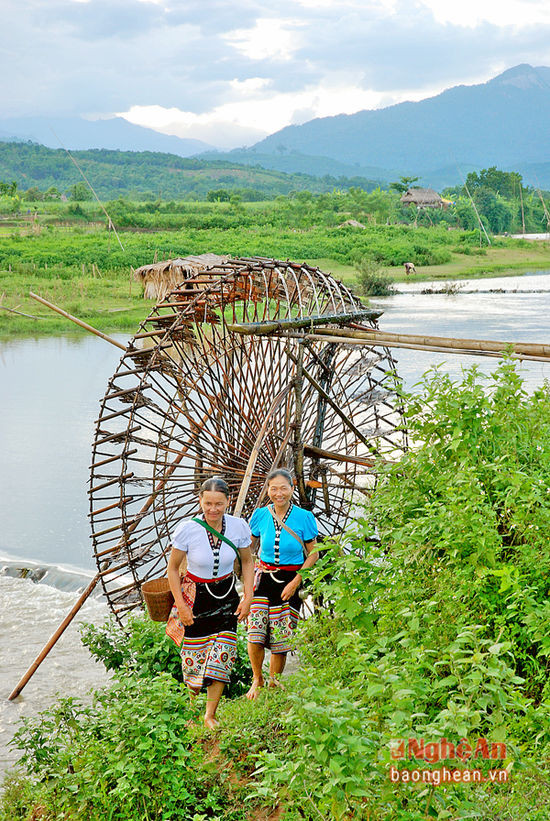 |
| Women from Chau Tien commune (Quy Chau district) returning from visiting their rice fields. (Archival photo) |
These days, Phu Quy has returned to its usual tranquil atmosphere. The festival season is over, and the land takes on a different hue, the color of young rice seedlings on the vast fields. Here and there, glimpses of people inspecting the fields and weeding the rice paddies can be seen. The hunched figures of women add a touch of charm, breaking the monotony of the rice paddies.
It felt truly refreshing driving past the Bua Cave tourist spot in Chau Tien commune, following the Nam Hat River into Chau Binh commune, Quy Chau district. The Nam Hat River is a tributary of the Hieu River that merges with the Nam Ton River in Chau Tien commune to form the Chieng Ngam area.
Chieng Ngam is one of many Thai ethnic minority villages in western Nghe An province. This area has two festivals. The Hang Bua festival in Chau Tien commune takes place at the end of January every year.
A smaller-scale festival takes place every two years at the foot of the mountain on the right bank of the Nam Hat River – Pha Xang Mountain in Xang 2 village, Chau Binh commune. The festival follows the Hang Bua festival, in the second lunar month. The festival is not only for the people of Xang 2 village, but also for all five villages on the right bank of the river in Chau Binh commune. People from Chau Tien and Chau Thuan communes also come to join in the festivities.
"It's small in scale, and there aren't as many participants as in larger festivals, but that doesn't mean the joy is small," Lang Van Thang, the head of Xang 2 village, once whispered to me. "But if you want to see the festival, you'll have to wait until next year. The village held its festival last year," the village official reminded me.
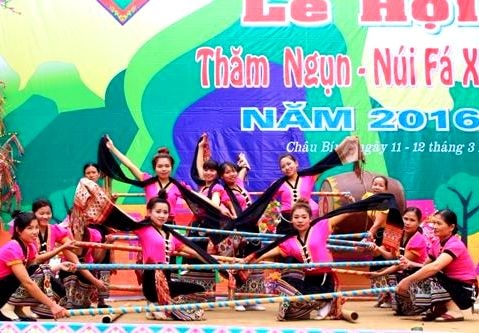 |
| A cultural activity during the 2016 Tham Ngụn - Núi Phá Xăng Festival in Châu Bính (Quỳ Châu). (Archival photo) |
Nevertheless, I decided to return to Xang 2 village on the last sunny day before the northeast monsoon arrived. Crossing the aqueduct connecting the two banks of the Nam Hat River, and then another rice field, I reached the most densely populated settlement on the right bank. Rows of ancient stilt houses lined up neatly at the foot of the mountain looked truly picturesque. The location, nestled against the mountain and facing the river, made this mountain settlement seem closer to the living philosophy of people in the lowlands.
Interspersed among the traditional stilt houses are smaller, single-story houses. However, most houses in the village still retain the stilt house architecture with an adjacent garden. In the garden, along the fence, there are rows of betel nut trees, betel vines, fruit trees, and a few vegetables still used in the daily meals of the local residents.
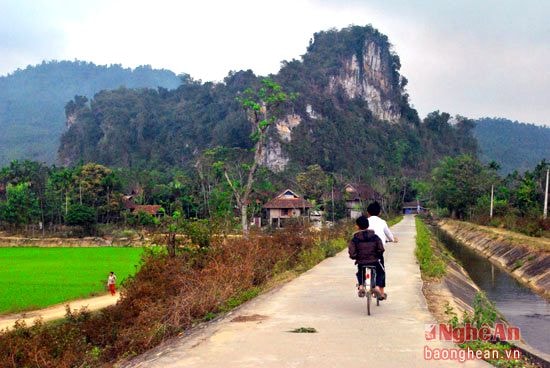 |
| The road leading to Pha Xang 2 village, Chau Binh commune (Quy Chau). Photo: Huu Vi |
The witty village chief, Lang Van Thang, opened the door of his spacious, villa-like house to welcome me: "The festival season is over. Now it's time to focus on making a living." The 35-year-old, who has served as village chief for 10 consecutive years, shared: "Although we're from the mountains, the vast majority of the villagers are farmers. The village has 112 households, over 500 people, each with 300 square meters of land."2 Rice paddies. With the application of new production techniques and varieties, there's no need to worry about rice shortages. Once people have enough rice and are well-fed, they can then think about getting rich. In the village, there are already over 30 relatively well-off households. Although no wealthy households have emerged yet, this is still encouraging for a highland village.
As a fairly dynamic community, the main source of income for the villagers is not from rice. Many households have prospered thanks to the sale of general merchandise and locally sourced goods such as brocade fabrics, vegetables and fruits grown in their home gardens and along the riverbanks, and fermented pork. During festivals and holidays, while people are enjoying themselves, it's a time for business for the households in the village. Life here has largely shifted towards commerce, which is an inevitable consequence of development. The good news is that the community still preserves its traditional local values well.
The village has a Thai cultural preservation club with 38 members. Once a month, on the 15th, the members gather to sing traditional Thai folk songs. Some practice writing Thai script so they don't forget it. The sight of elderly men playing flutes and women singing folk songs is a beautiful scene on quiet nights in this small village.
Ms. Sam Thi Khiem is an active member of the club. While she doesn't possess the melodious singing voice of traditional folk artists, she is a treasure trove of stories about the history of her village. In her stilt house with a spacious garden, the elderly woman often tells visitors stories about the Lang clan who established the village 200 years ago. This clan now makes up nearly 80% of the village's population. They originally came from the western part of Thanh Hoa province. From there, the clan spread to many areas in the western part of Nghe An province.
Regarding the Lang clan, there are also semi-fictional stories about Nang Don. She was a beautiful girl with skin as white as a peeled egg, and a gentle, virtuous nature. The son of the dragon king, a dragon from the Nam Hat River, heard of her and transformed into a handsome young man to "get to know her." Later, people had to take Nang Don to the mountains to hide her from the dragon's pursuit. Then, Nang Don turned into stone – a stunning stalactite halfway up Pha Xang Mountain. During the Tham Co Ngun festival, young men and women of the village still climb Pha Xang Mountain to admire the exquisite beauty of the ill-fated girl who turned into stone.
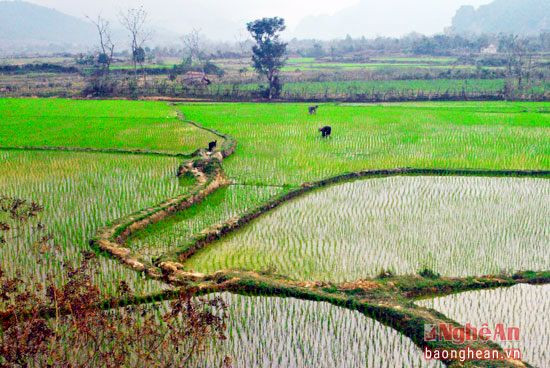 |
| Rice paddies in Xang 2 village. Photo: Huu Vi |
Mr. Lang Van Thang said: "Preserving the local cultural identity is also embraced by the young people in the village, especially with the Thai script. Among them, two people stand out: Lang Tuan Cong and Lang Thi Kieu Nga. These two young people are currently becoming active contributors to the popularization of the Thai script in the community."
After the festival season comes the rice weeding season. That's the rhythm of spring life along the Nam Hat River. Village head Lang Van Thang said: Life isn't yet prosperous, but it can be said that the village is peaceful, with few social evils, and the people are diligent in their work. Becoming rich requires a breakthrough in thinking and doing from each individual, and a stroke of luck.
On the riverside fields on the right bank of the Nam Hat River, glimpses of people still appear, heading to the fields. The villagers are busy weeding their fields to prepare for the approaching cold weather. The festive season is over, and the village is entering a new working season.
Huu Vi