
The shadow of Xuan Thinh blacksmith village remains.
(Baonghean) - Once upon a time, passing through Xuan Thinh village, one could hear the bustling sounds of hammers, bellows, and knife sharpening... This once-famous blacksmith village, which provided a livelihood for hundreds of people, now only exists in the memories of the elderly.
(Baonghean) - Once upon a time, passing through Xuan Thinh village, one could hear the bustling sounds of hammers, bellows, and knife sharpening... This once-famous blacksmith village, which provided a livelihood for hundreds of people, now only exists in the memories of the elderly.
In the last days of the year, with drizzling rain and biting cold, we made our way to Xuan Thinh blacksmith village in Nghi Duc commune (Vinh city). Silence – that was the feeling we got as we walked along the winding road into the village. Suddenly, I remembered that more than ten years ago, this small village was bustling with the sounds of hammers and anvils. We met an old man meticulously trimming a patch of trees in preparation for Tet (Lunar New Year). When asked about the blacksmithing trade, he shook his head: “This blacksmithing village is no more!”
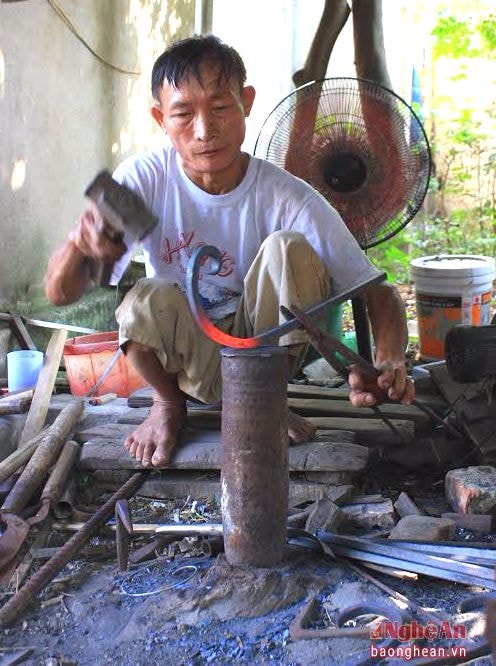 |
| Mr. Doan Huu Xin is one of the two people who still cling to the blacksmithing trade. |
The spacious, single-story house, enclosed by high walls and gates, sits right next to the main road of Xuan Thinh village. It belongs to Mr. Doan Huu Xin, one of the oldest blacksmiths in the village. He is also one of only two people left in the village still struggling to make a living from the trade. The house was deserted, with only Mr. Xin busy working by the forge. Seeing a visitor, Mr. Xin stopped working: "Who is it? What are you blacksmithing for? Wait a moment, I'm in the middle of something..." Around where Mr. Xin sat was a jumble of knives, hammers, hoes... and countless other unidentifiable trinkets.
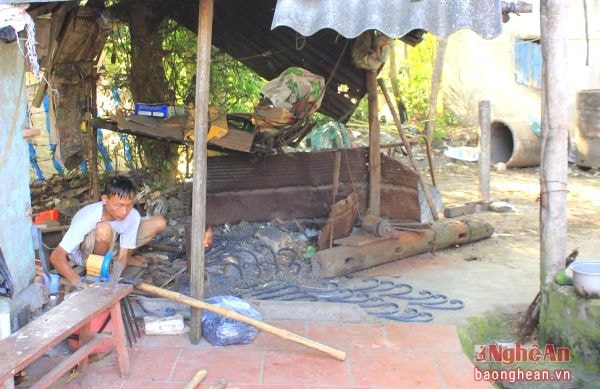
Through his story, Mr. Xin revealed that his family used to be one of the most prosperous households thanks to blacksmithing. A significant portion of his current wealth stems from the knives and hammers ordered by customers. In the past, every member of the family, from parents to wife, children, and grandchildren, worked together in the blacksmithing trade. The adults tempered the steel and made knife handles, while the younger ones carved knife handles and attached sickle handles. Back then, blacksmithing was only a secondary occupation after farming, but because his family was renowned for their craftsmanship, customers from far and wide flocked to his workshop. "Now the forge is cold and quiet. Occasionally, only two or three customers come to order a knife or a hoe; we barely make enough to live on anymore," Mr. Xin said, sighing as he took a puff of his pipe.
 | |
|
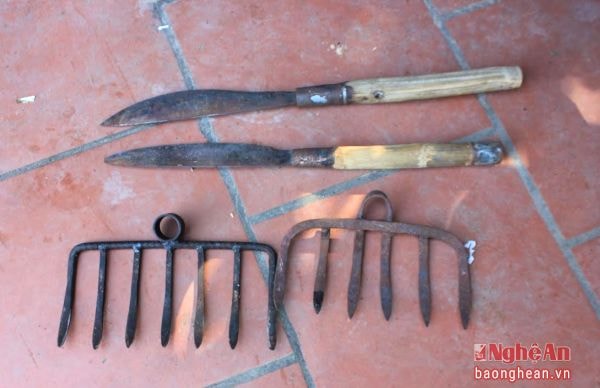
The history of Xuan Thinh blacksmith village dates back nearly a hundred years. Mr. Xin still remembers vividly the days when almost everyone in the village was enthusiastic and bustling around the forges, their furnaces blazing with fire year-round. In both winter and summer, customers from all directions came to order or buy agricultural tools. Some days, thousands of sickles, hoes, shovels, and other tools were sold. Through the skillful hands of the Xuan Thinh blacksmiths, knives, hammers, sickles, and other tools were meticulously forged, sharp, and durable. Farming work thus became easier. People from all over flocked here to buy agricultural tools, from Nghi Phong and Nghi Thai communes to Phuc Tho (Nghi Loc district), and even up to Hung Nguyen and Nam Dan districts. Anyone involved in agriculture, or even those needing knives and hammers, would come to Xuan Thinh village to buy them.
The blacksmithing trade in Xuan Thinh hamlet was established by descendants of the Doan Huu family from Thanh Hoa province who migrated there. They left Thanh Hoa due to historical upheavals, bringing with them the traditional blacksmithing craft of their homeland. Finding a good place to settle, Xuan Thinh village helped the Doan Huu family preserve and develop the craft. From this family tradition, many local families also learned and earned their living using this bellows-making trade.
Back then, the village was sparsely populated, but dozens of blacksmiths in Xuan Thinh were burning day and night. Without modern machinery, the forges were bustling with customers year-round. Xuan Thinh blacksmiths were known for their diligence; even in the freezing winters and scorching summers, they toiled tirelessly, bending their backs to hammer steel and temper iron. Regularly, starting at 4 a.m. each day, dozens of forges would light their fires. The entire blacksmith village was vibrant and bustling, and the prosperity of the people was thanks to the sounds of hammering and forging agricultural tools. The finished products were then carried by the women to the markets. Markets like Vinh Market, Coi Market (Hung Loc commune - Vinh City), Thanh Market (Nghi Phu commune - Vinh City), Lo Voi Market (Nghi Thai commune - Nghi Loc district), and many agricultural tool stalls all featured products made in Xuan Thinh blacksmith village.
The years when agricultural production was not mechanized were the golden age of blacksmithing in general and Xuan Thinh blacksmith village in particular. In the last decade or so, the blacksmithing trade in Xuan Thinh has become quiet and gradually faded away. This is all due to the objective development of life.
Blacksmithing is hard work, and the demand for handcrafted agricultural tools is dwindling. The profession doesn't provide enough to support families, so many artisans in Xuan Thinh village have abandoned the craft. Because they can't rely on a job that barely provides enough to eat and wear, young people in the village have sought other professions to make a living. Some have gone into construction, others have found work in industrial zones or abroad, and some have engaged in small-scale trading... Now, only two blacksmiths' workshops remain in the village: those of Mr. Doan Huu Xin and Mr. Doan Huu Hy. Occasionally, when someone wants to order a knife or a hoe, they light the furnace. Slowly but surely, the elderly like Mr. Xin and Mr. Hy earn a few extra dollars during their leisure time between farming seasons. Mr. Xin thoughtfully shared: "I don't want to give up the craft, because it's a traditional profession passed down from our ancestors. At least there should be one blacksmith's workshop in the area to serve the farmers! I only hope that some of my children or grandchildren will like this profession and continue the ancestral legacy."
Another spring has arrived in the quiet solitude of Xuan Thinh blacksmith village, though the laughter of children can be heard from the surrounding hamlets. People are already seen carrying peach blossoms and kumquats out of the village. In recent years, young men and women of Xuan Thinh village have been selling peach blossoms for Tet (Lunar New Year). Well, life is multifaceted and diverse; even without the blacksmith village and its craft, Xuan Thinh still welcomes spring.
Tian Tian
| RELATED NEWS |
|---|