

Locals are worried about crayfish being farmed by the Chinese.
Over the past few days, residents of Tan Hoi Trung commune, Cao Lanh district (Dong Thap province) have been abuzz with excitement over the appearance of aggressive red lobsters that can move both forward and backward. Remarkably, these lobsters have up to ten claws, and their two front claws can snap a rice stalk in half with a single "snap."
Mr. Bay Liem, a resident of Hamlet 6, Tan Hoi Trung Commune, recounted: “In April 2016, while we were preparing to harvest our rice, a man with a Northern accent and some Chinese people came here to discuss renting land. They offered a price one and a half times higher than the local rate, 35 million VND/hectare/year, for a 3-year lease, claiming it was for lotus cultivation. I have over 5 hectares, but I didn't rent it to them because I found their way of speaking untrustworthy. However, my neighbors, Mr. Ut Lui, Mr. Hai Cac, and Mr. Ba Liem, rented them about 5 hectares. Specifically at the location where the warehouse was to be built, they rented an additional 20 hectares, also claiming it was for lotus cultivation.”
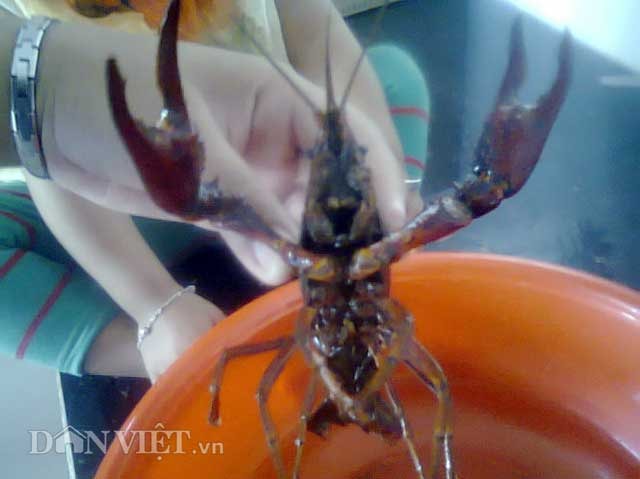 |
| The red lobsters at Mr. Hoa's farm were discovered by local residents. |
Mr. Liem added: "The unusual thing is that they wanted to immediately destroy the rice crop, accepting high land rental prices and compensation for the damage caused by destroying the rice, so many people destroyed their rice crops and handed over the land. The company agreed to compensate 10 tons/hectare, with the market price at that time being 6,000 VND/kg. It's unbelievable."
It is known that the facility belongs to Sen Hoang Giang Co., Ltd., with Mr. Tran Van Hoa as Director. On February 6th, the Department of Agriculture and Rural Development of Dong Thap province announced that on Sunday (February 5th), the Department and representatives of other functional agencies of the province visited the Sen Hoang Giang Co., Ltd. facility to inspect the company's operations. However, the entire business premises were deserted, with not a single person in sight.
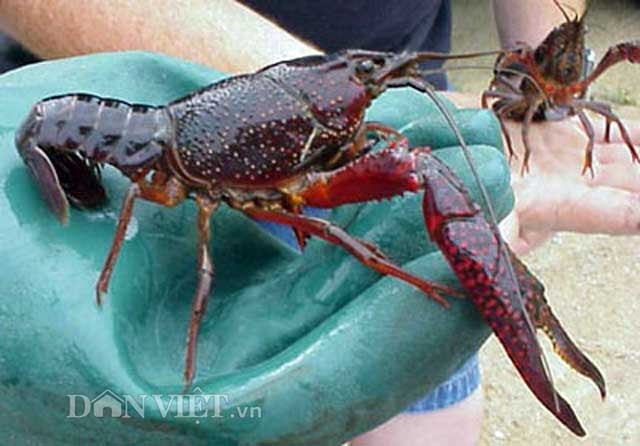 |
| Red lobsters have two large claws and eight smaller claws. |
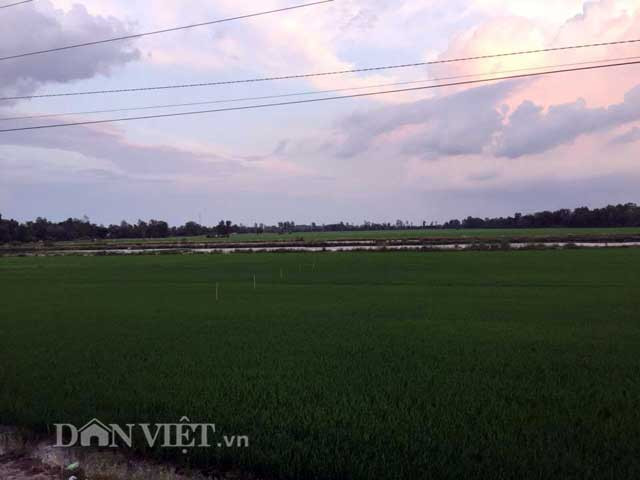 |
| Mr. Hoa's "project" is lying abandoned in the middle of a rice field. |
Nearly a year has passed, and the more than 5-hectare plot of land bordering Mr. Bay Liem's property has no lotus plants. Pointing to the abandoned land, Mr. Bay Liem recounted: "They planted lotus, then brought in a huge tractor to plow it up. They pumped water in, then pumped it out again, I don't know what for."
Before Tet (Lunar New Year), I went to visit my rice field and noticed something strange on the boundary between my field and their project. Looking closely, I saw it was a shrimp-like creature, similar to a scorpion, and red in color. It could move both forward and backward, its two large claws snapping. When I tried to plant a rice seedling, it snapped it in half. Even more horrifying, it had four small claws on each side. I called it the "ten-clawed shrimp." I was so disgusted that I took a picture of the shrimp and reported it to the local police.
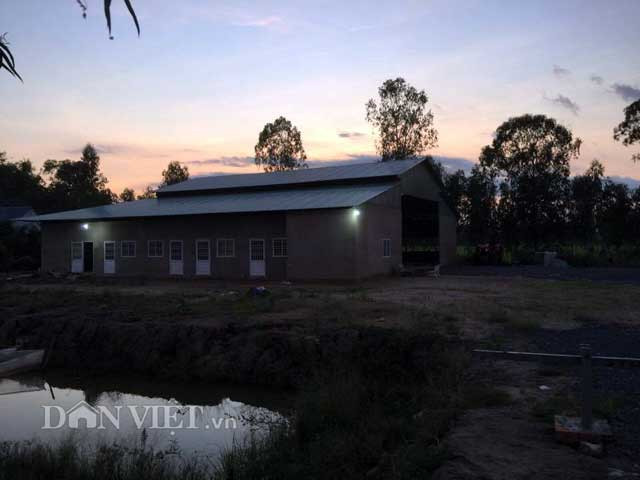 |
| Factory and shrimp ponds |
Ms. Tam Phung, the owner of a beverage stall opposite the Sen Hoang Giang Company headquarters, said that the Chinese men had left the company on the 10th day of the 12th lunar month. Mr. Tran Van Hoa, the director of Sen Hoang Giang Co., Ltd., and his wife left Tan Hoi Trung on the 20th day of the 12th lunar month, saying they were going to the North to celebrate Tet (Lunar New Year). "Mr. Hoa asked my family to turn on the lights at night and turn them off during the day," Ms. Tam Phung said.
Speaking to reporters, Mrs. Tam added: “Mr. Sau Hong from my neighborhood saw these shrimp crawling on the edge of the rice field, caught them to try raising them, but after a few days they died. These shrimp are very aggressive; their claws keep snapping at you. But the villagers are very vigilant; if they see anything strange, they report it to the authorities immediately. This company has invested billions of dong here, and so far they haven't recouped anything.”
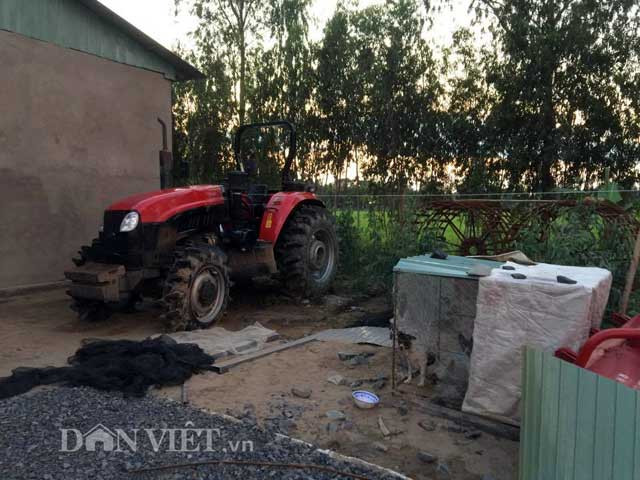 |
| The tiller is carrying out the project. |
Mr. Nguyen Van Cong, Director of the Department of Agriculture and Rural Development of Dong Thap province, stated that red lobsters, or freshwater lobsters, are dangerous invasive species that are not permitted to be farmed. In the case of Mr. Tran Van Hoa, Director of Sen Hoang Giang Company, he was farming this type of lobster secretly, and when discovered by the public, the authorities coordinated to destroy them immediately.
"The farming of red lobsters has long been banned. If any individual or organization is found to be secretly farming them, in addition to being forced to destroy them, they will be severely punished," Mr. Cong affirmed.
According to Mr. Pham Minh Chi, Deputy Head of the Inspection Department of the Dong Thap Provincial Fisheries Sub-Department, the species of shrimp that Mr. Hoa was raising is the red crayfish (or freshwater lobster), scientifically known as Procambarus clarkii, a type of freshwater crustacean originating in the southern United States, which is potentially even more harmful than the golden apple snail. According to research, red crayfish grow very quickly even in low-water conditions. During the dry season, they can withstand drought for up to 4 months, and their lifespan can extend to 6 years. The damage caused by red crayfish is significant; they are excellent burrowers, thus damaging irrigation systems and potentially devastating native ecosystems due to their omnivorous diet. In particular, they carry many viruses that cause diseases in shrimp, including parasitic worms that infect mammals and humans. |
According to Phuong Dung/danviet
| RELATED NEWS |
|---|