
The veteran spent 12 years as a 'gatekeeper'.
(Baonghean) - Day after day, from dawn until night, former soldier and war invalid Nguyen Huy Chi (born 1939) from Hamlet 6, Quynh Tan Commune (Quynh Luu District) is present at his "guard post" at the beginning of the village to perform his duty of keeping watch. Concerned about the tragic accidents at the intersection of the village road and the railway, for the past 12 years, Mr. Chi has devoted his heart and soul to this simple guard post – where trains pass by daily.
(Baonghean) - Day after day, from dawn until night, former soldier and war invalid Nguyen Huy Chi (born 1939) from Hamlet 6, Quynh Tan Commune (Quynh Luu District) is present at his "guard post" at the beginning of the village to perform his duty of keeping watch. Concerned about the tragic accidents at the intersection of the village road and the railway, for the past 12 years, Mr. Chi has devoted his heart and soul to this simple guard post – where trains pass by daily.
"Father Nguyen Dinh Thuc incites parishioners."
One afternoon in early March, we went to Hamlet 6 (Quynh Tan Commune) to inquire about Mr. Nguyen Huy Chi. The road to the hamlet was being widened and upgraded, causing dust to fly everywhere. Stopping to ask for directions at the beginning of the hamlet, a young man, about 25 years old, immediately spoke to us: “He’s currently at the guard post at the entrance to the hamlet. You should go there to find him, don’t go into his house or you’ll waste your time.” Then, he enthusiastically got into his car and led us to where Mr. Chi was on duty.
In the golden afternoon sunlight, Mr. Chi's small watchtower stood quietly beside the railway tracks, next to a patch of lush white reeds. The figure of a man gradually emerged, quite muscular, wearing a grayish-brown cotton jacket. His honey-colored skin peeked out from under his faded pith helmet.
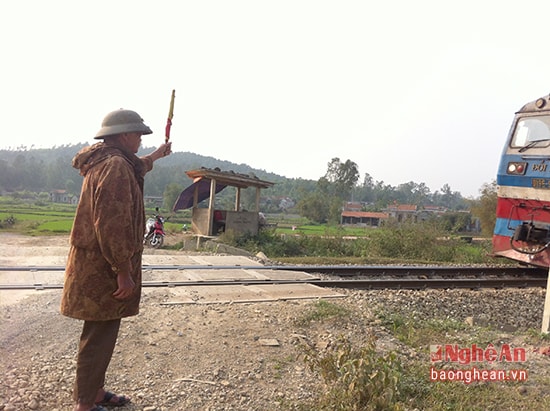 |
| Mr. Nguyen Huy Chi raised a flag to signal safety as the ship approached. Photo: Thuy Loi. |
His story begins with memories of his heroic time in the army. In 1964, he joined the military and fought in the Laotian war. After more than seven years, he was discharged and returned to his hometown with a 1/4 disability pension. He thought life would be peaceful with the meager disability allowance. But then, the level crossing at the beginning of the village, where dozens of trains pass daily and which had caused numerous tragic accidents, began to trouble the veteran.
Due to numerous accidents, losses, and train delays, the railway industry, in coordination with local authorities, organized a patrol at the level crossing at Km254 + 030 and assigned the task to the Youth Union of Quynh Tan commune.
In the early days, enthusiastic young people regularly assigned guards to ensure the safety of trains and civilian vehicles passing through the level crossing. However, due to various factors, this work was neglected. Later, the Veterans Association of Quynh Tan commune took over the job and assigned the guarding duties to Mr. Chi and another person, Mr. Nguyen Van Diem.
Recalling the day he first took on the job, Mr. Chi said: “Back then, in 2005, Mr. Diem and I were assigned to guard this section of road. Initially, they built a small hut next to the level crossing and gave us two signal flags, one red and one yellow, along with six landmines. Everything else we had to provide ourselves.”
After the guard post had been operational for about five months, his fellow guard quit because of lack of pay and insufficient equipment. So, Mr. Chi has been maintaining the level crossing guard post alone from that day until now. And during that time, he has saved up to build and equip the post with the necessary tools for his work.
Witnessing him on guard duty all afternoon, we truly understood the hardships and disadvantages of his job as a railway crossing guard. The level crossing had no barriers, and the guard was equipped with nothing but two flags and six explosives in case of an emergency. The guardhouse was bare, with four poorly constructed walls and a few sheets of corrugated cement roofing. There was no train schedule board, no telephone, no tea or water, and not even a chair. The only thing in the guardhouse was a rickety wooden platform he had pieced together from scraps of wood he'd begged from a nearby carpentry workshop. Yet, for years, day after day, around 6 a.m., people would see that familiar figure busily clearing trash from the tracks, and only in the late evening, after the last train, would they see him return home.
Sharing about his "operations," he recounted in less than two minutes a few simple actions of holding the command flag and how to plant defensive mines, as taught by his commanding officer when he first started the job.
 |
| The message on the wall is what he has wanted everyone to follow for the past 12 years. Photo: Thuy Loi |
Having done it for a long time, he now knows exactly when the trains arrive each day. There are five passenger trains passing through here every day: three in the morning and two in the afternoon. “As soon as I hear the train whistle from afar, I quickly go and stand at the beginning of the level crossing to stop vehicles preparing to cross the tracks and wave the signal flag to the train driver. For me, it's not just about knowing the train schedule; I also don't dare neglect my work at other times because train delays and missed trips are common. As for freight trains, their schedules aren't fixed; they leave whenever there's cargo. That's why the guard always has to be careful and attentive.”
The entire level crossing lacked barriers to raise and lower each time a train passed, so Mr. Chi considered himself a human barrier, daily performing the duties of both guiding trains and skillfully directing people across the tracks.
For years, working at the guard post, all he hoped for was for each train to pass safely. Luckily, he was blessed with keen hearing, which made his job somewhat easier. "My hearing is very sharp; I can tell when a train is about a kilometer away. Because there's a bridge on this side, the train will sound its horn, and if it's coming from the other side, there's a horn blast from inside the station. Because of that 'sensitivity,' I once stopped a group of drunk young men from crossing the tracks. I almost got beaten up because the kids thought the train hadn't arrived yet. After a long argument, I finally managed to get them off the tracks just in time for the train."
Many people still remember an incident that happened about three years ago, when a woman was transporting salt from the lowlands to sell. Her rickety cart was slowly making its way across the railway tracks. Because of the heavy load, the cart only moved inch by inch up the hill. Just as she was about to reach the tracks, the train whistle blew. “My legs and arms were weak, and just as we reached the beginning of the tracks, the salt cart broke down. I rushed out from the guard post and only had time to pull the salt seller behind me. In an instant, the train sped past the cart and crushed the sacks of salt. Both I and the woman were terrified!”
Having served as a railway guard for 12 years without pay, he can't remember how many trains have passed through this area, only that since he took on the job, fortunately, no accidents have occurred. He has never been awarded any honors, nor has he ever demanded any benefits. Rain or shine, summer or winter, he silently performs his duty, ensuring the safety of the trains.
There were many times his wife and children talked about him retiring from guard duty because his health was no longer strong enough to withstand the rain and sun on the railway tracks. But he always had his own reasons: "When there's work to be done at home, either my wife and children take care of it themselves, or my wife takes over guard duty so I can go. Or sometimes, when it's raining or windy, or I'm sick and can't go on my own, my children want me to take time off. But after hearing them, I just let it go. If I quit now, who will guard duty for me, who will guide me on the way? Not to mention, I wouldn't know what to do to pass the time when I got home."
And it is because of this concern that, at over 80 years old, Mr. Chi still works on the railway tracks every day without any intention of "retiring." He said: "As long as I am healthy and can still move around, I will continue to stand guard here. Seeing trains pass safely every day is my greatest joy."
Hearing stories about his ship-guiding duties and the times he saved people from the brink of death, we were even more impressed by the noble heart of this veteran.
Irrigation