

Van Temple - Cua Rao Festival: A convergence of traditional community beauty.
(Baonghean) - Every spring, in the latter half of January, the people of the villages in the mountainous district of Tuong Duong dedicate a spiritual corner to the Van Temple - Cua Rao Festival. At the festival, locals and visitors are immersed in a solemn and sacred atmosphere, joyful and lively, where they can entrust and pray for their innermost and sacred wishes.
The Van - Cua Rao Temple is located in Xa Luong commune, at the confluence of the Nam Non and Nam Mo rivers, where the gentle Lam River flows. This sacred temple has long been a cultural symbol of Nghe An province. It is associated with the career and merits of Doan Nhu Hai (during the Tran dynasty) – a military commander who sacrificed his life on this land to protect the country, its borders, and the lives of its people.
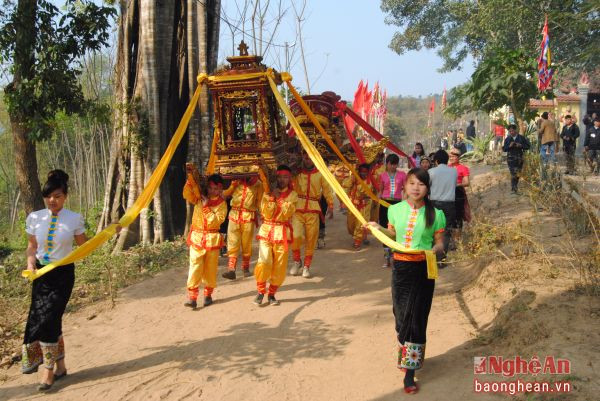 |
| Procession at the Van Temple - Cua Rao Festival. Photo: Cong Kien |
According to historical sources, around 1335, the Laotian invaders swept down and harassed the western border region of Nghe An province, then known as Nam Nhung (comprising the present-day districts of Ky Son, Tuong Duong, and Con Cuong). The peaceful lives of the villages were threatened, innocent people were killed, and their property was plundered. Upon hearing the news, despite his advanced age, Emperor Emeritus Tran Minh Tong decided to personally lead the army into this border region to suppress the invaders and secure the territory.
The Emperor appointed Doan Nhu Hai, who was then commanding the Than Vu and Than Sach armies and also serving as the Governor-General of Nghe An, as the Commander-in-Chief. During a battle at the river confluence, due to dense fog and unfavorable weather conditions, the Tran Dynasty Commander-in-Chief and many of his soldiers perished. When peace returned, the people of Nam Nhung erected a temple at the river confluence to commemorate the contributions of Doan Nhu Hai and the Tran Dynasty soldiers who sacrificed their lives for the peace of their community.
For many years, at the Van Temple - Cua Rao, the people have also worshipped the Three Holy Mothers (one of the "Four Immortals" according to folk beliefs). People from the villages in Tuong Duong take turns offering incense and organizing festivals at the beginning of spring throughout the year to commemorate the merits of their ancestors and to educate future generations about the traditions of their homeland. As we ascend to the Van Temple - Cua Rao, we pass by ancient trees thousands of years old casting their shadows onto the river, like witnesses to history in the endless flow of time. Incense smoke rises and spreads... Everyone lights an incense stick and prays for peace and prosperity.
The opening event of this year's Van Temple - Cua Rao Festival is a cultural exchange night that will attract thousands of locals and tourists to enjoy and cheer. Villages and participating groups will present unique performances showcasing the identity and aspirations of their communities, promising joy and enriching experiences for audiences near and far. This occasion will provide an opportunity for the folk songs and dances of the Thai, Mong, and Khmu ethnic groups to be performed, allowing visitors to better understand the rich cultural values of this highland border region.
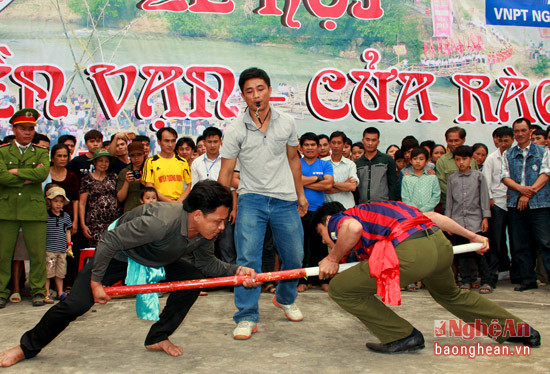 |
| Stick pushing competition at the Van-Cau Rao Temple Festival. (Archival photo) |
Many visitors have been captivated by the ever-changing tones of the bamboo flute, the flowing sound of the pí (a type of bamboo pipe) like a spring stream, and the melodious sounds of the flute accompanied by the graceful steps of the Hmong boys from the mist-shrouded mountain peaks. They are also enchanted by the rhythmic circle dances and the lam vong and sạp dances of the charming and gentle Thai girls. Then there are the resounding gongs and cymbals harmonizing with the Nậm Nơn and Nậm Mộ rivers, and the joyful sounds of nature and people blending together in a single rhythm.
Early in the morning, as the river awakens, the drums of the festival begin, and the procession of the ancestral tablets of Đoàn Nhữ Hài and the Three Holy Mothers commences. The chief priest proclaims the merits of the deities worshipped at the temple and prays for national peace and prosperity, favorable weather, abundant harvests, peaceful villages, and well-being for all people. Outside the festival grounds, various sports and folk games take place with great enthusiasm and excitement.
The young men and women of the highlands of Tuong Duong take turns playing games like crossbow shooting, tug-of-war, stick pushing, throwing the ball, swinging, and cockfighting... Held only once a year, everyone joins in the festivities before embarking on another busy and hectic year of work. Coming to the Van Temple - Cua Rao Festival is coming back to the values of our historical roots, back to the years of struggle to build and defend the nation.
At the same time, returning to a picturesque countryside, with friendly and hospitable people; a place where we can entrust our spirituality to live better in real life and a place where we can have moments of tranquility, excitement, and enthusiasm to begin a year of labor and production.
Speaking with us, Mr. Lo Thanh Nhat, Vice Chairman of the People's Committee of Tuong Duong District, affirmed: "The Van Temple - Cua Rao Festival is a place to demonstrate the spirit of unity of the ethnic groups living in Tuong Duong. It is also an opportunity to preserve the cultural identity of the ethnic groups, a gathering place for the beautiful traditions of the community..."
Tuong Anh - Dang Nguyen