
A moment of tranquility in the heart of the city.
(Baonghean) - That building stands modestly, even somewhat quietly, on one of the most beautiful and vibrant streets in Vinh City - Quang Trung Street. Every time I pass by, I often remember the letter and handwritten notes of General Vo Nguyen Giap to the Nghe An Provincial Party Committee.
(Baonghean) - That building stands modestly, even somewhat quietly, on one of the most beautiful and vibrant streets in Vinh City - Quang Trung Street. Every time I pass by, I often remember the letter and handwritten notes of General Vo Nguyen Giap to the Nghe An Provincial Party Committee.
The letter contained the following passage: “The location of Mr. and Mrs. Han Binh's house, which is also the residence of Ms. Minh Khai and Ms. Quang Thai, is house number 132, on Maréchal Foch street, on the road from the train station to Cau Ram bridge. You can ask: Mrs. Nhuan, Mrs. Dinh Thi Con, Ms. Lan, Mr. Doan… Of course, you should ask Mrs. Hien and Mr. Dung. Mr. and Mrs. Han Binh also have a house in Cho Thuong.” This letter from General Vo Nguyen Giap is dated November 6, 2005.
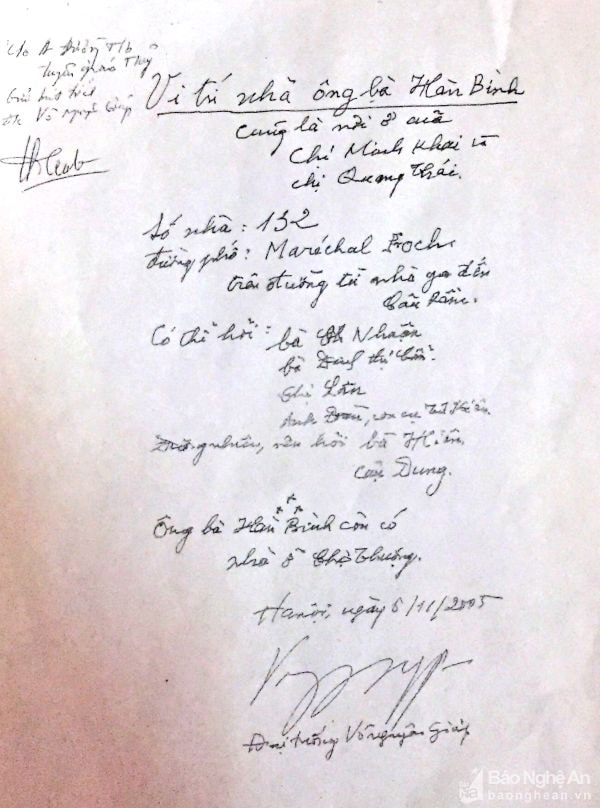 |
| A handwritten note from General Võ Nguyên Giáp to the Nghệ An Provincial Party Committee helped pinpoint the location of Mr. Hàn Bình's house. Photo: QS |
Yes! The project I'm referring to is the Nguyen Thi Minh Khai Memorial House in Vinh City. In 2005, when this project began, the Nghe An Provincial Party Committee, the Vinh City Party Committee, and related units conducted numerous surveys to find a suitable location for construction. The purpose was to honor the patriot Nguyen Thi Minh Khai and educate future generations about the revolutionary history of this land with its rich tradition in building and defending the nation.
Why did the Nghe An Provincial Party Committee and the Vinh City Party Committee seek the opinion of General Vo Nguyen Giap? Because the General's first wife was Nguyen Thi Quang Thai, the younger sister of Nguyen Thi Minh Khai. When helping Vinh City locate the former house of his wife's parents, the General was 94 years old, yet he still remembered every street name, every person involved. It must have taken a very deep affection for the woman from Vinh City – Nguyen Thi Quang Thai – and her family for General Vo Nguyen Giap to remember this place so clearly.
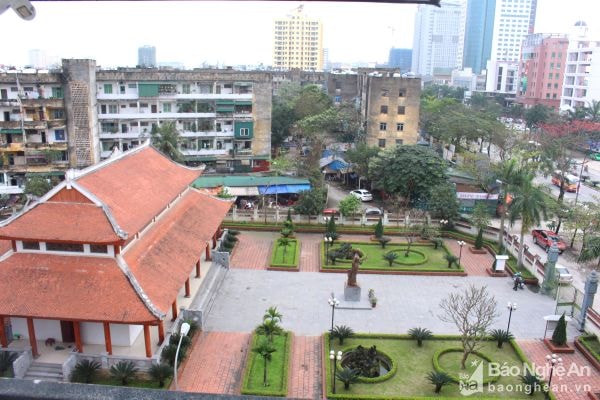 |
| The Nguyen Thi Minh Khai Memorial House is located in Quang Trung ward (Vinh City). Photo: Dao Tuan |
Before discussing the Nguyen Thi Minh Khai Memorial House in Vinh City, let's briefly outline the formation of the Quang Trung ward area in its history alongside the city's development. On December 10, 1927, the Governor-General of Indochina issued a decree establishing the city of Vinh - Ben Thuy by merging three urban centers: Vinh, Ben Thuy, and Truong Thi. On January 18, 1930, Governor-General Pasquier issued a supplementary decree dividing Vinh - Ben Thuy into 10 streets, from Street 1 to Street 10, with the Quang Trung ward area belonging to Street 1.
By 1945, following the success of the August Revolution, the Democratic Republic of Vietnam was established. The revolutionary government of Vinh City consolidated the administrative boundaries of Vinh City from 10 wards into 5 wards, with Quang Trung ward belonging to ward 1…
It can be said that even during the feudal and colonial periods, the area that now belongs to Quang Trung ward was the economic and administrative center of both the feudal government and the colonial regime. It was also where the French colonialists built a center for French capitalist administration, commerce, and industry. As an objective necessity, Maréchal Foch Avenue on First Street became a gathering place for the middle and upper classes, and especially for the bourgeoisie in the area, including the national bourgeoisie. Mr. Han Binh's family was one of them.
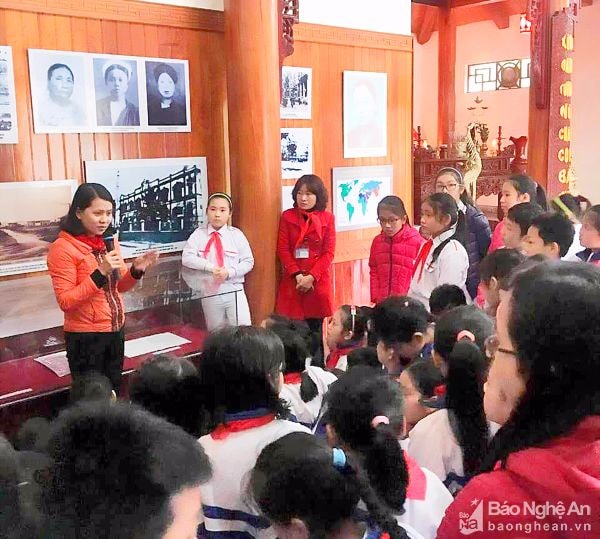 |
| Students from Quang Trung ward participate in extracurricular activities at the Memorial House. Photo: Dao Tuan. |
Mr. Nguyen Huy Binh - Han Binh, originally from Moc village - Thuong Dinh, Nhan Chinh commune, Tu Liem district, now Ha Dinh ward, Thanh Xuan district, Hanoi. A man of education and social standing at the time, he earned the respect of the local residents when he came to Vinh to do business. It was in De Nhat Street, near the train station and a bustling commercial area, that Mr. Nguyen Huy Binh's children demonstrated a deep understanding of the suffering of the people under colonial rule, oppressed by two layers of oppression. At that time, in the Vinh Yen - Yen Truong region, few middle-class families had as many children involved in the revolution as Mr. Han Binh's family. He and his wife had eight children, all of whom wholeheartedly followed the revolution.
Among them, the two eldest daughters, Nguyen Thi Minh Khai (1911-1941) and Nguyen Thi Quang Thai (1915-1944), are considered special cases in the revolutionary struggle not only of Nghe An but also of the whole country in the early 20th century. Everyone knows that the husband and comrade of the patriotic Nguyen Thi Minh Khai was the late General Secretary Le Hong Phong, while the husband of the female revolutionary fighter Nguyen Thi Quang Thai was General Vo Nguyen Giap. They were figures with immense influence in the struggle for national independence, democracy, and people's rights throughout the 20th century and to this day. This is also a rare case in the history of the Vietnamese revolution.
Returning to the Nguyen Thi Minh Khai Memorial House in Vinh City, this is a project built by Nghe An province and Vinh city to honor one of the outstanding and heroic daughters of the homeland.
After a period of construction, the project was completed in 2012, on the occasion of the 110th anniversary of the late General Secretary Le Hong Phong. The project has many components designed and arranged harmoniously and logically. Accordingly, in addition to the Memorial House with a construction area of 362m².2Built in the ancient architectural style of the Nguyen Dynasty, the complex also includes a 68m² reception house.2and auxiliary items such as grounds, vases, ornamental trees, flowerbeds… Particularly in the center of the grounds, right in front of the Memorial House, is a bronze statue of Nguyen Thi Minh Khai, facing south. The Memorial House is located right next to the 12/9 Cinema - which was formerly the Majestic cinema built by the French colonialists to serve the entertainment needs.
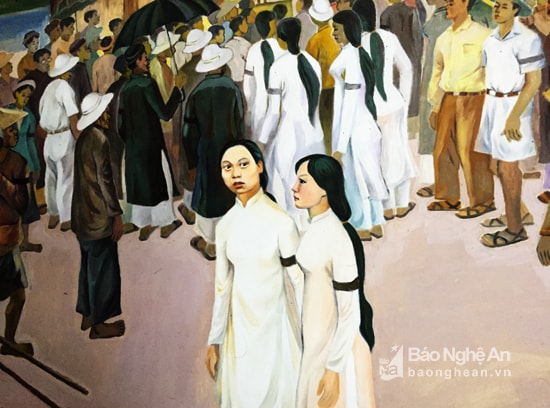 |
| The painting depicts Nguyen Thi Minh Khai (left) and her comrades participating in revolutionary propaganda at Diec Pagoda (Vinh City). |
Amidst the bustling and vibrant streets of Vinh City, stepping into the Memorial House immediately evokes a sense of tranquility and serenity, allowing anyone to find a moment of peace for their soul.
I met Ms. Nguyen Thi Thu Hang, a tour guide at the Memorial House, one early spring afternoon. She smiled gently and said that this was truly a tranquil space, a soft haven amidst the hustle and bustle. Besides the main altar and numerous documents and images about the life and revolutionary career of the patriot Nguyen Thi Minh Khai, the Memorial House also displays images and artifacts of her family members, as well as comrades and fellow soldiers from the early period of the 20th-century revolutionary struggle.
However, according to Ms. Nguyen Thi Thu Hang, the Memorial House is not as crowded with visitors as other places. Most visitors are students from the ward. Primary schools often organize ceremonies for their children to join the Young Pioneers at the Nguyen Thi Minh Khai Memorial House, in addition to extracurricular activities and learning about historical figures of Vinh City. Furthermore, every year during the Commemoration of War Invalids and Martyrs Day (July 27th), Vietnamese Women's Day (October 20th), or International Women's Day (March 8th), the Nguyen Thi Minh Khai Memorial House only briefly becomes bustling with groups coming to lay flowers and incense in remembrance. Afterwards, it returns to its usual quiet and peaceful state. Perhaps this is what creates a unique cultural highlight in the modern urban space of Quang Trung ward – one of the most vibrant areas of Vinh City.
First Street, formerly known as Maréchal Foch Street, was once called "Train Station Street." Every day, the sound of train whistles echoed through the bustling streets. I imagine that it was at that very train station that General Võ Nguyên Giáp met and made his vows to his first wife, Nguyễn Thị Quang Thái; and on the train leaving Vinh, the late General Secretary Lê Hồng Phong held the hand of his wife and comrade, Nguyễn Thị Minh Khai, as they embarked on their revolutionary activities, and they lived and dedicated their lives to their great beliefs and ideals. It was a place where outstanding individuals, the finest of the nation and the era, converged.
Quoc Son