

Thanh Chuong: A transformation in border communes
(Baonghean) - In recent years, thanks to the Ho Chi Minh Highway and the developed transportation system, the five border communes of Thanh Chuong district (including Thanh Duc, Hanh Lam, Thanh Thuy, Thanh Son, and Ngoc Lam) have risen through investment in tea cultivation, acacia planting, and commercial cattle farming, creating a rapid and sustainable economic growth rate.
Having been a member of the Hanh Lam Tea Plantation for decades, after retiring, Ms. Le Thi Thao from the Dien Bien team continued to work on the tea hills. To increase its value, her family invested in expanding the tea plantation with new, high-yielding varieties. According to Ms. Thao, tea is a crop that provides year-round income with stable prices. From an initial area of only 1 hectare leased from the plantation, her family now owns 3 hectares, generating hundreds of millions of dong in income each year.
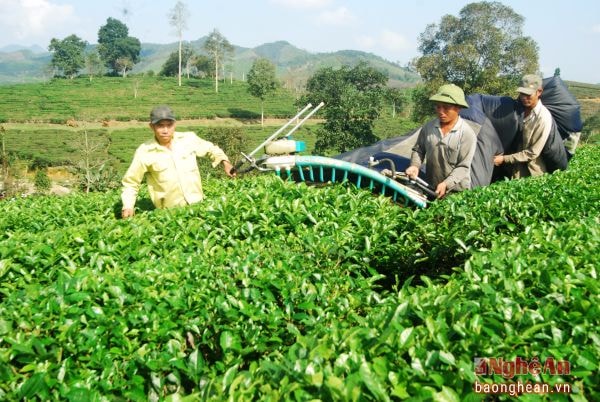 |
| Tea growers at Ngoc Lam Tea Factory are busy harvesting spring tea. Photo: T.D.H. |
About 50 years ago, in late 1967, recognizing that Thanh Chuong had suitable land and soil conditions for tea cultivation, the Ministry of Agriculture and Rural Development and the People's Committee of Nghe An province established a tea plantation in Hanh Lam commune. Since then, generations of workers and thousands of local people have been involved in tea cultivation. The Ngoc Lam tea plantation, the 5th Youth Volunteer Brigade in the border commune of Thanh Thuy, and the 2nd Youth Volunteer Brigade in Thanh Duc commune were also established in the area. These units also chose tea as the main economic crop for their members to produce, establish themselves, and build their careers.
Tea plants have become a means of poverty alleviation and wealth creation for the people. Currently, in the three communes of Thanh Duc, Hanh Lam, and Thanh Thuy alone, the tea growing area reaches over 1,500 hectares, accounting for 30% of the total tea growing area in the district. Mr. Nguyen Huu Vinh, Chairman of the People's Committee of Thanh Duc commune, shared: "Currently, the entire commune has about 700 hectares of tea."
Thanks to tea cultivation, the lives of people in the mountainous region are now more prosperous than in the outer areas where only rice is grown. Many households with farms have either leased their land or rented it out to others to focus on tea cultivation…”. In areas with very little paddy rice, the two newly established border communes of Thanh Son and Ngoc Lam are also prioritizing investment in tea cultivation. After three years of planting, each commune now has approximately 150 hectares, and they aim to reach 500 hectares within the next five years.
Along with tea cultivation, the border communes of Thanh Chuong district are actively implementing land allocation for forest planting to households under programs such as 327, Pam 4304, and 661. In particular, the construction of the Ho Chi Minh Highway has broken the deadlock for hybrid acacia cultivation and the development of forestry. Thanks to abundant land resources, people in the border communes have boldly invested in forest planting and are leading localities in acacia cultivation area, with a total area of approximately 10,000 hectares. Acacia is a type of timber tree used as raw material for paper processing and some household goods, and is readily marketable. Acacia cultivation requires no weeding, fertilizing, or pest control.
From planting to harvesting takes about 4-5 years, and after deducting expenses, each hectare yields a net profit of approximately 50 million VND. Mr. Nguyen Van Dung from Hamlet 4, Thanh Thuy Commune, who recently harvested 15 hectares of acacia trees, earning over half a billion VND, happily stated: “The income isn't high yet, but because of the large area, the acacia trees provide a considerable source of income for the family. We are researching further forest planting focusing on large timber, increasing the value per unit area...”
In addition to the income from selling acacia wood, during the harvesting process, people also benefit from peeling the bark, a job currently employed by around 1,000 people. Although the work is arduous, the income is stable, with each worker earning between 200,000 and 250,000 VND per day. This is a significant source of income that allows farmers to remain in this border region.
Along with the success of crops such as tea and acacia, in recent times, in border communes, farmers in border areas have been promoting the movement of commercial cattle farming with the formation of farms and family farms that bring high income.
Many households have invested billions of dong in cattle farming, such as Mr. Nguyen Sy Thin in Thanh Thuy commune who owns nearly 100 cows, and hundreds of other households with 10-70 cows. However, according to the district's assessment, these results are not commensurate with the potential and advantages. Therefore, the Thanh Chuong District People's Committee has just issued a project entitled "Developing several livestock species associated with brand building and product consumption in the period 2016-2020".
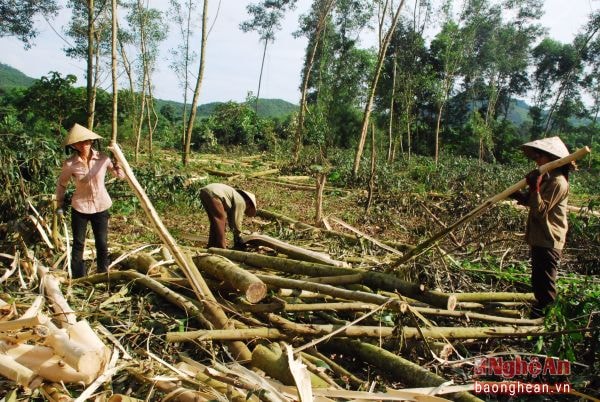 |
| Residents of Ngoc Lam resettlement commune (Thanh Chuong district) harvest acacia trees. Photo: T.D.H. |
Specifically, the goal is to have an average of 20 or more livestock animals per household in border communes, raised on family farms or larger farms. The district will provide partial funding for the construction of barns and pastures, and subsidize interest rates on loans for households raising 100 or more animals.
The project also proposes solutions for continuing the transfer and application of scientific and technological advancements in breeding and feed. Along with support policies from provincial and central levels, the district will issue appropriate mechanisms and policies to promote the development of cattle herds in border communes.
To encourage economic development in border areas, along with the Ho Chi Minh Highway, Thanh Chuong district has invested tens of billions of VND in building connecting roads from the Ho Chi Minh Highway to communes and tea and acacia growing areas. Besides facilitating the transportation of raw materials, these new roads contribute positively to socio-economic development.
Along the roads, prosperous villages are increasingly appearing in the border region of Thanh Chuong, an area that was once a dense forest and treacherous terrain. The socio-economic development of the Thanh Chuong border region is also expected to be promising with the upcoming investment in the Hanoi-Vientiane (Laos) expressway, which passes through the Thanh Thuy border gate.
Tran Dinh Ha
| RELATED NEWS |
|---|