

Phan Boi Chau and the Dong Du movement
(Baonghean.vn) - On the occasion of the Japanese Emperor's official visit to Vietnam, let's join Baonghean.vn in reviewing the Dong Du movement initiated by Phan Boi Chau.
Interesting and little-known facts about the Japanese royal family.
"The life of Japanese Emperor Akihito in photos"
1.Initiating the Dong Du movement
In 1868, the Meiji era began in Japan. This period was a time of reform for Japan, marked by experiments in pragmatic politics and a redefinition of the imperial system.
Japan opened up completely and especially encouraged the learning of English. However, during this period, Japan also faced threats from the West. Therefore, the country's modernization was also aimed at resisting external forces. But due to the unwavering resilience of the Japanese people, both China and Tsarist Russia suffered crushing defeats. This victory of Japan had a profound impact on the entire world.
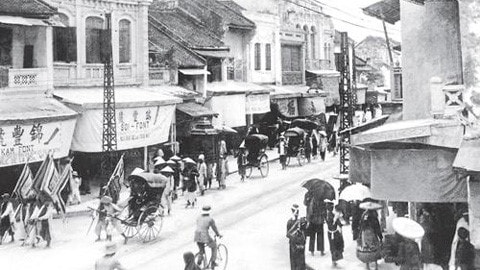 |
| Hang Dao Street, Hanoi in the early 20th century. |
In Vietnam during this period, numerous patriotic uprisings failed repeatedly, and the people had to continue living in slavery and misery.
The patriot Phan Bội Châu (1867-1940) founded the Duy Tân Hội (Modernization Society) to promote the patriotic movement in the country. However, finding a path to save the country and liberate the people proved to be a difficult task.
This was also a period when news documents related to the world situation and patriotic movements were widely disseminated. Phan Boi Chau was not immune to the influence of these documents. Unlike other patriots, he chose his own path, the path of national liberation.
Phan Bội Châu, believing he could rely on Japan for the resistance against the French, established the Đông Du (Eastward Movement). With the aim of learning from Japan, in January 1905, a group of Vietnamese intellectuals led by Phan Bội Châu traveled to Japan for the first time. Through an introduction by Liang Qichao, the Vietnamese intellectuals met with several patriots and supporters of Vietnam, such as Okumura, Kashiwabara Buntaro, and Dr. Asaba Sakitaro.
Phan Bội Châu also agreed with the proposal of his Japanese friends to send Vietnamese students to study in Japan, thus building the revolutionary movement that would follow.
2. The Eastern Journey and the ideology of national liberation
From 1906 onwards, the Dong Du movement became increasingly active throughout all three regions of the country. Numerous works by Phan Boi Chau were translated from Chinese into the Vietnamese Quốc ngữ script and sent back to Vietnam. The period from 1907-1908 was the peak of the Dong Du movement, with over 200 students studying abroad.
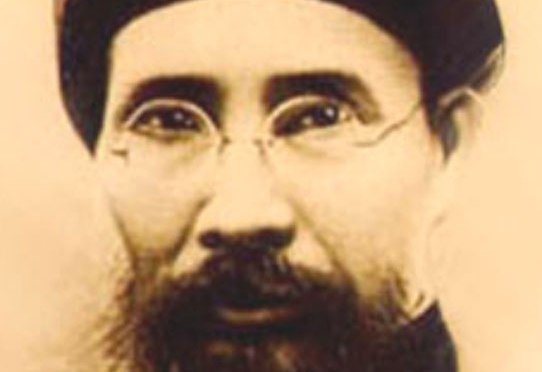 |
| Mr. Phan Boi Chau. |
At this time, two important figures of the ruling Progressive Party in Japan, Okuma Shigenobu and Prime Minister Inukai Tsuyoshi, advised Phan Boi Chau to encourage young people to study abroad so that they could return to help their country. Thanks to this support, Vietnamese youth focused intently on their studies, hoping to contribute to the cause of national liberation in the future.
The curriculum here was quite diverse; Japanese language and general knowledge were taught in the mornings and afternoons, while military knowledge was taught in the evenings, especially military training. When Vietnamese students attended Japanese schools, the curriculum and rules were set by the Japanese, while everything outside the school was managed independently by the Vietnamese. Phan Boi Chau and his comrades established the Vietnam Contribution Association (October 1907), which had its own program.
Phan Bội Châu served as the Prime Minister and Director, and Prince Cường Để served as the Chairman of the Association. Under the overall authority of the leadership board, the Association was divided into four departments, each responsible for a specific aspect of student activities.
The members of the Ministry of Economy played a crucial role in revenue collection, expenditure management, and preparatory work. At the same time, they were also skilled at lobbying and securing support both domestically and internationally. Vietnam Cong Hien placed great emphasis on organizing "political activities" to help students cultivate revolutionary ideology and ethics.
Phan Bội Châu once confided: “I am essentially a Vietnamese Resident Commissioner abroad, also holding the position of Inspector General. A deep well has short arms, and great tasks are of limited ability; I still fear I cannot handle the work I undertake. At the same time, we established the New Vietnam Cong Hien, modeled after a provisional government of Vietnam overseas. Although the organizational methods were rudimentary, they quickly influenced the national spirit.”
It was also at this time that the French colonial authorities discovered many clues about the movement. In September 1908, while students of the Chấn Võ School were graduating, an order was issued to disband the Vietnamese student organization, confiscate documents, and expel students from Japan. In February 1909, Phan Bội Châu and Cường Để were also expelled from Japan.
Faced with this situation, Phan Bội Châu and his comrades had to seek refuge in China, and then went to Siam to work for a while, hoping to wait for new opportunities.
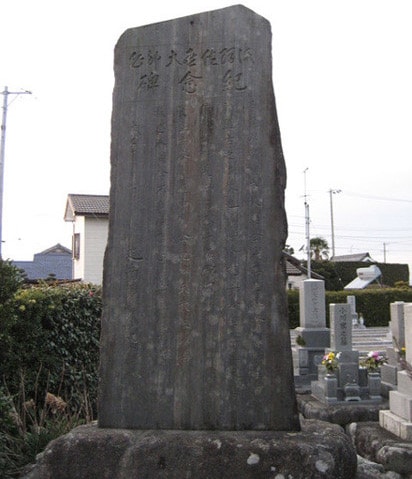 |
| A memorial plaque erected by Phan Bội Châu in Japan to commemorate the contributions of his great friend Asaba Sakitaro. |
The situation was very difficult at that time, and the cost of sending students back home became a major problem for Phan Boi Chau. It was at this critical moment that Dr. Asaba Sakitaro donated 1700 yen. This money helped many Vietnamese students. Not only at this time, but Dr. Asaba had also provided significant material support for Phan Boi Chau's Dong Du movement before this.
It was this selfless and pure assistance that, after things calmed down, Phan Bội Châu and several other comrades traveled to Asaba's (who had by then passed away) hometown to erect a memorial stele in his honor. The inscription reads: "Better than ever before, his kindness was boundless. He helped like the heavens, I endured like the ocean; my aspirations were not yet fulfilled, he did not wait for me. My heart aches for countless years. All members of the Vietnamese Nationalist Association respectfully remember this."
In 2003, to commemorate the 85th anniversary of Phan Boi Chau's erection of the memorial stele, the Patriotic Association of OWA Province solemnly organized a ceremony. Several Vietnamese scientists also attended the ceremony. In 2010, to commemorate the 105th anniversary of the Dong Du movement, the Asaba Association of Vietnam in Japan organized a commemoration of Phan Boi Chau and donated a relief and model of the Asaba stele to the Vietnam Historical Museum.
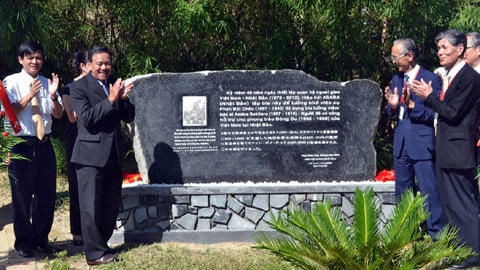 |
| We received the Phan Boi Chau memorial plaque from the Asaba Association, Japan. |
During his time in Japan, Phan Bội Châu wrote letters expressing his feelings for Japan and appealing for the support of the Japanese people for the Vietnamese national liberation movement. He also wrote many works demonstrating his patriotism and admiration for his Japanese friends.
Peace
(Synthetic)