

Cuong Temple Festival - an attractive spiritual tourism destination.
(Baonghean) - During these days, visitors from all over return to Hoan Chau, a place that preserves a part of the nation's origins - the temple of Thuc An Duong Vuong on Mo Da mountain (Dien An commune, Dien Chau district). The festival opens on March 11th (February 14th in the lunar calendar) and lasts for four days with many activities rich in local cultural identity, attracting a large number of local people and visitors from all over.
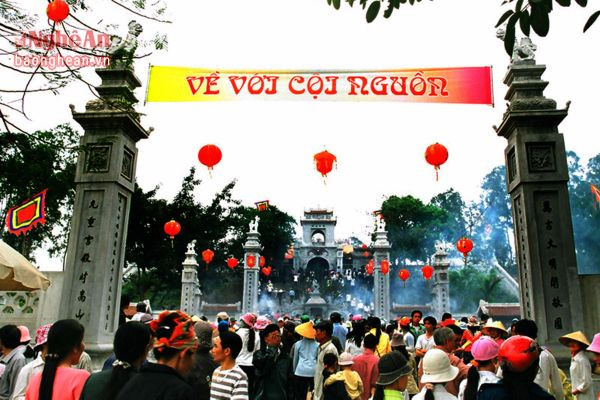 |
| Numerous tourists flocked to the Cuong Temple Festival. Photo: Thu Huong |
Cuong Temple is a beautiful and sturdy architectural structure, well-suited to the natural surroundings, with many trees interspersed around it. The temple has a three-part architectural style, consisting of a triple gate and three main halls: the Upper, Middle, and Lower halls.
I remember that in 1995, cranes flew to Cuong Temple on the very day of the temple's festival opening; during the 1996 festival, a dead whale washed ashore at Cua Hien beach. The people believed that the returning crane was the embodiment of Princess My Chau; and the dead whale washed ashore was evidence of the tragic self-sacrifice of An Duong Vuong.
These events further enhanced the mystique and sacredness of Cuong Temple, attracting people from near and far to offer incense and pray for national peace and prosperity, and family happiness. Every month, on the 1st and 15th, the people of Dien Chau coastal area prepare offerings with sincere hearts to King An Duong Vuong and light lamps to tend to the incense smoke.
During the festival days (from the 13th to the 16th of the lunar month), the area around the foot of Mo Da mountain attracts a large number of locals and tourists from all over. The ceremonial part of the Cuong Temple Festival includes: the opening ceremony, the middle ceremony, the offering ceremony, the grand ceremony, and the thanksgiving ceremony. In addition, there is also a standing vigil ceremony. When participating in the ceremony, members of the organizing committee wear ceremonial attire as prescribed.
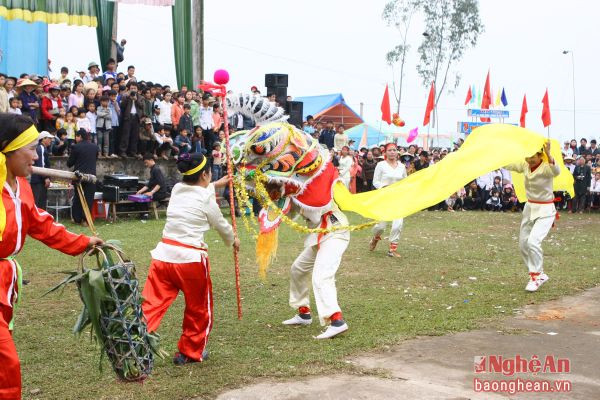 |
| Lion dance at the Cuong Temple Festival. Photo: Thu Huong |
The most spectacular part is the procession of palanquins from the Cao family church and Xuan Ai communal house to Cuong Temple, starting early in the morning of February 15th. Leading the procession are the flag bearers from both the communal house and church, followed by the music band, then the palanquin of the King, then the palanquin of Princess My Chau, and finally the palanquin of General Cao Lo. When the palanquins arrive at the temple, the main gate of the triple-arched gate will be opened to allow the procession to enter. The palanquins will be placed in the courtyard of the main hall in preparation for the ceremony.
Following the solemn and respectful ceremony, the festival takes place around the foot of Mo Da Mountain with many unique activities and traditional folk games such as: throwing the ball, carousel rides, wrestling, cockfighting, crossbow shooting, walking on a bridge, chess, card games... There are also cultural exchange activities from cultural villages, folk singing clubs, and traditional music groups... Every year, the Cuong Temple Festival features cockfighting with fighting roosters brought in by people from all over. Then there's the human chess competition, which is not only between communes within the district like other sports games, but also includes participation from teams from neighboring districts in the province.
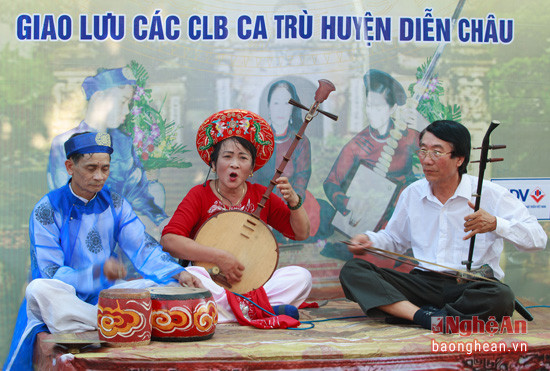 |
| A performance of traditional Vietnamese folk singing (ca trù) between different units in Dien Chau district. Photo: Sach Nguyen. |
It is known that in 2017, the Cuong Temple area received investment for restoration and renovation. Mr. Tran Sy Hong - Deputy Head of the Culture and Information Department of Dien Chau District, said: "With the attention of the District Party Committee, the People's Council, and the People's Committee, the festival grounds were upgraded and repaired in a timely manner, and the electrical system was also better ensured. Competitions such as the High School Student Singing Contest and the Elegant Youth Contest were also included this year, adding to the joyful atmosphere of the festival."
Previously, to disseminate information to the public, the Department assigned the Cultural Center to hang banners, slogans, and posters along National Highway 1A one week before the festival. All 39 communes and towns broadcast programs about the history of Cuong Temple through village and commune loudspeakers. The District Police, District Military Command, and Dien Thanh Border Guard Post were tasked with ensuring security, order, traffic safety, fire prevention and control, and preventing begging during the festival. Overall, the propaganda and preparation for the Cuong Temple Festival have been quite thorough so far...
The Cuong Temple Festival has truly become an indispensable cultural and spiritual activity for the people of Dien Chau in particular and visitors from all over in general. Here, visitors can immerse themselves in the romantic Cua Hien area, the tranquil Xuan Duong Lake, the Dien Thanh Beach Tourist Area, Co Am Pagoda, Ho Linh Son, and the Hai Vai rock formation reflected in the Bung River; they can also visit other scenic spots in Dien Chau to better understand the land and its people, a place with over 1,380 years of cultural history, and to reflect together and remind each other to preserve, protect, and promote the value of cultural heritage.
| According to legend, An Dương Vương, whose real name was Thục Phán, was an 18th-generation descendant of King Hùng. He possessed extraordinary strength and strategic intelligence. Thục Phán played a major role in uniting the northern tribes of Vietnam to defeat the invading Qin army. In the triumphal procession, Thục Phán was enthroned as King, taking the title An Dương Vương and renaming the country Âu Lạc. He moved the capital from Phong Châu to Cổ Loa and reigned for 50 years (from 257 - 208 BC). |
Thu Huong
| RELATED NEWS |
|---|