

The Arctic ice could melt completely by the middle of the century.
The complete melting of sea ice would lead to catastrophic weather events in most countries in the Northern Hemisphere and accelerate global warming.
"Father Nguyen Dinh Thuc incites parishioners."
Scientists warn that the Arctic Ocean could lose its ice cover for the first time in 100,000 years if humans do not take measures to limit the rate of global warming to 2 degrees Celsius, the Independent reported on March 7.
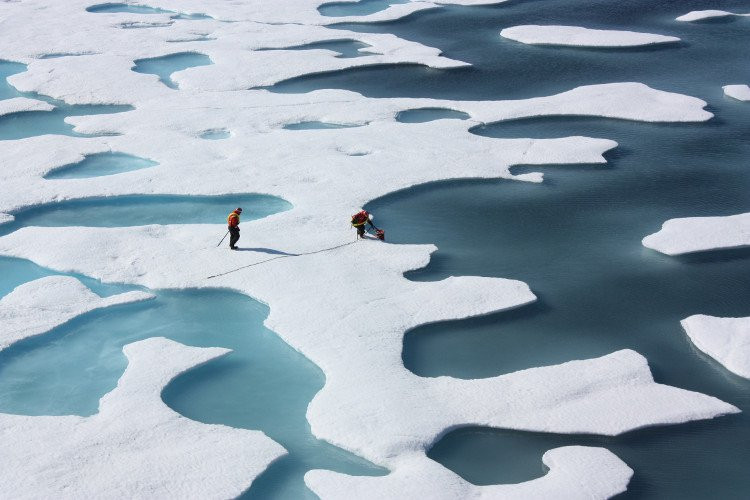 |
| Arctic sea ice is shrinking in size. (Photo: Flickr) |
This region has been experiencing a sharp increase in temperature in recent decades compared to the rest of the world. Winter temperatures on the northern Norwegian island of Spitsbergen are 8-11 degrees Celsius higher than the average between 1961 and 1990.
This will have a major impact on the climate in most of the Northern Hemisphere, increasing the number of dangerous storms. Sea ice reflects a large portion of the energy from sunlight. If sea ice disappears, the rate of global warming will also increase.
The Arctic will be considered ice-free if the ice area falls below one million square kilometers. This means the seas surrounding the Arctic will be clear, and the remaining ice will be concentrated mainly on small islands off the northern coasts of Russia and Canada.
Last September, Arctic sea ice shrank to approximately 4.1 million square kilometers, the second lowest level since 3.4 million in 2012, according to the U.S. Snow and Ice Data Center. Antarctic sea ice is currently at a record low of 2.14 million square kilometers, compared to 3.16 million between 1981 and 2010.
According to Khoahoc.tv
| RELATED NEWS |
|---|