
Sidewalks belong to no one in particular.
(Baonghean) - The "sidewalk war" started in Ho Chi Minh City and gradually spread to other provinces and cities across the country. Many conflicting opinions have arisen from the public; some agree, some disagree. There are also those who are half-agree, torn between reason and emotion.
(Baonghean) - The "sidewalk war" started in Ho Chi Minh City and gradually spread to other provinces and cities across the country. Many conflicting opinions have arisen from the public; some agree, some disagree. There are also those who are half-agree, torn between reason and emotion.
Logically, sidewalks belong to no one in particular; no one has the right to appropriate them for personal gain, let alone occupy the entire sidewalk, leaving no space for pedestrians, not even a small path. Emotionally, sidewalks are the livelihood of countless low-income workers; cleaning them up would mean pushing them into unemployment and loss of income.
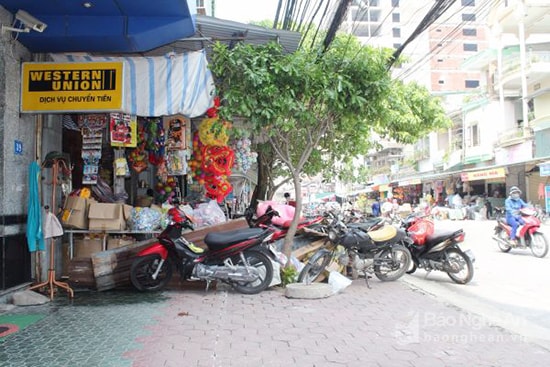 |
| Many businesses along Hong Son Street (Vinh City) have encroached entirely on the sidewalks. Photo: Nguyen Nguyen |
I remember once accompanying the city's urban order enforcement team on a "cleanup" of makeshift stalls encroaching on the sidewalks in front of one of the city's largest hospitals. The scene right in front of the hospital entrance was a chaotic makeshift market, with stalls strung up haphazardly and tables and chairs scattered everywhere – it was certainly not a pleasant sight.
Moreover, every time it rains, the dirt road next to the hospital becomes muddy and slippery, compounded by plastic bags and garbage from the market, creating an extremely unsanitary situation that is in stark contrast to the hospital right next door. As soon as they spot the patrol cars of the enforcement team in the distance, the stall owners hastily dismantle their umbrellas, awnings, and tarpaulins, extending them to occupy the entire sidewalk, even spilling onto the road.
The enforcement team arrived like a whirlwind, joining the dismantling operation, the only difference being that the dismantled items were loaded onto a truck to be taken to the team's collection point. A short while later, the truck was full of tables, chairs, tarpaulins, and frames for setting up stalls. People surrounded the truck, waiting for someone to be distracted so they could snatch back their confiscated items. One member of the enforcement team had to climb inside the truck to guard the goods. Shouts and curses filled the street. "Are you going to let us earn a living?", "Why are you oppressing us?", "Give us back our things so we can make a living!", "Hey villagers, come see them threatening people!" There were even vulgar threats.
Seemingly accustomed to these reactions, the enforcement team silently finished their work and then got back in their vehicles to move on to other locations. The street in front of the hospital looked slightly brighter, but the messy, makeshift stalls were still there. And a few days later, they bought new tables, chairs, umbrellas, and tarpaulins, and nonchalantly occupied the sidewalk again as if nothing had happened.
Everyone needs to earn a living, but it must be done humanely. Humanity here doesn't mean blindly bestowing pity, disregarding reason and the law, on those in more difficult circumstances. Humanity means earning a living for oneself, but at the same time, reflecting on whether one is trampling on the rights of others or the living environment of the community.
The sidewalk belongs to me, to you, to all of us. Just because I'm poor doesn't mean I have the right to claim the sidewalk as my own, while you, being richer, must yield to me and walk in the road instead. Before the law, everyone is equal – in both rights and obligations.
Hai Trieu