

What do you know about the Cold Food Festival on the 3rd day of the 3rd lunar month?
(Baonghean.vn) - The Han Thuc Festival on the 3rd day of the 3rd lunar month each year is not only a beautiful traditional cultural feature but also a beautiful aspect of culinary art.
1. The origin of the Cold Food Festival
In Chinese characters, "Han" means cold, and "Thuc" means food, so "Han Thuc Festival" means the festival of eating cold food. This ancient custom originates from China, based on a fascinating story passed down through generations.
The story goes that during the Spring and Autumn period (770-221 AD), King Wen of Jin, facing rebellion, had to flee his country and live in exile, sometimes in Qi, sometimes in Chu. At that time, a wise man named Jie Zitui served the king and offered many strategic advice. One day, while fleeing, their food supplies ran out, so Jie Zitui secretly cut a piece of flesh from his own thigh and cooked it for the king. After the king ate it and learned the reason, he was deeply moved.
 |
| The Cold Food Festival, celebrated on the 3rd day of the 3rd lunar month, originates from China. |
Jie Zitui served King Wen of Jin for nineteen years, enduring hardships and rigorous training together. Later, when King Wen of Jin regained the throne and returned to rule the state, he generously rewarded those who had helped him during his exile, but he forgot about Jie Zitui. Jie Zitui harbored no resentment, believing that serving the king was his duty, and that such actions were nothing to speak of.
Therefore, he returned home and took his mother to live in seclusion in the Tianshan Mountains. Later, Duke Wen of Jin remembered him and sent people to find Zitui. But because he was a man who did not seek fame or fortune, Zitui resolutely refused to return to receive the reward. Duke Wen of Jin ordered the forest to be burned (to force Zitui to return). Unexpectedly, Zitui was determined, and both mother and son perished in the fire in the forest.
The king regretted his actions and ordered a shrine to be built. Every year, on the 3rd day of the 3rd lunar month, the anniversary of the tragic death of Tu Thoi and his mother, cooking with fire is forbidden, and even the preparation of offerings must be done the day before. This day is considered the Cold Food Festival.
2. The significance of glutinous rice balls and vegetarian cakes in the Vietnamese Cold Food Festival (Tết Hàn thực).
Although originating from China, the Cold Food Festival in Vietnam still retains its own unique characteristics, deeply rooted in Vietnamese culture. On the 3rd day of the 3rd lunar month each year, people eat cooked food that has been allowed to cool with the utmost reverence to remember the nurturing love of their deceased ancestors.
Unlike the Cold Food Festival in China, on this day, Vietnamese people do not abstain from using fire and still cook as usual. Notably, the Vietnamese have also created glutinous rice balls and vegetarian cakes, symbolizing cold foods – "han thuc".
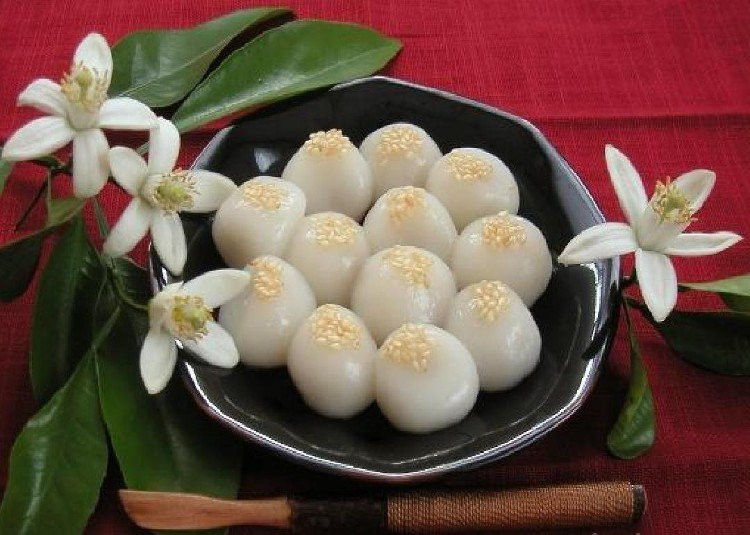 |
| Glutinous rice balls are offered as a sacrifice on the Cold Food Festival. |
3. Returning to our roots
The Cold Food Festival (Tết Hàn Thực) in Vietnam primarily carries the meaning of honoring one's roots and commemorating the contributions of those who have passed away. For example, the Vietnamese traditionally offer glutinous rice balls to the Two Trung Sisters on the 6th day of the 3rd lunar month in Ha Tay. Following that, on the 10th day of the 3rd lunar month, the Hung Kings' Commemoration Day, Vietnamese people from all over the country travel to Hung Temple in Phu Tho to light incense and offer plates of glutinous rice balls and vegetarian cakes, remembering their origins... Thus, it is clear that our Cold Food Festival has its own unique national character, enduring throughout the process of nation-building and national defense.
4. National traditions
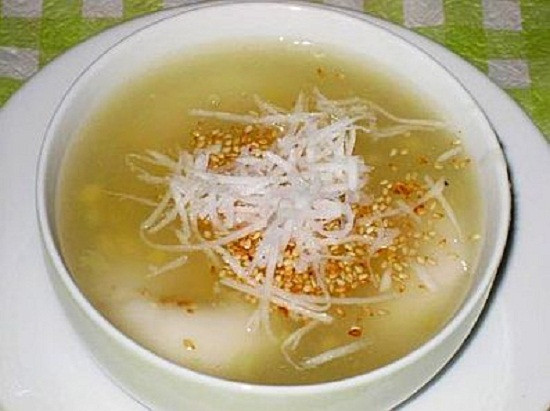 |
| Vegetarian cakes are offered as sacrifices on the Cold Food Festival. |
Sticky rice balls (bánh trôi) and vegetarian rice cakes (bánh chay) are characteristic dishes of this festival. Since ancient times, these dishes have been immortalized in Vietnamese poetry as popular and distinctive Vietnamese foods. Both are made from fragrant glutinous rice flour. Sticky rice balls are small, white on the outside with a red sugar filling, boiled in a pot of boiling water until they float to the surface and are just cooked through. Vegetarian rice cakes are flat, round, and unfilled, placed on a small plate, and served with sugar syrup poured over them.
5. Recalling the past
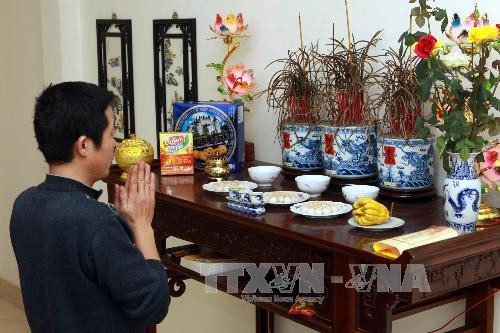 |
| The Cold Food Festival, with its traditional glutinous rice dumplings and vegetarian cakes, is an occasion for people to remember the nurturing love of their deceased ancestors. |
These days, enjoying a plate of glutinous rice balls or vegetarian cakes with loved ones allows us to feel the vicissitudes of life. Many people also say that eating glutinous rice balls or vegetarian cakes on this day helps us reminisce about old times, stories from a bygone era of our nation.
These traditions have become deeply ingrained in the Vietnamese psyche, so much so that every year on the Cold Food Festival, people eagerly prepare glutinous rice balls and vegetarian cakes. With the fragrant aroma of mung beans and molasses, the festive atmosphere seems to become more vibrant and meaningful.
Kim Ngoc
(Synthetic)
| RELATED NEWS |
|---|