

Does the US have evidence that Russia knew in advance about the chemical weapons attack in Syria?
However, the US has yet to reach a final conclusion confirming whether Russia knew in advance that chemical weapons would be used in Syria.
The evidence is inconclusive.
APAccording to a senior US official quoted on April 10, Washington believes Russia had prior knowledge of the chemical weapons attack in Khan Sheikhun, Idlib province, Syria, on April 4.
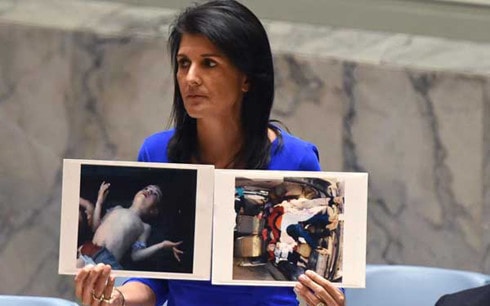 |
| US Ambassador to the United Nations Nikki Haley released photos of the chemical weapons attack in Syria on April 4. (Photo: AFP) |
The U.S. official said a Russian-operated drone flew over the hospital where victims of the attack were being treated. Hours after the drone left, a Russian-made fighter jet arrived and bombed the hospital, an attempt by U.S. officials to cover up the use of chemical weapons.
The senior official said that the U.S. has no evidence of actual Russian involvement in the chemical attack in northern Syria. However, the presence of reconnaissance aircraft in the hospital area was not a coincidence, and it is possible that Russia knew the chemical weapons attack would occur and that victims would seek help at this hospital.
The unnamed U.S. official did not provide a precise time when the unmanned reconnaissance aircraft appeared in the area where the attack killed more than 80 people. The official also did not provide detailed military information or intelligence that underpinned the Pentagon's aforementioned assessments.
Another U.S. official warned that there is no final conclusion from the U.S. confirming that Russia had prior knowledge of the chemical weapons attack in Syria. An official U.S. statement claiming that Russia knew in advance about the chemical weapons attack would be extremely serious and would negatively impact current bilateral relations.
Although Russia has consistently supported the government of Syrian President Bashar Al-Assad and they have coordinated military operations, the U.S. has never accused Russia of complicity in attacks on civilian targets in Syria.
The two former Cold War adversaries even collaborated in 2013 on an agreement to remove and destroy more than 1,300 tons of Syria's chemical weapons.
Until April 10th, US officials said they were unsure whether Russia or Syria controlled the drone that appeared in the area where the chemical weapons attack occurred, but yesterday (April 10th), an unnamed US official stated that the US had compelling evidence that Russia controlled the drone.
However, the US is still unsure who piloted the fighter jet that bombed the hospital, as Syria also has Russian-made aircraft.
U.S. officials have previously stated that Russians frequently work with Syrian counterparts at the Shayrat air base – the alleged site of the chemical weapons attacks. The U.S. claims that this is where chemical weapons were stored and that this information could be evidence of Russian complicity in the attack.
Attacking Syria leaves the US apprehensive about retaliation.
On April 6th, the US launched a surprise attack on Syria, targeting President Assad's forces with a barrage of 59 Tomahawk cruise missiles fired from two destroyers stationed in the Mediterranean.
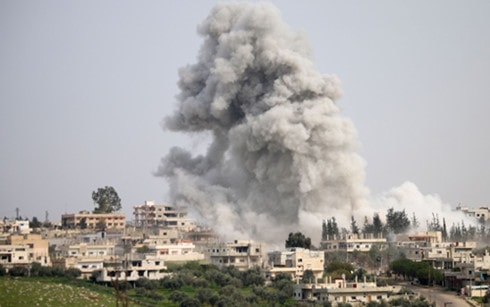 |
| A column of smoke rises after an airstrike in Syria. Photo: AP |
“Tonight, I call on all civilized nations to join us in ending the slaughter and bloodshed in Syria and to end all forms of terrorism and extremism… We pray for the souls of those who tragically lost their lives, for those who were wounded. And we hope that when America stands on the side of justice, peace, and harmony, we will ultimately prevail,” said U.S. President Donald Trump regarding the decision to attack Syria.
Amid concerns that a joint command center bringing together forces from Russia, Iran, and armed groups supporting Syrian President Bashar al-Assad had stated that U.S. airstrikes on Syrian air bases crossed a “red line” and that they would retaliate against any U.S. aggression, on April 10, Colonel John J. Thomas, a U.S. military spokesman, said that the U.S. had special precautionary measures in place in Syria in case U.S. forces were retaliated against for attacking the Shayrat military base.
According to Thomas, strengthening defensive measures to protect American troops in Syria will temporarily reduce the intensity of US airstrikes against ISIS in Syria.
Currently, there has been no retaliatory attack by Syria in response to the US cruise missile strike on the Shayrat air base. Meanwhile, Thomas said that the US intends to resume full-scale operations against ISIS as soon as possible.
According to VOV
| RELATED NEWS |
|---|