

Nghe An: Why is pig farming struggling?
(Baonghean) - Nghe An province has a developed livestock industry. Besides the current herd of 750,000 buffalo and cattle, the province's pig population exceeds 915,000. However, many pig farms are currently facing difficulties in selling their pigs due to plummeting prices and a lack of buyers.
Each pig resulted in a loss of 1 million dong.
These days, pig farms and smallholders in the province are in a state of anxiety due to the drastic drop in live pig prices. Located near Vinh City, Hung Nguyen district has identified pig farming as a strength to serve the city's consumption needs. Currently, the district has 60 pig farms, with an average of 50 pigs per farm, totaling 3,000 pigs, mainly fattening pigs and breeding pigs. However, most farms are currently facing difficulties in selling their pigs and are borrowing money from one source to cover expenses in another to maintain their herds of pigs ready for slaughter.
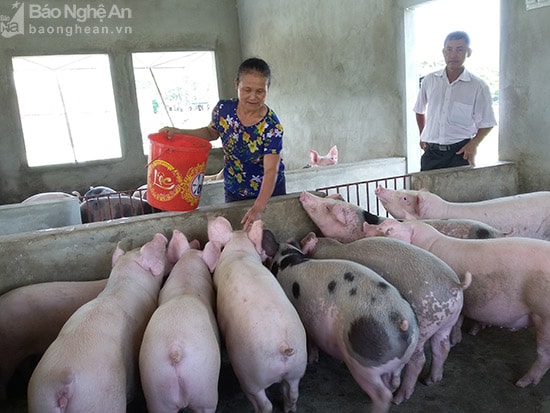
| Commercial-scale pig farming is a viable economic development direction for many households. Photo: Hong Son |
Mr. Vo Ngoc Duyen, residing in Hamlet 16, Hung Thang Commune, has been raising pigs for 16 years and recently invested 1.6 billion VND in his farm. Last year, the price of live pigs sold was 50,000 VND/kg, yielding a profit of 500,000 - 700,000 VND per pig. Recently, however, the price of live pigs has been continuously falling, making sales very difficult. In his previous batch of 70 pigs, when they reached market weight, the price dropped to 28,000 VND/kg, resulting in a loss of 500,000 - 800,000 VND per pig.
Mr. Duyen said: "My family currently has nearly 50 breeding sows and 120 fattening pigs. For every pig I sell, I lose 1 million dong. A 100kg pig costs 4 million dong to raise, but only sells for 3 million dong (if sold at 30,000 dong/kg). Last year, piglets sold for 1 million dong each, but now they've dropped to 400,000 dong each and I still can't sell them."
With low pig prices and a lack of buyers, Mr. Duyen has to sell individual pigs to people in the village. "But it's not like there are buyers every day. With low live pig prices, many farmers are worried about mounting debts."
We visited Mr. Ho Van Cuong's farm in Hung Tan commune and witnessed a similar situation. Mr. Cuong raises 200 pigs for meat, and in the past few months, he has lost over 100 million VND. Mr. Cuong said that a few months ago, he sold live pigs for 35,000 VND/kg, but now no one is buying anymore. He has exhausted all his money borrowing from everywhere to buy feed for the pigs, and now he only dares to feed them one spoonful at a time each day to keep them alive. When asked, "Why don't you slaughter them one by one and sell the meat in the village?", Mr. Cuong replied: "Everyone in the village raises pigs, every household slaughters them, sometimes it takes me all day to slaughter one pig to sell it all. All the potential buyers say they won't buy."
The current situation is one of increasing losses for pig farmers. Mr. Tran Quoc Trung, Chairman of the Hung Nguyen District Farm Economic Association and one of the farmers raising hundreds of pigs for meat and breeding in Hung Nguyen, stated: “This time last year, the average price of live pigs was 50,000 VND/kg, but now it’s below 30,000 VND/kg and we can’t even sell them. The more we raise, the more losses we incur, but farms haven’t been able to find a solution to this problem.”
There are currently about 60 pig farms in the district facing similar circumstances. We are arranging a meeting to find a way to save ourselves. As far as I know, the reason is that China is not buying the pigs, but I don't know why. Currently, all the pig farms are heavily indebted, and some have already gone bankrupt.”
| Farmers in Hung Tan commune (Hung Nguyen district) are struggling due to low pork prices. Photo: Tran Chau |
In Nghi Loc district, pig farming is also a strong point. On average, the district develops its pig herd by 17,000 to 21,000 pigs each year. With the current low pig prices, pig farmers throughout the district have suffered losses of more than 10 billion VND.
In 2013, Ms. Le Thi Hang's family in Hamlet 15B, Nghi Kieu Commune, invested hundreds of millions of VND in building a closed-system pig farm with a biogas digester, raising over 40 pigs per batch. On average, the family sells a batch every four months (equivalent to 3 tons of live pigs), earning over 200 million VND annually. However, since the beginning of this year, the price of live pigs has dropped to 30,000 VND/kg (a decrease of 10,000 VND/kg) compared to the same period last year. Therefore, her family is extremely worried because feed prices remain unchanged, while the price of live pigs is too low. Ms. Hang explained: "We have invested all our savings accumulated over the years into pig farming, but now that the price of live pigs has dropped, my family is losing over 40 million VND per batch. I don't know when we will be able to recover our capital."
 |
| The pigs belonging to Ms. Hang's family in Hamlet 15B, Nghi Kieu (Nghi Loc) are ready for market but there are no buyers. Photo: Thu Hien |
Shortcomings in pig farming
According to Mr. Tran Quoc Cuong, Head of the Livestock and Veterinary Station of Nghi Loc District, the main reason for the rapid drop in live pig prices is the oversupply. Furthermore, local live pig consumption is overly dependent on the Chinese market, so when China reduces imports, domestic live pigs immediately become unsaleable. Meanwhile, according to Mr. Tran Quoc Trung, Chairman of the Hung Nguyen Farm Association, this is because farmers are left to fend for themselves and have not received timely and effective support from local authorities during this difficult time.
Paradoxically, while live pig prices have plummeted, the cost of industrial feed remains high. As a result, after selling their pigs, most pig farmers are incurring losses and lack the capital to restock their herds. Only small-scale farmers are still able to maintain their operations. Despite the sharp drop in live pig prices, pork prices at wholesale markets remain high. Specifically, shoulder, leg, belly, and rib meat range from 75,000 to 80,000 VND/kg, while lean meat costs between 90,000 and 100,000 VND/kg.
| Another reason for the increase in the total pig population, leading to a large supply of pigs, is the government and local authorities' policies to stimulate demand and increase supply. Since 2014, Nghe An province has had a policy to support investment in pigs in the area, such as: providing a subsidy of 1 million VND per breeding sow (grandparent and parent generation) with an average weight of 60 kg/sow. The subsidy is equal to 50% of the number of pigs imported and a maximum of 100 million VND per farm. The province subsidizes the price of foreign-bred boars (2 million VND/boar) with a target of 1 boar per farm for every 30 or more sows that meet the standards for grandparent and parent generation production. In addition, the province also subsidizes 50% of the price of foreign-bred boars to replace and supplement the boar herd at the province's artificial insemination units. The average weight of the breeding boars is 100 kg/boar. Nghe An province aims to reach a total pig population of 1,800,000 by 2020, including 288,000 breeding sows (of which 57,000 are foreign breeds); 1,357,800 market pigs, with 2,400,000 pigs ready for slaughter, and a total output of 180,000 tons of live weight pork. |
Oversupply is the main reason why pigs across the country are in such a dire situation today. A livestock industry focused on quantity and weight gain without considering market demand, not to mention the massive meat imports in recent times, is a "laughable" situation for the entire country's livestock sector. Information gathered shows that from the beginning of the year until now, the country has imported 7,800 tons of various types of pork, worth over 9.4 million USD, an increase of nearly 16% in volume and 21% in value compared to the same period last year. The average price of imported meat is only 27,000 VND/kg.
| According to a summary by the Department of Animal Husbandry - Ministry of Agriculture and Rural Development, it is estimated that by the end of 2016, excluding small farms, the number of large and medium-sized farms nationwide had reached 26,000, an increase of 23% compared to 2015. Notably, all three key pig farming regions – the Red River Delta, the Central Coast, and the Southeast – experienced rapid growth in their pig herds. |
In the livestock chain, Vietnamese farmers are passive in both feed and market access, including breeding stock. In other words, they are farming in a robotic, "outsourcing" style, essentially "fighting without weapons." Farmers import foreign feed and breeding stock, borrow money from banks to invest in farms and feed, then fatten their pigs before exporting them informally to China, becoming completely dependent on this market. These pigs are fattened with imported growth-enhancing feed from Australia, China, Thailand, and the US, while thousands of hectares of Vietnamese corn, rice, and potatoes are being sold raw at low prices. Dozens of Vietnamese feed processing plants are buying corn and wheat from other countries to process into pig feed, while Vietnamese corn and potatoes are unsaleable. This is a significant inadequacy in the animal feed supply chain.
| According to the Prime Minister's Project No. 124/TTg on the overall planning for agricultural production development until 2020, with a vision to 2030, Vietnam's livestock sector will focus on developing pig herds that meet domestic consumption demands by 2020. High-quality pig farming will be developed in advantageous regions such as the Red River Delta, the northern midland and mountainous areas, and the Southeast region, following an industrial production approach, ensuring disease safety and food hygiene for domestic consumption and export. The total pig population is projected to reach 34 million head by 2020, with a live weight meat output of approximately 4.8-4.9 million tons. |
Reporters' Team
(To be continued)