

Japan and Russia: Rebuilding Trust
(Baonghean) - Yesterday (March 20), the Russian Foreign Minister and Defense Minister held a 2+2 meeting with the Japanese Foreign Minister and Defense Minister in Tokyo. Besides realizing the agreement between Russian President Vladimir Putin and Japanese Prime Minister Shinzo Abe from their meetings last year, this was also an opportunity for both sides to build trust and strengthen cooperation on regional and international issues.
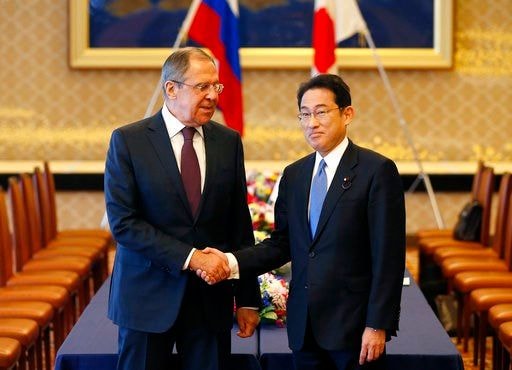 |
| Russian Foreign Minister Sergey Lavrov and Japanese Foreign Minister Fumio Kishida shake hands ahead of their meeting. (Photo: AP) |
Overcoming obstacles
This was the first meeting between the Foreign Ministers and Defense Ministers of Russia and Japan since November 2013 – the time when the 2+2 talks were suspended due to Japan's participation in imposing sanctions on Russia after Russia annexed Crimea. During this meeting, the two sides discussed concrete plans to realize joint economic cooperation in the disputed archipelago, which Russia calls the Southern Kurils and Japan calls the Northern Territories.
To prepare for this meeting, the two sides' Vice Foreign Ministers held a preliminary meeting on March 18 in Tokyo, demonstrating their seriousness and desire to achieve tangible results in promoting this new area of cooperation. Priority areas for cooperation in the disputed islands include fisheries, tourism, and healthcare. Both sides are also considering the possibility of allowing Japanese citizens who previously lived on the Southern Kuril Islands/Northern Territories to visit the area.
The Japanese side stated that they would strive to reach a consensus on issues aimed at the future, based on the principle of not harming each other's positions, with the common goal of signing a peace treaty. Meanwhile, Russia expressed its willingness to cooperate if the cooperative activities did not conflict with Russian law.
Territorial disputes are the most thorny issue in bilateral relations between Russia and Japan, especially when both sides firmly maintain their positions regarding national interests in the disputed territories. Japanese Prime Minister Shinzo Abe himself once stated, "As Prime Minister of Japan, I affirm Japan's correct position, while President Putin is completely confident in Russia's correct position. If we continue like this, negotiations will drag on for many more decades."
While Russian President Vladimir Putin has repeatedly sent the message that Russia "does not trade territory," officials from both Russia and Japan do not expect the 2+2 talks to create a breakthrough in resolving the sovereignty dispute over the Southern Kuril Islands/Northern Territories. The important thing is that economic cooperation, once implemented, can create a foundation and a favorable atmosphere for further negotiations, as Russian Foreign Minister Sergei Lavrov stated: "I believe that this joint cooperation is an important step towards creating a favorable environment for resolving the issue of a peace treaty."
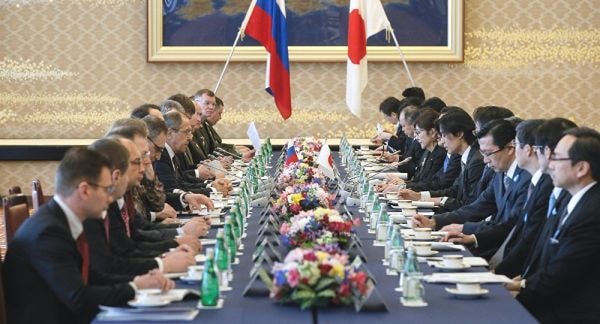 |
| The 2+2 summit between Japan and Russia has resumed after more than three years. (Photo: Sputnik) |
From economics to security
According to analysts, once economic cooperation between the two sides in the disputed archipelago progresses smoothly, cooperation in many other areas will advance rapidly, especially security cooperation in the context of a volatile regional situation. Japan has always been a close ally of the United States in the region; therefore, Japan tends to share the US's views on issues such as China's increased activities in the South China Sea and East China Sea, or North Korea's missile and nuclear programs.
Evidence supporting this assertion is the fact that the defense ministers of the two countries, in their first 2+2 meeting after more than three years, focused their discussion on the Terminal High Altitude Area Defense (THAAD) missile defense system in South Korea. Russia is very concerned that this missile defense system will disrupt the strategic balance in the Asia-Pacific region and threaten Russia's security. However, Japan has repeatedly expressed its intention to participate in this system. Therefore, at this 2+2 meeting, the task of Japanese Defense Minister Tomomi Inada was to reinforce confidence with Russia that, if Japan were to participate in this defense system, it would be to counter security threats originating from North Korea and not to target any third country.
It can be said that strengthening cooperation on regional security issues between Russia and Japan could bring strategic benefits to both countries. In the context of China's rise in the region, including its more assertive actions in territorial disputes with Japan in the East China Sea, strengthening relations with Russia could somewhat alleviate Japan's anxieties about the risk of clandestine dealings between Russia and China. Japan's desire to improve relations with Russia is also part of a strategy to balance its relationships with major powers, rather than relying solely on US policy as before. For Russia, strengthening relations with Japan aligns with its "Eastward" policy – targeting the region considered the most developed in the 21st century.
Furthermore, President Putin has not hidden his determination to establish around Russia “an ambitious new international order.” This international order will not only require deeper and more effective Russian involvement in international hotspots, but also strengthened relations with major, influential regional powers such as Japan and China. More concrete steps towards a warmer Russia-Japan relationship will be discussed in the upcoming meeting between Russian President Vladimir Putin and Japanese Prime Minister Shinzo Abe, scheduled for the end of April.
Thuy Ngoc