
How powerful is the THAAD missile defense system?
The Terminal High Altitude Area Defense (THAAD) missile defense system is a mobile missile defense system designed to intercept tactical and medium-range ballistic missiles both inside and outside the atmosphere to protect populated areas and critical infrastructure targets.
The Terminal High Altitude Area Defense (THAAD) missile defense system is a mobile missile defense system designed to intercept tactical and medium-range ballistic missiles both inside and outside the atmosphere to protect populated areas and critical infrastructure targets.
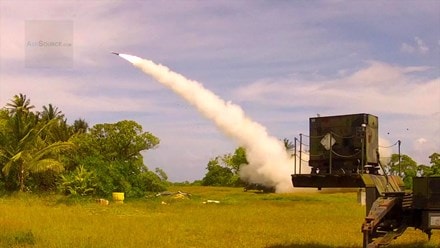
The system is highly mobile and capable of deployment worldwide, and can interact with other missile defense systems.
The THAAD system employs the concept of "hit-to-kill," using only the kinetic energy of the interceptor to destroy the target upon direct impact, rather than explosives.
Thanks to the high kinetic energy of its interceptor stage, the THAAD system will be much more effective in combating outdated ballistic missiles such as the R-17 Scud.
History of development
The US THAAD mobile missile defense system was developed by a group of industrial companies, led by Lockheed Martin Missiles and Space, starting in 1992. In early 1995, prototype launchers were deployed at the White Sands test range in New Mexico.
In January 2006, the US Department of Defense signed a contract with Lockheed Martin for the supply of the first two THAAD systems along with 48 anti-missile missiles.
To date, there have been 39 test launches (including intercepting training targets under conditions close to real combat), 31 of which have been confirmed successful. Since 2005, the interception tests have yielded 100% success.
System components
The THAAD system comprises four main components: interceptor missiles (anti-missile missiles), launch vehicles, a command and communications center, and radar.
Interceptor missile
The THAAD anti-missile system is a single-stage, solid-fuel missile with a launch weight of 900 kg, a length of 6.17 m, and a maximum body diameter of 0.37 m. It consists of a nose cone, a mid-chamber, and a solid-fuel rocket engine with a tail-stabilizing nozzle, developed by Pratt & Whitney.
The missile's nose section features a split-type kinetic energy interceptor stage, designed to destroy ballistic targets through direct impact. The nose section is protected by a two-piece splitter, which deploys during the anti-missile phase of flight.
The interceptor stage includes: a multispectral infrared seeker operating in the mid-infrared (3.3-3.8 micrometers) and far-infrared (7-10 micrometers) regions, an inertial command-and-control system, and a motor system for maneuvering and orientation in space.
THAAD missiles can destroy tactical-operational missiles (range up to 1,000 km) and medium-range ballistic missiles (range up to 3,500 km) at altitudes of 40-150 km and ranges up to 200 km.
Launch vehicle
The launcher is equipped with 8 anti-missile missiles housed in sealed launch tubes, linked together in a module on a 10-ton M1075 tractor chassis, developed from the high-performance off-road truck of Oshkosh Truck Corporation.
The launcher has a total weight of 40 tons, a length of 12 m, and a width of 3.25 m. The reloading time for the launcher is 30 minutes.
THAAD launchers are air-liftable and can be transported by C-141 heavy transport aircraft.
Command post and communication equipment
The command post can be located up to 14 km away from the radar, ensuring signal processing and data transmission between command posts. Each THAAD company is equipped with two command posts, each with two workstations.
Radar
The ground-based AN/TPY-2 radar, supplied by Raytheon Systems, is used for observing, classifying, and identifying targets. THAAD can also receive information from military reconnaissance satellites such as Brilliant Eye.
The radar equipment can be transported by C-130 transport aircraft. The AN/TPY-2 uses a 9.2 m² phased array antenna operating in the I and J bands (X band), capable of tracking missile targets at ranges up to 1,000 km.
According to TPO
| RELATED NEWS |
|---|