
Villagers establish a village agreement for buying and selling "clean" pork.
(Baonghean.vn) - Local pigs are considered a "clean" meat product by the people of Muong Ai commune (Ky Son district). Some villages here even prohibit the sale of pigs without a clear origin to customers.
(Baonghean.vn) - Local pigs are considered a "clean" meat product by the people of Muong Ai commune (Ky Son district). Some villages here even prohibit the sale of pigs without a clear origin to customers.
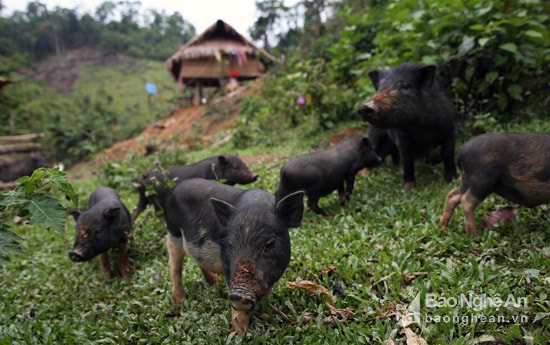 |
| "Clean" pigs from the Mekong Delta are mainly raised free-range in high mountainous areas. Photo: Ho Phuong |
Muong Ai is a difficult border commune in the mountainous district of Ky Son. The commune is primarily inhabited by the Khmu and Thai ethnic groups. Besides their cultural and artistic traditions, the people here have also established their own community agreement regarding the buying and selling of "clean" pork.
According to the beliefs of the people in Muong Ai commune, the origin of a pig is determined by identifying its mother. The way the villagers in Muong Ai prove the origin of the pigs they sell is also very simple and unpretentious.
With their unpretentious nature, they managed to convince buyers. According to food connoisseurs, the local pork from Muong Ai is the most preferred in the mountainous district of Ky Son. This is not only because the pigs are raised traditionally in a free-range environment, fed on natural food, but also because of the unique way the pig owners prove their origin.
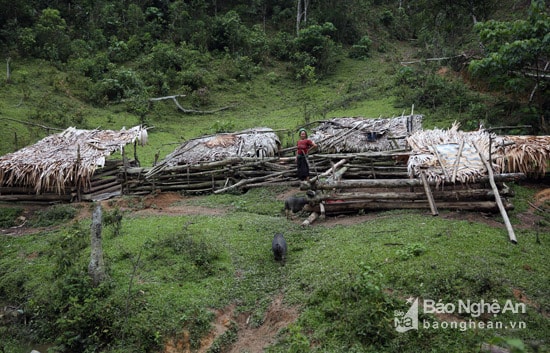 |
| The livestock pens are built on hills and mountains. Photo: Huu Vi |
According to Mr. Luong Pho Keo, head of Pung village (Muong Ai district), villagers have long complained about the habit of keeping sows for many years. They only slaughter them when they are too old and no longer able to reproduce. Many sows in the village weigh up to 200 kg and are nearly 20 years old.
That's why almost all of the native pigs sold have their origins proven by their mother pigs, which everyone in the village knows.
According to Mr. Keo, the head of Pung village, if anyone is found selling pigs of unknown origin without disclosing this to the buyer, they will be reprimanded by the village. After two reprimands, they will be fined 100,000 VND, which will be added to the village's operating fund. However, according to the village head of Pủng, the "agreement" has been in place for over a year now, but there have been no violations. When the village head urged villagers not to sell pigs of unknown origin at a meeting, some people bought piglets from the lowlands to raise, but they no longer dared to sell them. "Basically, they are ashamed in front of the village," Mr. Kèo confided. |
The head of Pủng village, Mr. Phò Kèo, added: "In the commune, most villages raise pigs in a free-range system. The villagers mostly raise local pig breeds. Recently, some pig traders, mainly from Yên Thành district, have brought pig breeds from the lowlands to sell to the people. Initially, some bought them to try raising them. Later, they realized that the pig breeds from the lowlands were not suitable for free-range farming, and gradually, not many people bought them anymore. The main reason, according to the head of Pủng village, is: 'They wander too far away.'"
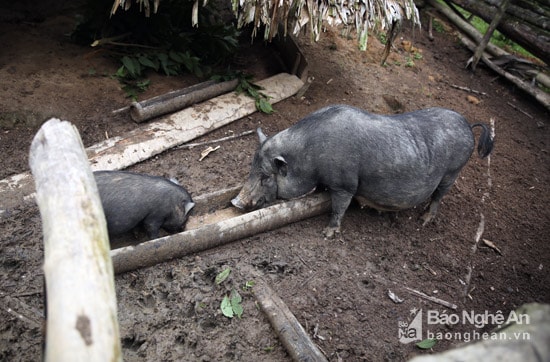 |
| The pigs' main food source is wild vegetables. Photo: Huu Vi |
However, some unscrupulous individuals have bought piglets from the lowlands, raised them free-range, and then sold them to buyers, claiming they are "local pigs." Mr. Keo stated that this is "dishonest" because the local people have never sold anything fraudulent.
Native pigs must have a clear origin, meaning their mother must be identifiable. Pigs bought from the lowlands and raised there, even if their meat is firmer than those raised in confinement and fed with feed, are not native pigs.
Some teachers in Muong Ai commune, Ky Son district, recount a story about maintaining "trustworthiness" in the buying and selling of local pigs among the Khmu and Thai communities. When asked to buy, the seller will point to the sow in their house and say, "This is its origin. That's its mother."
Although not having a "convention" like the Pủng village, some villages surveyed in Mường Ải commune also do not sell pigs of unknown origin. Mr. Moong Phò Vinh, head of Xốp Xăng village, said that the villagers only sell local pigs of lowland origin at a lower price.
However, only a few households raise this type of pig. The people in the Khơ Mú community here still maintain the habit of raising pigs of local origin rather than imported breeds from the lowlands. Because of this commitment to maintaining trust with buyers, the "local pigs" in Mường Ải are always trusted by buyers for their quality.
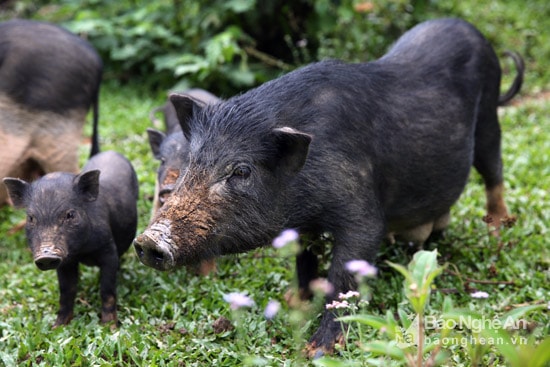 |
| Những con lợn bản thường được nuôi thả rông. Ảnh: Hồ Phương |
Tuy nhiên, theo ông Lữ Văn Lâm, bản Xốp Lau xã Mường Ải thì việc chăn nuôi thả rông tuy giữ được đặc sản lợn bản nhưng cũng gây ra những bất cập.
Ngoài việc nuôi lợn ảnh hưởng đến vệ sinh môi trường thì chính hình thức chăn nuôi này khiến dịch bệnh lây lan nhanh mỗi khi xuất hiện. Đầu năm 2017 nay, nhiều địa bàn ở huyện Kỳ Sơn xảy ra dịch tụ huyết trùng khiến hàng nghìn gia súc trên toàn huyện chết.
Ông Nguyễn Sỹ Sơn - Phó phòng NN&PTNT huyện Kỳ Sơn cho biết, tổng số đàn lợn trên địa bàn hiện có 34.710 con. Phần lớn, trong số này đều là lợn bản. Lợn bản chủ yếu được nuôi nhỏ lẻ trong các hộ gia đình theo tập quán của người vùng cao. Hầu hết các xã ở huyện Kỳ Sơn đều có những hộ nuôi lợn bản theo hình thức thả rông./.
Hữu Vi - Hồ Phương
| RELATED NEWS |
|---|