

The plight of the commune police
(Baonghean) - Commune police play a core role in the movement to combat and prevent crime and ensure security and order at the grassroots level. However, this force still faces many disadvantages and shortcomings in its operations.
"Father Nguyen Dinh Thuc incites parishioners."
The allowances are not commensurate with the amount.
Nguyen Quang Phuc has been a police officer in Hung Khanh commune (Hung Nguyen district) for many years, but his allowance is only 0.8% of his basic salary, which is less than 1 million VND per month. Despite the low salary, as a police officer, Mr. Phuc has to patrol his assigned area every night. Especially during holidays and Tet (Lunar New Year), the frequency and duration of his shifts are even longer.
Despite the demanding nature of his duties, Mr. Phuc is not covered by social insurance or health insurance, nor does he receive any additional allowances. Mr. Phuc stated: "Actually, being a police officer is partly due to the trust of the people and partly due to a shared responsibility to society and the overall security situation of the village and commune. If we're talking about income, it's simply not enough."
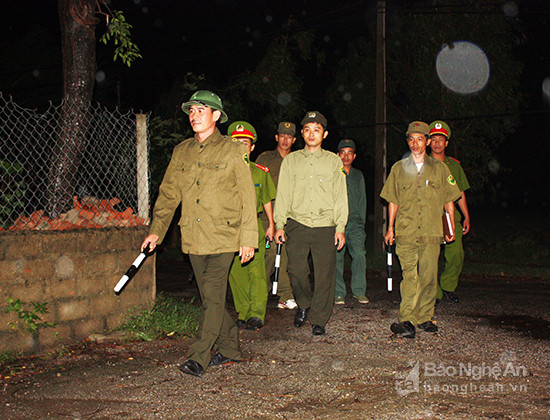 |
| Police officers from Nghi Phu commune (Vinh city) patrol to ensure security and order. Photo: N. H. |
"Lack of resources" is a common sentiment among many commune police officers when asked about their monthly income. According to Government Decree No. 92/ND-CP, further specified by the Provincial People's Council in Resolution No. 117/2013, the monthly allowance coefficient for deputy heads of commune, ward, and town police is 1.1, and for permanent police officers it is 0.9. Also according to Decree 73/ND-CP, the implementation of health insurance and social insurance for commune police officers is covered by the local budget.
However, apart from the head of the commune police, who is a civil servant and entitled to health insurance, social insurance, and seniority allowances after 60 months or more of continuous service, the deputy head of the commune police and police officers are not entitled to these benefits.
According to Lieutenant Colonel Phan Tuan Anh, Head of the Department for Building the Movement of the Entire People to Protect National Security, Provincial Police, there is a significant disparity in income between the commune police force and the militia. While they receive the same salary, positions such as commune military commanders, deputy military commanders, and village militia leaders receive additional allowances for management and command responsibilities, as well as special national defense allowances, which commune police do not. Furthermore, when deployed to perform security and order maintenance duties, the mobile militia receives benefits, while commune police do not.
Due to low remuneration and the complex nature of the work, it is difficult to attract qualified and capable people to the commune police force, especially police officers. From 2009 to the present, many deputy commune police chiefs and permanent police officers have quit their jobs. For example, Mr. Ngo Duc Quynh in Nghi Hung commune, Nghi Loc district. After 5 years as Deputy Head of the Commune Police, Mr. Quynh suddenly resigned and borrowed money to go work abroad.
Mr. Nguyen Thanh Van, Head of the Nghi Hung Commune Police, said: Nghi Hung is a key area for security and order. Currently, the commune police force has one police chief and one deputy police chief because one deputy police chief recently resigned. The job of a deputy police chief is extremely demanding and stressful, but the allowance is very meager. Therefore, Mr. Quynh could not stay and had to leave to find another path to ensure a better life for his family.
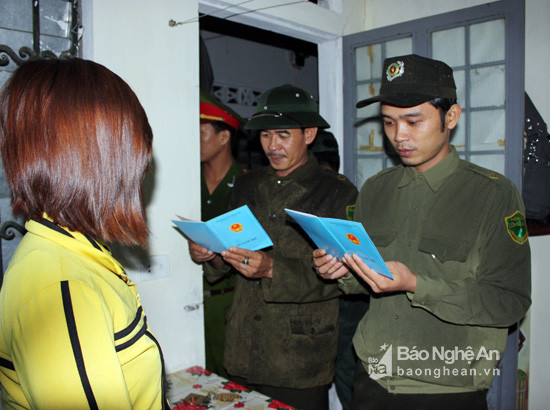 |
| Police in Nghi Phu commune (Vinh City) check temporary residence registrations in the area. Photo: NH |
Shortcomings in troop deployment.
As of October 2016, the province had 448 commune and town police stations across 20 districts, cities, and towns, with a staff of 448 commune police chiefs, 803 deputy commune police chiefs, 1,225 permanent police officers, and 5,571 police officers in charge of villages and hamlets. However, according to the head of the Department for Building the Movement for National Security Protection, the current arrangement and deployment of commune police forces is not in line with the actual situation.
Specifically, according to Government Decree 73, each commune is allocated one deputy head of the commune police. For key communes with complex security and order issues, and communes classified as type 1 and type 2, no more than two deputy heads of the commune police are allowed; at the commune police station or workplace, no more than three police officers are assigned to work on duty. Despite these regulations, in the province, out of more than 355 key communes with complex security and order issues, only 1-2 police officers are currently assigned to work on duty.
According to Decree 73, each village or hamlet is allocated one police officer. For key areas, classified as type 1 or type 2, no more than two police officers may be assigned. However, Decision 14/2014 of the People's Committee of Nghe An province stipulates that each village or hamlet can only have one police officer, who must also serve as the deputy village head. This regulation has caused considerable inconsistencies.
Because, according to regulations, the term of office for a deputy village police officer is no more than 2.5 years. In reality, many police officers, after receiving training, being issued uniforms, and performing effectively, fail to be elected as deputy village police officers and are forced to resign. This greatly affects the selection, training, development, and building of a stable commune police force.
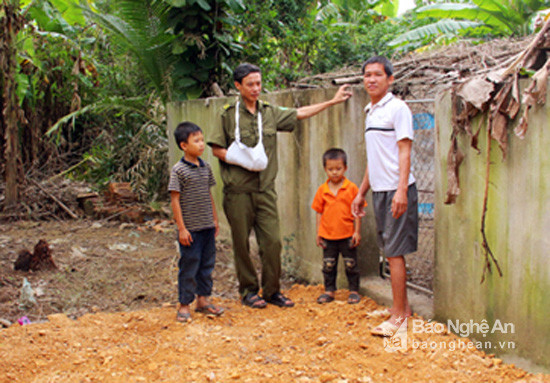 |
| Le Xuan Toan, the police chief of Trung Son commune (Do Luong district), was attacked with a machete while mediating a land dispute between local residents. (Archival photo) |
Lieutenant Colonel Nguyen Minh Dung - Team Leader of the Movement Building and Security Team (Nghi Loc District Police) said that many police officers, after failing to be elected as village deputy heads, do not return their uniforms, affecting overall operations. Newly elected village deputy heads require retraining by the district police, taking a long time to become familiar with the job. By the time they begin to understand the area and manage the target group, they may again fail to be elected in the next term.
Although a semi-professional force, the commune police have truly served as a bridge and an extension of the provincial and district police to the grassroots level. Currently, in many rural areas and key areas with complex security and order issues, the activities of various types of criminals are becoming increasingly sophisticated, thuggish in nature, and even armed with "hot" weapons, ready to resist arrest. Many commune police officers have been injured and shed blood while participating in the fight against crime.
For example, Nguyen Van Diep, a police officer on duty in Dien Bich commune (Dien Chau district), bravely apprehended an HIV-infected suspect who was holding hostages with a knife and scissors, requiring post-exposure prophylaxis treatment; Lo Van Tuan and Ven Van Bien, police officers in Luong Minh commune (Tuong Duong district), despite being seriously wounded by a suspect wielding a sharp knife, still bravely apprehended the suspect for theft. However, the policies and benefits for these individuals remain inadequate.
Despite facing many difficulties, the commune police force has been actively and effectively operating in recent times, making a significant contribution to the fight against crime and ensuring security and order at the grassroots level. To make this force even more professional, the aforementioned difficulties and shortcomings need to be studied and addressed promptly.
| Over the past period, commune-level police forces, in coordination with other agencies, have investigated and clarified 162 cases involving 234 theft suspects, recovering money and assets worth over 1 billion VND; arrested 214 cases involving 393 gambling suspects, imposing administrative fines exceeding 60 million VND; arrested 84 cases involving 104 drug offenders, seizing 3.01 grams of heroin and 1,225 ecstasy pills; compiled dossiers for compulsory drug rehabilitation for 268 individuals; and encouraged the public to surrender 579 homemade guns, 2 AK rifles, 26 detonators, and 597 rounds of ammunition. |
Nguyen Hung