

Nghia Thai (Tan Ky): Improving the quality of sustainable new rural criteria.
(Baonghean) - When embarking on the construction of new rural areas, the biggest concern and worry of Nghia Thai commune (Tan Ky district) is the criteria for transportation and irrigation infrastructure.
"Father Nguyen Dinh Thuc incites parishioners."
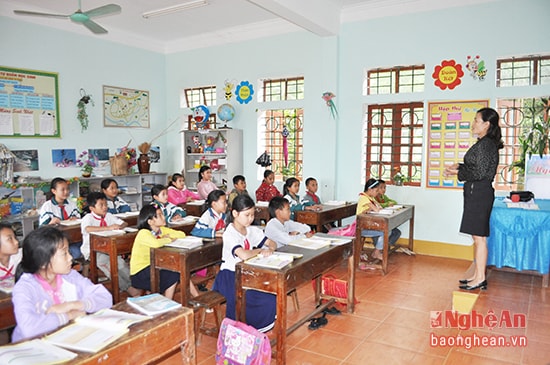 |
| A lesson at Nghia Thai Primary School (Tan Ky district). Photo: Nguyen Hai |
After establishing the Steering Committee and the Management Board of the New Rural Development Program, the commune reviewed the current status of the criteria; continuously held meetings from the Party branches to the residential hamlets to disseminate the policy; continuously broadcast on the radio system exemplary cases of building new rural areas and donating land for road construction among the people; organized many training courses on science and technology in livestock farming, repairing plows, and implementing model rice production fields for farmers.
Based on an accurate assessment of the current situation, the commune unanimously agreed that all resources contributed by the people would be managed and regulated by the commune; with a focus on prioritizing the implementation of criteria that have not yet been met, and gradually consolidating and improving the quality and sustainability of criteria that have already been achieved.
In the field of transportation and irrigation, by integrating programs and projects with the mobilization of resources from the people, the commune mobilized 24.5 billion VND, of which the people contributed money and labor worth 17.8 billion VND to build 11.9 km of commune and inter-commune roads; concrete 9.8 km of main village roads; and lay gravel on all 58.4 km of village and alley roads, achieving 100% of the required rate. Along with investment in transportation, to ensure irrigation water for over 310 hectares of rice and other crops, the commune invested over 3.1 billion VND to upgrade and repair 9 large and small pumping stations.
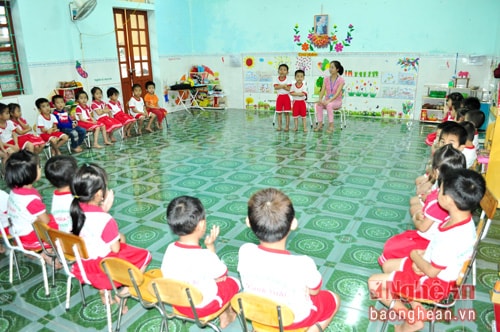 |
| A lesson at Nghia Thai Commune Kindergarten. Photo: Nguyen Hai. |
To improve the quality of education and healthcare for the people, despite the commune's poverty and low income, over 13 billion VND (of which over 4 billion VND was contributed by the people) was allocated to upgrade the basic infrastructure of schools and health stations. Over the course of five years, all three schools achieved national standards; the commune also achieved national standards for healthcare in phase 2 in 2014. To date, the Nghia Thai Commune Health Station not only provides medical services to residents within the commune but also serves people in neighboring communes such as Tan Phu, Nghia Dong (Tan Ky district), and Ha Son (Quy Hop district)...
Another priority for the commune is supporting production models to increase people's income. The commune has launched emulation movements to develop the economy in conjunction with implementing each criterion of the New Rural Development program. After land consolidation and exchange, the commune has put 30 hectares of land in Tan Thanh hamlet into production according to the large-scale model; developed several livestock farming models oriented towards high-value commercial production, ensuring food safety and hygiene; and converted dozens of hectares of low-yield crop land in Bai Da hamlet to sugarcane cultivation.
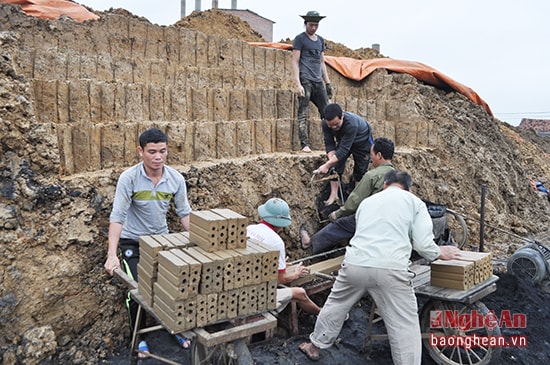 |
| Brick production in Nghia Thai commune (Tan Ky district). Photo: Nguyen Hai |
The commune also organizes many training courses and vocational training programs to create more jobs for the people; accesses policies so that farmers can benefit from interest rate support mechanisms when purchasing plows and implementing large-scale model fields; households with sufficient resources borrow capital from banks or the commune's People's Credit Fund to develop their economy.
Thanks to these proactive solutions, several new crop and livestock models have begun to emerge in the commune, along with additional supplementary occupations, contributing to job creation for hundreds of unemployed workers. In five years, the average per capita income in the commune nearly doubled, from 11.5 million VND in 2011 to 22.2 million VND in 2016; 93.3% of the workforce has stable employment; dozens of households now have multi-story houses and no longer live in temporary housing; and the poverty rate has decreased from 16.4% to 5.08%.
Comrade Phan Kim Son, Secretary of the Party Committee of Nghia Thai commune, shared: “To improve the lives of people in Nghia Thai, the most practical thing in building new rural areas is to develop transportation infrastructure and schools. As a commune that suffered from a dilapidated transportation system, people were uneasy seeing the school facilities in disrepair. Therefore, when we mobilized the people, they understood the goal and readily agreed, contributing their labor to building schools and roads. Today, the people are directly benefiting from these improvements, so everyone is excited and proud.”
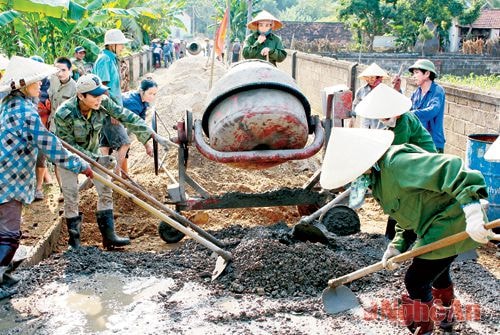 |
| Road construction in Nghia Thai commune. (Photo: Archival image) |
With unity and cooperation in building their new homeland, the people of Nghia Thai commune not only contributed tens of billions of VND to rebuild the commune's essential infrastructure but also mobilized and invested hundreds of billions of VND to rebuild houses and expand production and business.
Starting from a commune with only 6-7 criteria for New Rural Development, after more than 5 years, Nghia Thai has completed its goal of reaching the target with all 19/19 criteria met. While excited about the journey towards achieving New Rural Development goals, the commune's Party Secretary, Phan Kim Son, shared his concerns: the commune still faces some difficulties, including low achievement rates for some criteria, poverty reduction challenges, difficulties in product distribution for some models and industries, and a lack of conditions for technological transformation in production.
Despite facing many challenges ahead, Nghia Thai remains determined to improve and maintain the criteria for New Rural Development, and has a roadmap to strive for practical and sustainable improvements in the quality of these criteria.
Nguyen Hai