

Levels of autonomous driving
Vehicles capable of assisting drivers, or even fully autonomous driving, are no longer a pipe dream but are gradually becoming a reality in the near future.
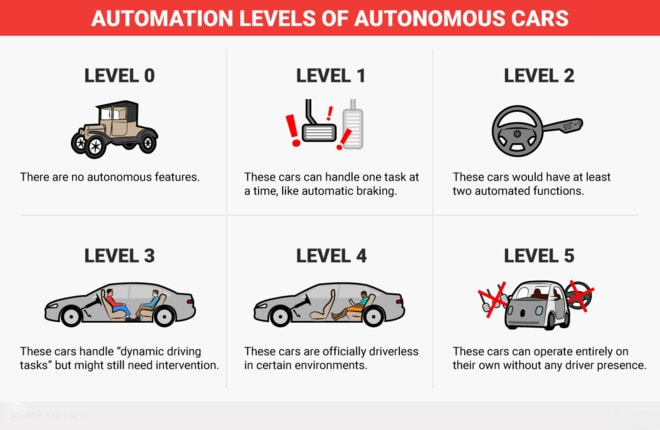 |
| According to the definition provided by the Society of Automotive Engineers (SAE) in 2014, self-driving cars are divided into five levels. |
In 3-4 years, we will have self-driving cars on the market. Future self-driving cars will not require human presence at all; they will drive, brake automatically if there are obstacles, and steer automatically. According to the definition given by the Society of Automotive Engineers (SAE) in 2014, self-driving cars are divided into five levels.
Level 0
Level 0 vehicles rely entirely on the driver behind the wheel to control the car's features. There are no self-driving features. Most cars on the market today can be classified at this level, including those with features like collision warning or blind spot monitoring.
Level 1
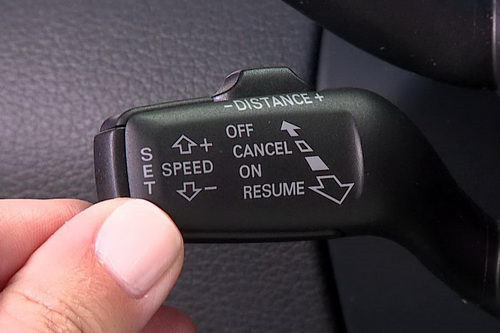 |
| Cars with automatic emergency braking features are in Level 1. |
There are several driver-assistance features, such as the ability to control the vehicle's speed or steering, but not both simultaneously. Examples of Level 1 features include cruise control – which automatically maintains the throttle position based on driver settings. Subaru also offers active lane keeping on some of its mainstream vehicles. Cars with automatic emergency braking also fall under this Level 1 category.
Level 2
While offering more driver assistance, self-driving cars at this level cannot control the vehicle in all situations, including merging lanes on highways. Several high-end car manufacturers now offer features that allow simultaneous steering and speed control without driver interaction for a certain period (under 1 minute). Volvo, Mercedes-Benz, and BMW all offer Level 2 features, but all require the driver to monitor surrounding environmental conditions while the vehicle is in motion. Tesla's Autopilot can also be considered a Level 2 autonomous driving feature, adjusting steering torque based on the driver's concentration.
Level 3
Conditional autonomous driving. Unlike Level 2, Level 3 autonomous vehicles can operate independently in all situations, and will also monitor road conditions, but will switch back to human control when they are no longer able to handle the situation.
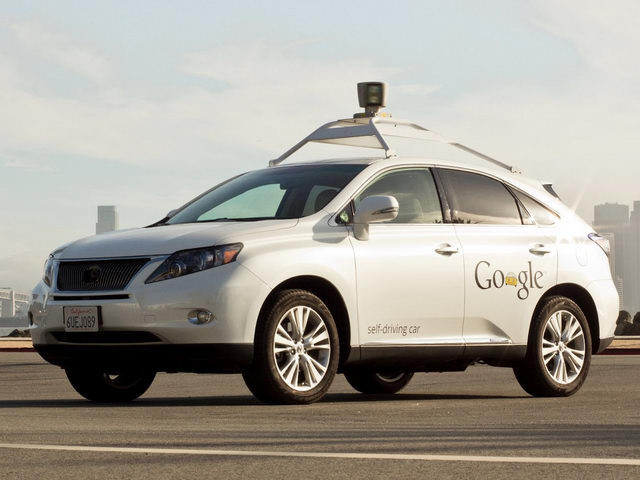 |
| Level 3 autonomous vehicles can operate independently in all situations and monitor road conditions on their own. |
According to the SAE definition, Level 3 vehicles require human intervention when the self-driving system malfunctions, but some car manufacturers believe this could compromise driver safety, and some, such as Ford and Volvo, have announced they will skip this stage.
Level 4
It's almost like self-driving. At level 4, the car no longer requires driver interaction, and the system will automatically stop if it detects an error. Several automakers, such as Tesla and Mercedes-Benz, have integrated features that automatically reduce the car's speed or issue warning lights if they detect driver distraction. Recently, Ford and Volvo both announced they will release level 4 self-driving cars before 2021.
Level 5
Fully autonomous driving. This is the final level, and if a vehicle reaches this level, it can drive itself in all conditions, without a driver present. Levels 4 and 5 represent a significant leap forward and require many technological advancements. Level 5 requires no human intervention; it will handle situations automatically.
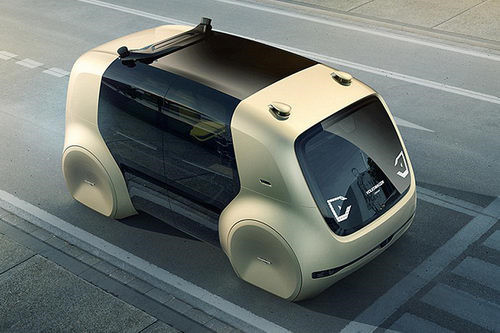 |
| Level 5 is the final level; it can drive autonomously in all conditions, without the presence of a driver. |
Basic vehicle components like the accelerator, steering wheel, and brake pedal will be unnecessary on this final-level self-driving car, as there will no longer be a human driver. No automaker has yet provided a specific timeline for this final stage, only a general estimate of about a decade.
A recent study by Navigant indicates that self-driving cars will initially be for ride-sharing services (like Uber and Lyft today) rather than for individual users, and they will be operated by car manufacturers for better safety management. But we are gradually getting closer to fully autonomous vehicle technology.
According to Zing
| RELATED NEWS |
|---|