

Farmers raising free-range chickens earn over 200 million VND per year.
(Baonghean.vn) - While the price of live pigs is falling, causing hardship for many livestock farmers, those who have chosen the model of raising free-range chickens in Nam Dan district are still earning high incomes, with traders coming directly to their homes to buy the chickens.
Ms. Ngo Thi Sam, from Hamlet 4, Nam Thai Commune, Nam Dan District, happily shared: "I just sold 300 kg of chicken at 110,000 VND/kg, which is nearly five times higher than the current price of live pigs." In 2010, Ms. Sam began raising free-range chickens after visiting and learning from other farms. Starting with a few hundred chickens as a trial to gain experience, her family now raises 2-3 batches annually, with 1,500-2,000 chickens, selling them at 100-110,000 VND/kg, earning a net profit of 200 million VND from free-range chicken farming.
Ms. Sam added: “Taking advantage of the spacious hillside garden, I chose to raise free-range chickens. Because the chickens are raised in a free-range style on the hillside, the meat is firm and delicious, so traders often come to my house to buy them or supply restaurants in the area. While pork prices have dropped, chicken prices have remained the same or even increased, thanks to the holiday season.”
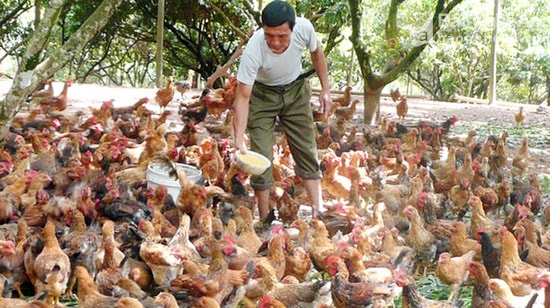 |
| Taking advantage of the hillside garden area, many households have invested in raising livestock on a large scale. Photo: Hong Suong |
Currently, in Nam Dan district, there are over 300 households applying the model of raising free-range chickens on a large scale, with each breeding cycle ranging from 150,000 to 200,000 chickens. The highest concentration is in the mountainous and semi-mountainous communes such as Nam Hung, Nam Thai, Nam Nghia, Nam Thanh, and Nam Anh.
Typically, chickens are raised for about 3.5 to 4 months before they can be sold on the market. With careful care, chickens can reach a weight of over 2kg/each, and with a selling price of around 100,000 VND/kg, farmers can make a profit. During peak seasons like holidays, the price can increase to 120,000 - 130,000 VND/kg.
However, because they are raised free-range, hill chickens are susceptible to diseases, especially those originating from the external environment or brought in by migratory birds. Therefore, ensuring hygiene and preventing disease outbreaks must be a top priority.
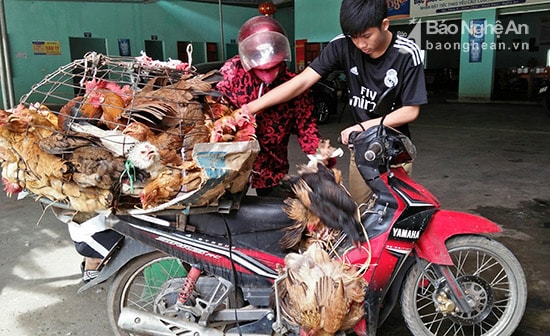 |
| Locals sell the chickens to famous free-range chicken restaurants in Nam Dan district. Photo: Hong Suong |
Ms. Nguyen Thi Thiep, a specialist at the Department of Agriculture and Rural Development of Nam Dan district, said::“Raising free-range chickens in Nam Dan has provided people with a relatively large income, helping many households escape poverty by utilizing the large grazing areas. However, because of the free-range method, farmers need to adhere to the chicken vaccination schedule, similar to other free-range farming methods. During unfavorable weather, farmers need to confine the chickens because diseases can easily spread. Regarding the chicken coops and farming equipment, farmers need to clean and disinfect them regularly. For sick chickens, isolation for disposal or treatment should be carried out immediately.”
According to experienced free-range chicken farmers, to ensure the flock grows quickly and the meat is firm and flavorful, in addition to the main feed of rice and commercial feed, farmers should mix in disease prevention medication to protect the flock. In addition, young grass should be provided to supplement the chickens' nutrition. Drinking water must be clean, free from disease sources, and changed regularly. After selling the chickens, the coop must be thoroughly cleaned, all diseases eradicated, and green vegetables and banana trees planted in the yard to provide food for the chickens before starting another batch. |
It can be affirmed that raising free-range chickens in Nam Dan is a highly economically efficient livestock farming method. However, to effectively promote and exploit this potential, the involvement of all levels and sectors is needed in defining sustainable development goals, disseminating information, and connecting with markets so that people can confidently engage in livestock production.
Hong Suong
(Nam Dan Radio Station)