
Part 1: The Sea Voyage
(Baonghean.vn) - More than 10 days after China unilaterally implemented a fishing ban in the South China Sea, I decided to join the fishermen on a trip out to sea in the Gulf of Tonkin.
Through an introduction from Mr. Ho Xuan Huong - Vice Chairman of the People's Committee of Quynh Phuong ward (Hoang Mai town), at exactly 5:00 AM, I arrived at Lach Corn fishing port - one of the largest fishing ports in Nghe An province...
I was sent aboard the boat of Mr. Nguyen Van Dien (43 years old, Quynh Phuong ward), one of the experienced fishermen in Hoang Mai town. Mr. Dien's boat uses a three-layered net, specializing in fishing in the northern part of the Gulf of Tonkin with 10 crew members.
“It’s our sea, so we fish. How can they stop us?” fisherman Nguyen Van Dien began his conversation with me. “But are you seasick, reporter? If you are, you’re not allowed to go anywhere; nobody will bring you back halfway,” he continued. To get on board, I immediately said no, even though this was my first sea voyage.
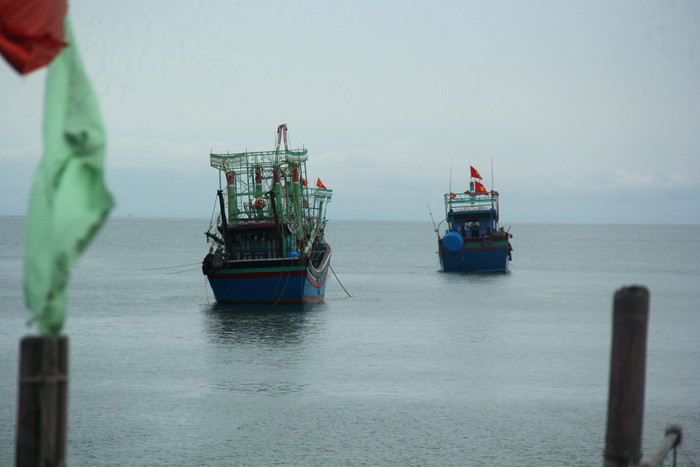 |
| The ships lined up to leave Lach Corn port and head out to sea. Photo: Tien Hung |
As dawn broke, some crew members were already on board, preparing for a voyage expected to last nearly half a month. Other boats had set sail a few days earlier, fearing they would miss the tide. Preparations were underway with urgency. “This profession depends on the tides; if we go out late and encounter weak tides, we catch fewer fish. If we go out earlier, we can choose better fishing spots,” said Dien, while busily checking the machinery. The other crew members were also busy with their own tasks. Some were transporting provisions onto the boat, others were loading over 400 blocks of ice into the hold…
In the early afternoon, Mr. Dien started the engine and steered the ship towards the open sea. On the dock, the women watched intently. The ship sped at 6 knots, and as it left the harbor, the undulating mountain ranges near Lach Corn fishing port were gradually obscured by the waves. We were heading towards the northern part of the Gulf of Tonkin. The 150-nautical-mile journey would take nearly 30 hours. At this time, the crew members took advantage of the break to rest and conserve energy for the arduous days ahead. Meanwhile, Captain Nguyen Van Dien steered the ship while simultaneously using the radio to contact the other ships in the fleet that had already set sail.
At sea, walkie-talkies are the only means of communication between ships and boats, primarily for exchanging information about fishing grounds and providing assistance when needed. Amidst the chatter of the captains emanating from the walkie-talkies, Mr. Dien recounted that he dropped out of school before finishing first grade to follow his father to sea. He "put down his pen" before he even learned to read and write. "On the ship, I'm the boss, but also the least educated person; I can't read or write. But I can still sing karaoke," Mr. Dien said cheerfully. The crew members burst into laughter, explaining that he loved to sing and had memorized the lyrics so many times...
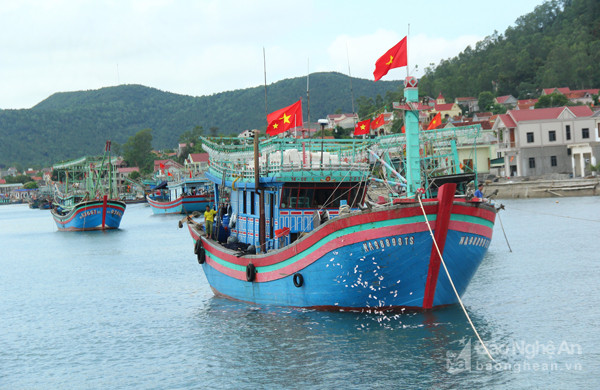 |
| Fishing boats from Nghe An province head out to sea. Photo: Tien Hung |
However, Mr. Dien is a highly experienced fishing boat captain. In this sea region, he knows every wave and wind, as well as every nook and cranny of his fishing village, Quynh Phuong. Previously, in his early days at sea, he worked as a hired hand on local fishermen's boats. In 1998, he borrowed over 300 million dong to build his first boat. He became a boat owner and captain before he was even 25 years old. Since then, Mr. Dien has changed boats four times, each one larger than the last.
Like most fishing boats in Quynh Phuong, Mr. Dien's boat uses a three-layered net – a type of net used to catch bottom-dwelling seafood. This season, the boats mainly catch axefish, also known as pipefish. This species is often exported. But other secondary seafood, although not caught in large quantities, fetch high prices, providing fishermen with a significant income each trip, such as horseshoe crabs, red crabs, and groupers...
Our conversation was interrupted by the captains' radio exchanges, reporting that several ships had caught a large number of axehead fish in the shallow waters. Captain Dien looked thoughtful: "We'll try fishing here, and if there are no fish, we'll head out to sea later. Anyway, it's on our route." At 10 PM, our ship reached the area where other ships had reported a school of fish. We were 50 nautical miles from the mainland. It was still too early to start casting our nets, so Captain Dien decided to anchor the ship, and the crew continued to sleep.
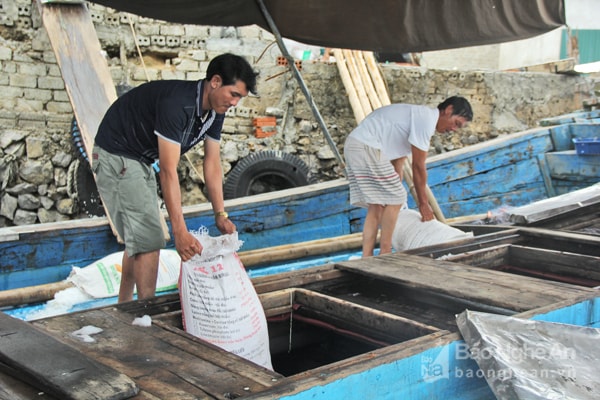 |
| Fishermen load ice into the boat's hold in preparation for their fishing trip. Photo: Tien Hung |
At 5 a.m., Mr. Dien woke the crew. Without breakfast, the 10 crew members hurriedly began their tasks. Some busily weighed anchor and pulled it onto the ship, while others dismantled planks to retrieve nets from the two storage compartments. Mr. Dien's nets, stretching 10 nautical miles, were made up of nearly 500 smaller pieces, divided by the crew into five parallel lines. Each line was spaced a few hundred meters apart. The ends of the lines were marked with buoy flags to indicate the fishing area, warning other ships not to enter and helping the crew identify the area when pulling in the nets.
After more than three hours, the entire net was deployed. Mr. Dien steered the boat into the middle of the fishing area to anchor, making it easier to observe the net lines. The first task was completed, and only then did the crew members take a break to brush their teeth and wash their faces. Meanwhile, cook Lin Da busied himself preparing breakfast, which also served as lunch. After eating, the crew would have nearly two hours of rest before starting the work of pulling in the nets until late at night. On "unlucky" days, they might even have to continue untangling the nets until the next morning. During that time, they didn't eat or drink anything.
The first meal of the sea voyage was lively. The fishermen's faces were full of excitement, thinking about the "bountiful" catches of seafood that would be pulled up in just a short while...
(To be continued)
| RELATED NEWS |
|---|
Tien Hung