

The life and contributions of the great thinker Karl Marx
(Baonghean.vn) - Karl Marx was one of the world's greatest thinkers. His life and career were full of ups and downs and hardships. His ideas contributed to changing the thinking of a segment of oppressed nations, thereby helping them rise up to regain independence and escape misery.
Marx was born on May 5, 1818, into a middle-class family in the Rhineland city of Trier, Germany. At the age of 17, Marx received a classical education and studied for a year at the law faculty of the University of Bonn. At 18, he became engaged to Jenny von Westphalen (1814-1881). He began to be influenced by the philosophy of GWF Hegel, which later dominated the German Idealist movement.
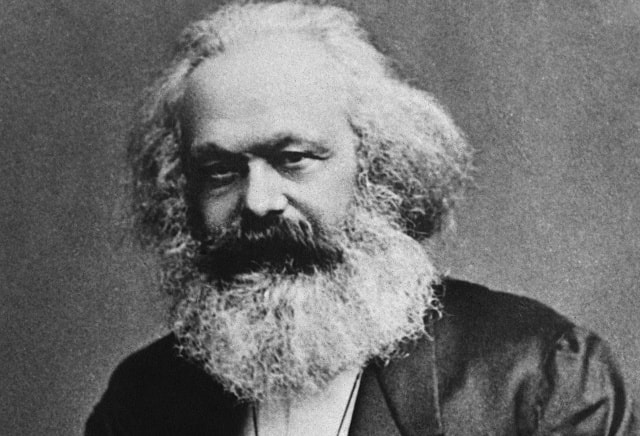 |
| Marx - a great thinker. |
After completing his doctoral dissertation, he turned to journalism and began collaborating with the Rheinische Zeitung. He quickly became editor-in-chief, but the newspaper was subsequently shut down by authorities in May 1843, and Karl Marx returned to Paris.
While in Paris, he developed a lasting association with F. Engels and formulated the philosophical ideas on communism that are now known as the Paris Manuscripts. After being expelled from France, he moved to Brussels and recorded the philosophical ideas that developed in the Theses on Feuerbach.
In 1846, Karl Marx co-authored *The German Ideology* with Engels, a document that laid the foundation for the *Communist Manifesto*. Returning to France, he began working on a series of pamphlets on the class struggle in France, and it was during this time, in 1848, that he and Engels published the *Communist Manifesto*.
After moving to London in 1849, Karl Marx devoted many years to his major work, *Capital*—a crucial work on political economy written in German. The book is an analysis of capitalism, the capitalist mode of production, and capitalist relations of production.
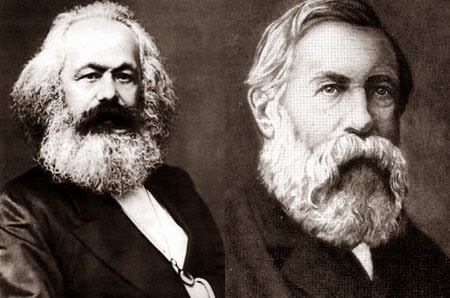 |
| Marx and Engels. |
With the slogan "Workers of the world unite" serving as a rallying cry for the Bolshevik revolutionary movement in Russia and the 1949 Chinese revolution; and Karl Marx's adage "From each according to his ability, to each according to his needs" becoming a source of inspiration for communist parties around the world.
Prior to World War I, the works of Karl Marx elicited some positive responses outside of Eastern Europe. Lenin's enthusiastic support was a key factor influencing the revolutions in Russia, and part of the Soviet mainstream ideology was shaped by postwar influences. In 1920, the Frankfurt Organization, an organization of intellectuals that met to discuss and disseminate Marxism, was later joined by the American philosopher Herbert Marcuse.
Marxism became a major force among Western European and English-speaking intellectuals in the 1930s, its intellectual influence peaked in the 1970s, but was subsequently rejected. The remaining intellectual legacy of Marx is limited to philosophical principles.
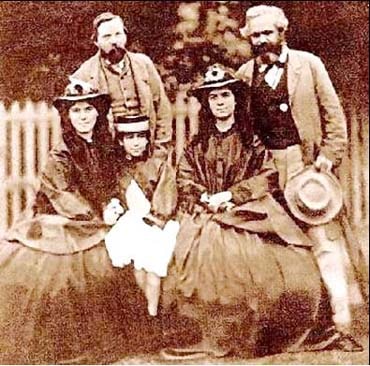 |
| The Marx family pictured with Engels. |
Marx left behind a vast legacy. Marxism became the official ideology of nations at the time, representing their pinnacle, what was seen as the third race for survival. His theories also influenced the emergence of democratic and socialist movements that had previously rejected or even forbidden Marxism from being considered part of their ideology.
Some of his works, especially the Communist Manifesto, are familiar to millions of political activists worldwide and were a key factor in the adoption of forms of Communism by the Soviet Union, and subsequently by the governments of Cuba, Venezuela, Bolivia, Nicaragua, and other countries.
Throughout the later years of his life until his death in 1883, Karl Marx was an active supporter of the Communist League, which later became the Communist International.
Peace
(Synthetic)
| RELATED NEWS |
|---|