

Over half a century, the US has detonated more than a thousand nuclear bombs.
The 1,032 nuclear bomb tests conducted by the United States over 47 years exposed most of the population to radiation, with many paying the ultimate price.
Images from two nuclear bomb tests declassified by the US.
The quality of nuclear weapons is a very difficult factor to determine. Their power is measured by the visible explosion pressure and heat released, but it can also include things invisible to the naked eye such as electromagnetic pulses and destructive radiation.
Between 1945 and 1992, the United States conducted 1,032 nuclear tests in an attempt to assess this weapon of mass destruction. Many of these tests were deemed unnecessary, too dangerous, and bizarre, but they still provided the U.S. with valuable information about nuclear weapons, at the cost of numerous craters on the ground and long-term health problems for the population, according to National Interest.
According to military expert Kyle Mizokami, the majority of U.S. nuclear tests took place in the middle of the western desert at the Nevada test site, with 699 tests of nuclear devices both above ground and underground. The average explosive yield of the tests was 8.6 kilotons, equivalent to 8,600 tons of TNT detonated simultaneously. Atmospheric tests could be observed from Las Vegas, 8 km southeast of the test site.
The remaining tests took place on the Bikini Atoll, Enewetak, Johnson, and Christmas Islands in the Pacific Ocean. These nuclear tests forced the relocation of indigenous residents, while those living near the test sites were exposed to dangerous levels of radiation, necessitating evacuation.
The first American thermonuclear bomb test took place in October 1952 on Enewetak Island. Codenamed Ivy Mike, the 82-ton nuclear device looked more like a building than a real bomb. It had a yield of 10.4 megatons, equivalent to 10.4 million tons of TNT, nearly 700 times more powerful than the atomic bomb dropped on Hiroshima. Ivy Mike was the largest test up to that point, creating a fireball nearly 2.9 km wide and a mushroom cloud over 41 km high.
In 1954, sailors on the Japanese fishing vessel Daigo Fukuryu Maru inadvertently passed through a cloud of radioactive dust emitted from a test codenamed Castle Bravo, which had a destructive power of 15 megatons, equivalent to 15 million tons of TNT. One person died, and the rest vomited due to radiation poisoning.
One of the strangest nuclear tests took place in 1962 at the Nevada Test Site. The U.S. military was testing a field artillery piece firing a nuclear warhead called the Davy Crockett, with a power equivalent to 10-20 tons of TNT. The test, codenamed Little Feller, took place on July 17, 1962, in the presence of the Attorney General and presidential advisor Robert F. Kennedy.
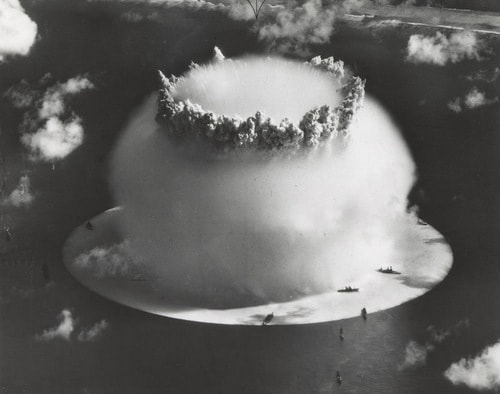 |
A US nuclear bomb test at sea. Photo: National Interest. |
Also in 1962, the US tested a series of airborne nuclear weapons, including the Thor rocket carrying a W49 thermonuclear warhead at an altitude of nearly 402 km, outside the atmosphere.
The Starfish Prime test that year generated the equivalent of 1.4 million tons of TNT and a massive electromagnetic pulse that spread across the eastern Pacific Ocean.The electromagnetic wave traveled over 1,287 km, causing 300 streetlights and a telephone exchange to go out, as well as activating burglar alarms and causing garage doors to open by themselves.
Nuclear tests were not limited to the Pacific and Nevada. In October 1964, during Operation Whetstone, the U.S. government detonated a 5.3-kiloton nuclear device just 45 kilometers southwest of Hattieburg, Mississippi. The purpose of the explosion was to determine whether nuclear test results could be measured by seismometers.
In 1967, the US detonated it.The warhead has a destructive power of 29 kilotons at a depth of more than 1.2 km.Near Farmington, New Mexico, as part of the Gasbuggy project aimed at exploiting underground natural gas using nuclear bombs, the U.S. government wanted to study whether the explosion would cause cracks in the surrounding rock and expose gas deposits.
This test failed, but the US conducted two more tests near Colorado, codenamed Rulison and Rio Blanco. The Rulison test was successful in uncovering a large gas deposit, but it was so heavily contaminated with radiation that it was unsuitable for commercial use.
The US also conducted several nuclear bomb tests in Alaska, specifically on the Aleutian Islands off Amchitka. The first explosion...has a destructive power of 80 kilotonsThe first test took place in October 1965 to test the technology for detecting nuclear weapons. A second test occurred four years later, with a yield of 1 megaton, while the third, considered the largest, used a Spartan anti-ballistic missile warhead with a yield of 5 megatons.
In the 1952 Big Shot test, 1,700 American soldiers took shelter in trenches just 6.4 km from the epicenter of a nuclear explosion twice the power of the bomb dropped on Hiroshima. Following the test, the soldiers conducted a simulated attack, approaching within 160 meters of an open area. The results showed an increase in the number of test participants suffering from leukemia, prostate cancer, and nasal cancer.
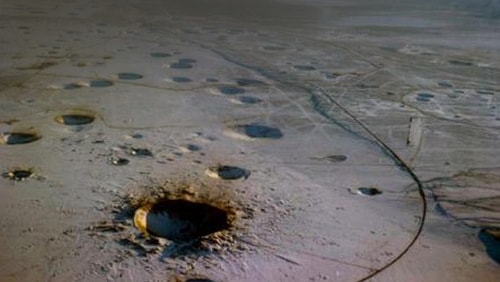 |
Unused bomb craters in the Nevada desert. Photo: CTBTO. |
The United States ended nuclear testing in 1992. By 2002, the Centers for Disease Control estimated that most Americans who had lived since 1951 had been exposed to radioactive fallout, and the cumulative effect from all nuclear tests conducted by various countries could have resulted in the deaths of 11,000 people in the United States alone.
In fact, the US has learned many ways to manufacture reliable and safe nuclear weapons, as well as understand their impact on human life and the environment. However, to gain this experience, they have paid a terrible price, expert Mizokami noted.
According to VNE
| RELATED NEWS |
|---|