

Touching encounters between President Ho Chi Minh and his relatives.
(Baonghean.vn) - The story of the meeting between President Ho Chi Minh and his older sister, Nguyen Thi Thanh, and his older brother, Nguyen Sinh Khiem, took place at a time when the revolutionary government had just been established but was facing an extremely difficult situation with internal and external enemies. This allows readers to once again feel the profound affection and noble sacrifices of President Ho Chi Minh for his country, homeland, and family.
From a touching encounter with Mrs. Nguyen Thi Thanh...
The story goes that, after the August Revolution of 1945, Mrs. Nguyen Thi Thanh, President Ho Chi Minh's older sister, after a period of revolutionary activity in various places, moved to Kim Lien commune, Nam Dan district, Nghe An province. At this time, she was over 60 years old. There, she received attentive care from the Party and the government. Upon learning that President Ho Chi Minh was actually Nguyen Ai Quoc (her younger brother), she went to Hanoi in late 1946 to visit him.
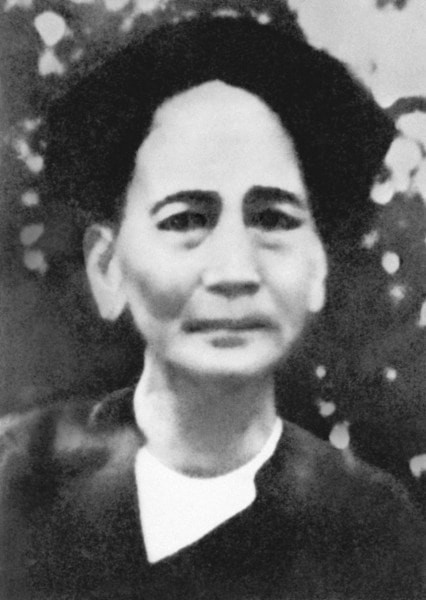 |
| Ms. Nguyen Thi Thanh - the older sister of President Ho Chi Minh. |
Comrade Ho Quang Chinh, who witnessed that touching encounter and later authored the memoir "Uncle Ho Meets His Sister and Brother," recounted in the book as follows: That day, at 11:30 AM on October 27, 1946, upon seeing Uncle Ho, Mrs. Thanh called out and ran to embrace him: "Uncle, uncle, uncle, how are you?" Uncle Ho wept, his tears soaking into her sleeve. He blinked, wiped his eyes with a handkerchief, and said: "How are you, sister? I know you've been waiting a long time, but I'm busy receiving comrades from the South and haven't been able to finish my work yet."
After that touching moment, Uncle Ho and Mrs. Thanh walked back to the table. Uncle Ho pulled up a chair and invited Mrs. Thanh to sit down. Mrs. Thanh asked him, "You've been away for so long, do you miss your homeland? Do you remember me rocking you to sleep in the hammock, singing lullabies about our country? Back then, our family had a hard time."
At this point, she started crying again, making Uncle Ho's face fill with emotion. He dabbed at his eyes with a handkerchief, and while smoking, looked out the window and said, "Sister, the homeland holds such deep meaning and gratitude. Over those decades, there was so much affection, and the true revolutionary fighters were all dutiful children. Sister, sometimes in foreign lands, in the quiet of the night, hearing a lullaby sung by one of our people, my heart aches even more with longing for my country, my homeland, and my relatives."
Then, Uncle Ho asked about the villages of Kim Lien and Hoang Tru (his paternal and maternal hometowns), the paternal grandfather of Nguyen Sinh Tho (whom Uncle Ho called "grandfather"), and some elders in his hometown. Mrs. Thanh and Mr. Tho answered in turn. After Uncle Ho spoke with Mrs. Thanh and Mr. Tho, he turned to me, placed his hand on my shoulder, and asked, "And what village are you from?" I replied, "Sir, I am from Tho Toan village at the end of the district."
At this point, fearing that Uncle Ho might not know my village, I continued: "Sir, my village is near Pho Dong, Pho Tu, and Nam Kim villages, close to the Lam River and the Yen Xuan iron bridge." Uncle Ho said: "Ah, ah, I remember now. That area has a rather large sandbar in the middle of the Lam River. I once took a ferry across there to deliver letters to the elders who were fighting against the French imperialists." Then Uncle Ho asked my parents, and when I first met and became acquainted with Uncle Ho Tung Mau. I answered Uncle Ho in turn. He said: "Although I've been away from my hometown for a long time, I still remember the hibiscus bushes, the rows of green tea plants, the soy sauce, the dried fish, and the folk songs of Nghe An and Ha Tinh." He asked if we often went to folk singing performances, and he smiled.
Mrs. Thanh suddenly remembered and said, "I'll give you a bottle of soy sauce."
Mrs. Thanh affectionately asked Uncle Ho: "When will you be able to visit your hometown?" Uncle Ho looked out the window, and after a moment, he replied: "I also want to visit my hometown, but it will certainly be a long time, because I still have very heavy responsibilities for the country." The two sisters' eyes welled up with tears.
After that, Ms. Thanh returned to live in her hometown of Kim Lien. Her life was an example of patriotism, love for the people, intelligence, studiousness, and selflessness. She dedicated herself to the cause of the revolution and deserved to be considered the respected elder sister of the beloved President Ho Chi Minh.
...To meet his elder brother Nguyen Sinh Khiem
According to Mr. Ho Quang Chinh's account, a few days after Mrs. Nguyen Thi Thanh's visit, Uncle Ho's elder brother, Mr. Nguyen Sinh Khiem, also came to visit him. That day, around 11:30 a.m., the door to Uncle Ho's office slowly opened. Uncle Ho, with his bright and gentle eyes, still wearing his faded yellow khaki uniform, walked straight towards my grandfather and me.
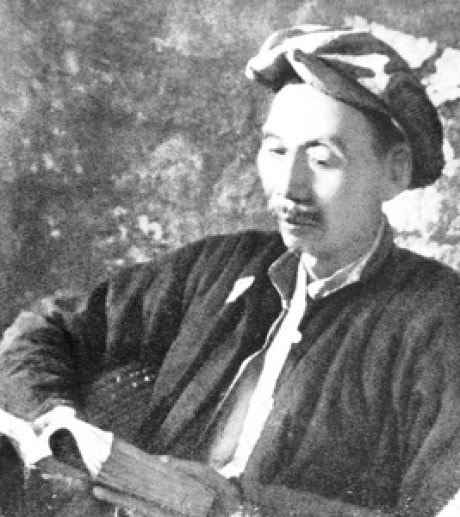 |
| Mr. Nguyen Sinh Khiem - the older brother of President Ho Chi Minh. |
Just like when Mrs. Thanh met Uncle Ho, Mr. Khiem ran up and hugged Uncle Ho tightly: "Uncle, Uncle Cung (Uncle Ho's childhood name), how are you? We've been apart for so long!" Uncle Ho's beard trembled as it brushed against Mr. Khiem's cheek. Uncle Ho's face showed emotion but joy. He said: "You've just arrived, how are you? How are you? How are you, Mr. Khiem? When she came here, these two children came with me, but I was too busy to entertain them much. I invited her and the two children to stay until the afternoon, but she left."
Mr. Khiem replied, "When Ms. Thanh returned, she mentioned that you've become very thin, that you're busy with work all day, and that everyone comes to visit and is very happy about it." President Ho Chi Minh invited Mr. Khiem to sit down and gestured for us to sit. President Ho Chi Minh's cheerful smile made the atmosphere in the room even more joyful, warm, and intimate. President Ho Chi Minh offered Mr. Khiem a cigarette, but he waved his hand, declining: "I'm used to smoking Cam Le cigarettes; those are lighter, you should use them." President Ho Chi Minh smiled and recited a poem: "In a flash, several decades have passed / The mountains, the rivers, and the people remain today."
Hearing this, Mr. Khiem, who was rolling a Cam Le cigarette, also recited: "Fulfilling a long-held wish / The land is covered with flying flags to welcome Him."
After reciting the two verses, Mr. Khiem said, "Today, my grandson and I have come to visit you. I've brought you some Xa Doai oranges as a gift." President Ho Chi Minh was moved, blinked, remained silent, and then asked Mr. Khiem about the situation in Nghe An, Ha Tinh, Thua Thien - Hue, Nam Dan district, about the activities of the local government and organizations, and about some of his relatives and childhood friends.
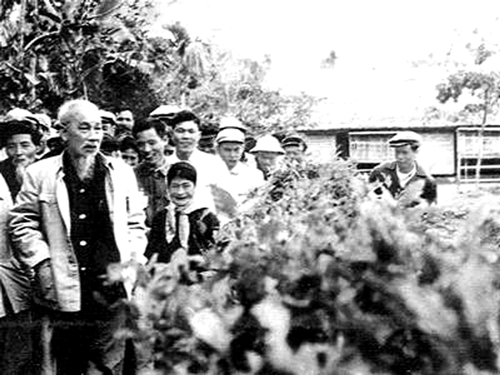 |
| President Ho Chi Minh visited his hometown in Kim Lien, Nam Dan, Nghe An in 1961. Photo: Archival material. |
Mr. Khiem replied, "You've been away for so long, yet you have such a good memory?" President Ho Chi Minh then asked Mr. Khiem, "Do you still remember the story of 'Khom Cong'?" President Ho Chi Minh immediately added, "Not only me, but tens of millions of our compatriots at that time were also 'Khom Cong' (Khom Cong, a wordplay on words, means 'no rice,' referring to the poverty of President Ho Chi Minh's youth and the family of his father, Nguyen Sinh Sac).
Uncle Khiem asked Uncle Ho, "When do you plan to visit your hometown?" Uncle Ho calmly replied, "Coming here is like coming home. The current situation and work don't allow me to think about it yet; it will probably be a while."
As predicted by Uncle Ho, it was not until 11 years later, in 1957, that he visited his hometown for the first time. After meeting with Uncle Ho, Mr. Khiem happily returned to live in Kim Lien. He lived surrounded by the love of the people and received attentive care from the local government. He passed away on October 15, 1950, in Kim Lien village, at the age of 62.
Upon receiving the news, President Ho Chi Minh, being away on official business, was unable to return. Therefore, he sent a telegram to the Administrative Resistance Committee of Inter-Region IV, asking them to forward it to Kim Lien village. The message read: “Hearing the news of my eldest brother’s passing, my heart is filled with sorrow. Because of the heavy burden of national affairs and the long distances, I was unable to care for him when he was ill, and unable to attend to his needs after his death. I beg forgiveness for my negligence before his spirit and ask the villagers to forgive a man who sacrificed family affection for the sake of the nation.”
Peace
(Synthetic)