

Imposing a fee cap on hospitals for those without health insurance cards.
From June 1st, people without health insurance cards will be subject to the new ceiling on hospital fees when seeking medical treatment.
|
| Price caps will be applied to those without health insurance starting June 1st. |
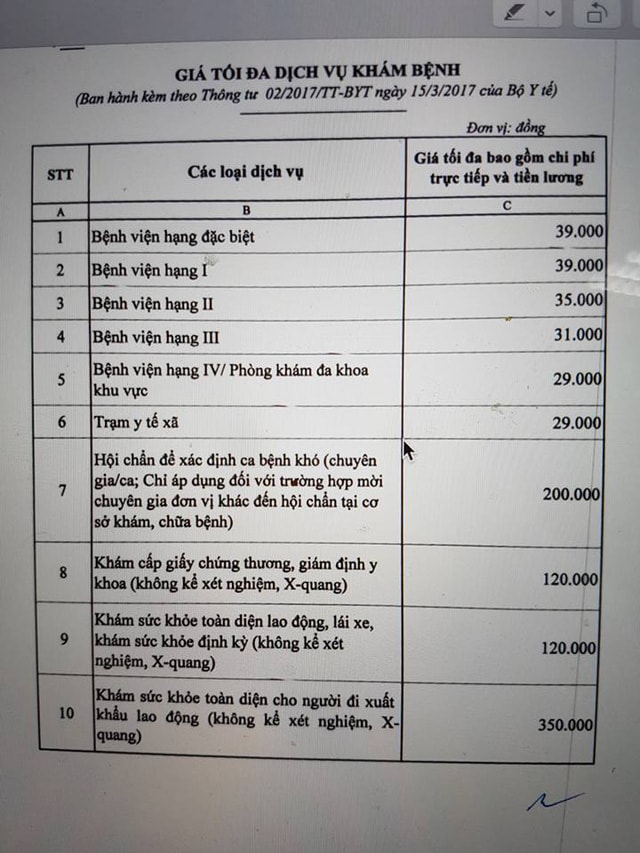
The Ministry of Health has just issued Circular No. 02/2017/TT-BYT stipulating the maximum price framework for medical examination and treatment services not covered by the Health Insurance Fund in state-owned medical facilities and providing guidance on the application of prices and payment of medical examination and treatment costs in certain cases.
This circular adjusts hospital fees for those who are not covered by health insurance, or who have a health insurance card but seek medical treatment or use services not covered by the health insurance fund (excluding examinations at voluntary or on-demand clinics).
This circular applies to public medical facilities, patients who are not covered by health insurance, and those with health insurance cards but whose medical examinations or treatments are not covered by the Health Insurance Fund.
Accordingly, the maximum price range for medical examination and treatment services includes: direct costs such as medicines, intravenous fluids, chemicals, consumables, and replacement materials used in medical examination and treatment services; costs for electricity, water, fuel, waste treatment, environmental sanitation; costs for equipment maintenance and repair, and replacement of tools and instruments; and salary costs including salary based on rank and position, allowances, on-call allowances, surgical and procedural allowances, etc.
From June 1st, healthcare facilities will officially implement new medical service prices covering over 1,900 services, including: maximum prices for health check-up and examination services; inpatient treatment services; technical services, laboratory tests, etc.
According to this price framework, the cost of a medical examination at a top-tier hospital is 39,000 VND, at a level 2 hospital is 35,000 VND, at a level 3 hospital is 31,000 VND; and at a level 4 hospital and commune health station: 29,000 VND. Some procedures and surgeries have also been adjusted upwards by approximately 20-30% compared to current prices.
The competent authority (Ministry of Health, Provincial People's Council, etc.) shall decide on the specific price, but it must not exceed the maximum price range stipulated in this circular. This price includes direct costs (medicines, intravenous fluids, chemicals, consumables, etc.) and salary costs.
The daily bed rate is calculated per person per bed. For two people sharing a bed, a maximum of 50% of the daily rate is charged, and for three or more people sharing a bed, a maximum of 30% is charged. In cases where beds are on stretchers or temporary folding beds, the daily bed rate for two people sharing a bed applies.
The duration of treatment at medical facilities is determined by the competent authority.
In addition, this circular also supplements the prices of 35 services not yet covered by health insurance, such as: cosmetic services, dentures, hearing aids, treatment for strabismus, myopia and refractive errors... For these services, people with health insurance cards will still be charged the same price as those without health insurance cards because these services are not covered by the Health Insurance Fund.
According to the Ministry of Health, this adjustment to medical service prices aims to create equality between those with and without health insurance cards, thereby encouraging people to participate in health insurance. Currently, according to statistics from the Vietnam Social Insurance, the number of people participating in health insurance reaches 82% of the population, meaning that 18% of the population is still not covered by health insurance.
| This Circular does not apply to medical examination and treatment services in the following cases: Units contributing capital, raising capital, joint ventures, and partnerships in accordance with the Government's regulations on the operational and financial mechanisms for public health service units and the pricing of medical examination and treatment services of public medical facilities, and implementing service prices according to the principle of ensuring sufficient cost recovery and accumulation; Medical facilities operating under a business model where public service units borrow capital for investment or cooperate in investment according to the Government's Resolution on some mechanisms and policies for health development; Medical facilities investing in the form of public-private partnerships. |
According to Infonet