

The "coverage" of village heads being Party members
(Baonghean) - Village heads are considered "extended arms" of the local government. Therefore, in recent years, the Party Committee and the government of Do Luong district have always paid attention to selecting capable and reputable individuals to assume the position of village head, training them, admitting them into the Party ranks, or appointing Party members as village heads.
Streamlining the village and hamlet administrative apparatus.
Do Luong District has 367 rural Party branches under the Party committees of communes and towns. For more than 10 years, with the goal of streamlining the apparatus and ensuring comprehensive and unified leadership of the Party organization at the grassroots level, the district Party committee and government have implemented many solutions to strengthen the team of Party members serving as village heads in the area, including the implementation of the model where the Party secretary also serves as the village head.
During the 2015-2017 term, 234 out of 367 hamlets in the district had Party branch secretaries who also served as hamlet heads. Among these, 8 communes implemented the model of Party branch secretary also serving as hamlet head in 100% of their units: Hong Son, Ngoc Son, Boi Son, the town, Luu Son, Trung Son, Van Son, and Thuong Son.
In Thuong Son commune, where 100% of hamlets follow the model of Party branch secretary also serving as hamlet head, the Party Committee Secretary Nguyen Cong Thang said: The advantages of this model are that it reduces the number of meetings and briefings; it promotes the comprehensive leadership role of the Party branch secretary and the management and operation of the hamlet head in all areas of the hamlet in a synchronized and effective manner. It promotes the individual capacity, dynamism, creativity, and willingness to think, act, and take responsibility of cadres, limiting the tendency to wait, rely on others, avoid responsibility, and show deference in work; it effectively implements the principle of democratic centralism, creating consensus among cadres, Party members, and the people…
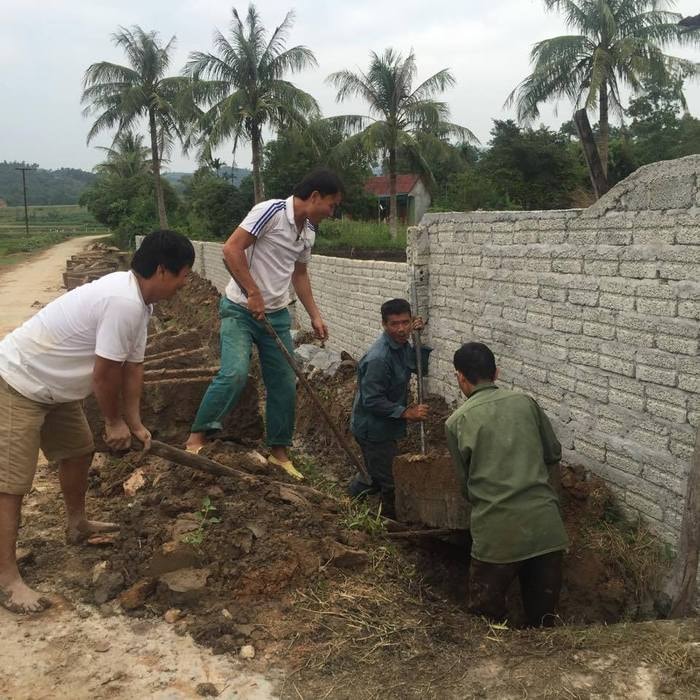 |
| Party members of the Yen Luong Party Branch (Giang Son Dong commune - Do Luong district) actively participate in building rural roads. Photo: Khanh Ly. |
However, in reality, not every unit has the necessary personnel with the capacity and health to fully fulfill both roles of Party Secretary and village head. Therefore, the Do Luong District Party Committee advocates creating conditions for grassroots Party organizations to arrange dual roles depending on local conditions, such as: Deputy Party Secretary serving as village head, Party Committee member serving as village head, Party member serving as village head, etc. To date, the entire district has 36 villages with Deputy Party Secretary serving as village head, 9 units with Party Committee member serving as village head, and 6 units with Party member serving as village head.
According to local Party committee leaders, this dual-role arrangement not only ensures a streamlined organizational structure but also improves remuneration compared to non-dual-role positions, creating motivation for village-level officials in their work. Furthermore, appointing Party members as village heads creates unity, speed, and timeliness in the implementation of policies and plans at the village level because village heads directly participate in discussions and contribute opinions from the outset to the Party branch's resolutions. Conversely, through Party members serving as village heads, the Party branch committee can promptly grasp the situation in the village, thus making the Party branch's resolutions more practical.
In reality, there are people who, despite not being party members, are very enthusiastic and responsible in carrying out the tasks. However, wherever there is a village head who is a party member, the implementation of the Party and State's policies and guidelines will be smoother and faster; it will enhance the role and responsibility of party members in leading the effective implementation of tasks at the grassroots level, and reduce disunity or lack of consensus due to disagreements between the village head, the Party branch secretary or Party branch committee, and the village committee in leading and managing movements in the village...
Difficulties due to lack of resources.
Despite implementing many coordinated measures to increase the percentage of Party members serving as village heads, there are still 83 individuals holding these positions across 22 communes in Do Luong district. Specifically, Giang Son Dong commune has 12, Tru Son commune 9, Nhan Son commune 7, and Quang Son commune 5, among others.
Explaining this, the leader of the Party Committee of Giang Son Dong commune (where 12 village heads are not yet Party members) said: The biggest obstacle remains the human resources. Currently, in rural areas, a large number of young people leave to work elsewhere, making annual Party development difficult. The reality of "aging Party members" means that some Party branches cannot nominate Party members who meet the requirements to run for village head.
Some party members nominated lacked the qualifications, capabilities, and credibility of the general public, leading to a situation where "the party nominated but the people did not elect." Furthermore, the Party committees and local authorities were not proactive in creating a pool of village-level cadres, acting subjectively, failing to closely monitor the grassroots, and misjudging the situation regarding elected personnel. Therefore, during the 2015-2017 term, only four units in Giang Son Dong commune elected a Party branch secretary who also served as village head. Thus, the lesson learned is the need to improve the training, development, and planning of village-level cadres based on the characteristics of each unit; and to thoroughly and skillfully implement the steps and procedures for the Party branch congress and the election of village heads.
Similarly, Quang Son commune has 11 rural Party branches with a fairly large number of Party members, 230 in total. However, during the 2015-2017 term, only 1 unit had a Party branch secretary who also served as village head, accounting for 9.1%; 4 units had deputy secretaries who also served as village heads, accounting for 36.4%; and 6 units had village heads who were ordinary citizens, accounting for 54.5%. According to Mr. Le Van Vinh, Secretary of the Quang Son Commune Party Committee, the reason is that some young, capable, and qualified Party members are only focused on economic activities and are not committed to the local area. Some rural Party branches have older, weaker members, and retired Party members who are capable and qualified but are not enthusiastic about carrying out village-level activities and find ways to avoid them. "The Party Committee had devised a solution to assign some young, part-time cadres at the commune level to serve as Party branch secretaries and village heads in some units, but when they ran for election in the village, they received few votes and were not elected as village heads," Mr. Vinh explained.
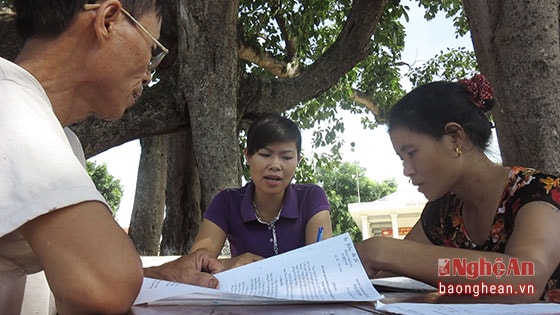 |
| The Party branch secretary and village head of Hoa Phu hamlet, Hien Son commune, Do Luong district, speaks with the villagers. (Photo: Archival image) |
Furthermore, another reason stems from the fact that some Party committees have not paid sufficient attention to propaganda, mobilization, training, and recruitment of Party members, especially from the ranks of village heads who are ordinary citizens. Some village heads with prestige, ability, enthusiasm, and ambition may not meet the criteria for Party membership due to violations of population policies or low educational levels. Not to mention that in some areas, Party members and citizens still harbor strong parochial and clan-based tendencies in elections, making the selection process difficult. Therefore, some localities suggest that the policy of selecting village heads who are Party members should be applied flexibly rather than rigidly.
Increase the percentage of village heads who are Party members.
Based on practical experience at the grassroots level, in orienting the organizational structure of Party branches and hamlets/blocks during the 2017-2020 term, the Standing Committee of the Do Luong District Party Committee decided that in Party branches with a source of cadres and Party members with high qualities, capabilities, and prestige among the people, the structure of Party branch secretary also serving as hamlet/block head, deputy Party branch secretary also serving as head of the Fatherland Front working committee, Party committee member also serving as police officer, hamlet deputy or village militia leader will continue.
In areas lacking resources and qualifications, the Party branch secretary will also serve as the head of the Fatherland Front Committee, and the deputy Party branch secretary will also serve as the village head. In special and difficult areas, the structure will still maintain separate Party branch secretaries and village heads, but capable individuals with aspirations and motivation to join the Party must be selected to serve as block leaders and village heads. In this case, the Party branch secretary will also serve as the head of the Fatherland Front Committee, and the deputy Party branch secretary will also serve as a police officer or village deputy.
Comrade Truong Hong Phuc, Secretary of the Do Luong District Party Committee, stated: The arrangement of concurrently holding positions in villages and hamlets, as well as ensuring that village heads are Party members, is consistent with the practical realities and the Party and State's policy on streamlining the apparatus and ensuring comprehensive leadership by grassroots Party organizations. Therefore, the District Party Committee Standing Committee requests that localities and units seriously implement this, especially in the 22 units where a large number of village heads are ordinary citizens, striving to have approximately 70-80% of village heads in the district be Party members during the 2017-2020 term.
For the 9 units where only 1-5 village heads are non-Party members, the District Party Committee Standing Committee requires that during the 2017-2020 term, the personnel structure must ensure that 100% of village heads are Party members. “Where this is not done well, not only the locality but also the members of the District Party Committee Standing Committee assigned as cluster leaders and point leaders must bear responsibility. In addition, local Party committees, authorities, and mass organizations must play their role in propaganda, mobilization, planning, training, and nurturing promising individuals, especially village heads who are not Party members, considering this an important task contributing to strengthening the grassroots political system and enhancing the capacity and fighting strength of village Party branches,” Comrade Truong Hong Phuc affirmed.
Khanh Ly