
75% of Thai universities are at risk of closure due to low enrollment.
Low enrollment numbers and increasingly fierce competition from foreign universities are making it difficult for domestic universities to survive.
Low enrollment numbers and increasingly fierce competition from foreign universities are making it difficult for domestic universities to survive.
The government's decision to allow foreign universities to establish campuses in special economic zones along Thailand's border has raised concerns among many education experts in the country, according to the Bangkok Post on May 22.Arnond Sakworawich, lecturer in predictive science and risk management at the University of Applied Statistics, National Institute for Development (NIDA)This would put many universities in the country at risk.
Thailand's higher education market has been shrinking for years due to demographic shifts, with birth rates declining from high to low. “Currently, only about 600,000-700,000 children are born each year in Thailand, compared to one million 30 years ago. The National Economic and Social Development Board (NESDB) also predicts that the number of people in the school-age group (0-21) will fall to 20% of the population by 2040, a record decline from 62% in 1980,” said Arnond.
In 2016, the NESDB reported that 704,050 children were born in Thailand. During last year's enrollment period, universities had 150,000 places available across various disciplines, but only 80,000 applied. This figure serves as a wake-up call for the 170 universities nationwide.
"When the market is shrinking and you allow more competitors, the level of competition is inevitably pushed higher. I think the worst-case scenario is that within the next decade, three-quarters of universities in Thailand will have to close because they are unable to compete with well-known and foreign universities," he added.
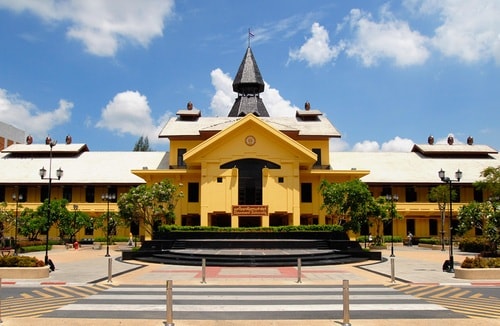 |
Thammasat University is considering balancing its faculties and departments in order to survive. Photo: Best Masters |
Pong-In Rakariyatham, a researcher on university admissions, said he has observed a significant drop in student numbers and that changes in the labor market are likely to have a major impact.
"New social trends may render some majors obsolete, so universities that want to remain financially stable may have to close certain programs. Majors in the social sciences may be the first to disappear," he lamented.
Somwang Phithiyanuwat, a scholar at the Royal Society, also suggested that university administrators need to start thinking about changing the number of students in each department in order to survive. “Students now prefer studying natural sciences over social sciences, so I think universities need to reduce the number of social science majors.”
Thammasat University, one of Thailand's most prestigious universities, is also facing the risk of being phased out. It is becoming aware of its declining student numbers and is seeking ways to balance the workforce. The university is considering downsizing or even closing some important social science programs such as law, journalism, and mass communication.
According to VNE