
Sugar inventories reach record highs.
Smuggled sugar from Thailand is flooding the border, sold at prices a few thousand dong cheaper than domestic businesses, leading to record-high sugar inventories.
Smuggled sugar from Thailand is flooding the border, sold at prices a few thousand dong cheaper than domestic businesses, leading to record-high sugar inventories.
Sugar smuggled from Thailand is flooding the border through various sophisticated methods, across a wide area, and at prices several thousand dong cheaper than domestic businesses, leading to record-high sugar inventories.
Speaking at the "Sustainable Sugar Consumption Solutions" conference recently held in Ho Chi Minh City, Mr. Pham Quoc Doanh, Chairman of the Vietnam Sugar Association, stated that sugar inventories a week ago were approximately 750,000 tons, with about 90% of that amount held at factories. This is a record high for Vietnam's sugar industry, indicating an unusually volatile crop year.
Mr. Doanh believes that, in addition to objective factors such as the impact of weather causing sugar factories to start crushing later than planned, resulting in a large concentration of production in the final stages, the increasingly complex smuggling situation from Thailand is the main cause of this problem.
"Previously, smuggling activities were concentrated only at the borders of the southern provinces, but now they have spread to the North. From transporting goods by motorbike, now there are also boats and ships via rivers and seaports, then transporting them to the market by trucks carrying tens of tons," this person said, affirming that inventory buildup is a genuine difficulty for businesses, and there is no speculation to drive up prices.
Currently, the wholesale price of smuggled sugar from Thailand is about 1,000-2,000 VND per kilogram lower than domestically produced sugar. Many sugar businesses predict that this price difference may continue to widen due to Thailand's export protection measures for this product. This will further reduce the competitiveness and slow down sales of domestic products.
In 2015, sugar imports from Thailand amounted to approximately 382,000 tons, equivalent to one-third of the domestic production. According to estimates by the Sugar Cane Association, traders profited about 40,000-50,000 VND per 50 kg bag of sugar successfully transported.
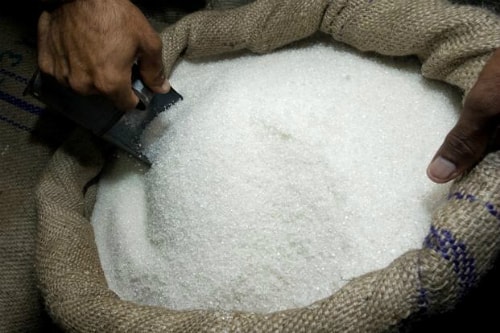 |
| The surge in smuggled sugar from Thailand has led to record-high domestic stockpiles. |
Mr. Dang Phu Quy, a member of the Board of Directors of Quang Ngai Sugar Corporation, believes that the sudden increase in sugar inventory also stems from the sharp decrease in Thailand's exports to the Chinese market due to strict controls, while Vietnam's more "flexible" policies have resulted in a continuous influx of sugar.
Furthermore, increasingly sophisticated trade fraud has significantly impacted the sugar industry recently. Several cases have been discovered where businesses, lacking factories and raw materials, register as sugar producers and processors to repackage sugar into smaller bags of 0.5-1 kg; or they purchase and use documents from officially licensed sugar import companies, both within and outside the tariff quota, to falsely declare the origin of goods.
Proposing a solution to this situation, a representative from Thanh Thanh Cong Tay Ninh Sugar Joint Stock Company stated that they have approached five provinces to buy back the smuggled sugar confiscated by authorities. The company requested that the provinces reduce the value-added tax by 10% and the unloading costs by 20-25%, and that the auction process be conducted according to the Law on Auctioning Assets, but only businesses with factories capable of processing and ensuring quality should participate, in order to exclude small traders who want to repackage and distribute substandard goods. However, most provinces did not support this plan, citing their desire to increase the starting price and comply with the law.
Besides some proposed solutions such as recommending that the Anti-Smuggling Police Department (C74) strengthen patrols and decisively handle smuggled goods, develop a set of product quality standards, and improve the distribution network, many businesses have also expressed their intention to adjust selling prices downwards to narrow the price difference between domestic and smuggled sugar. This is considered a feasible measure to limit the impact of smuggled sugar, but it requires more time for careful consideration and simultaneous implementation to avoid directly affecting the purchase price of raw materials from farmers.
According to VNE
| RELATED NEWS |
|---|