

Multifaceted impact on the textile and garment industry.
(Baonghean) - In the first six months of 2017, 12 out of 15 textile and garment businesses in Nghe An reported a growth of 113.2% compared to the same period in 2016. Export turnover is estimated at over 74 million USD, with a production volume of 11,406,442 tons of various types of fibers and yarns. This sector has a positive impact on production and job creation in the province, as statistics show that textile and garment businesses provide employment for over 15,000 workers.
According to statistics from the Department of Industry and Trade, in the first six months of 2017, export turnover in Nghe An province was estimated at nearly 453 million USD, an increase of nearly 26% compared to the same period in 2016; of which goods exports reached 307.9 million USD, an increase of 11.5%, accounting for 65.5% of total export turnover.
Specifically, the agriculture, forestry, and fisheries group reached $69 million, an increase of 241.6% compared to the same period and accounting for 22.6% of total merchandise exports; the fuel and mineral group reached $33 million, an increase of nearly 35% compared to the same period and accounting for 10.7% of total merchandise exports...
The textile and garment sector alone achieved $74 million, accounting for over 24% of the province's total merchandise export turnover. Leading textile and garment enterprises with high export volume and value in the first six months of 2017 include Prex Vinh Co., Ltd. (over $26.2 million); Minh Anh - Kim Lien Garment Joint Stock Company (over $13.3 million); Hoang Thi Loan Textile and Garment Joint Stock Company (over $12.3 million); Nam Sung VINA Co., Ltd. (over $10.6 million)...
To secure the aforementioned export orders, textile and garment businesses have strived to innovate technology and equipment, improve design capabilities, meet order requirements from partners, and actively expand their markets.
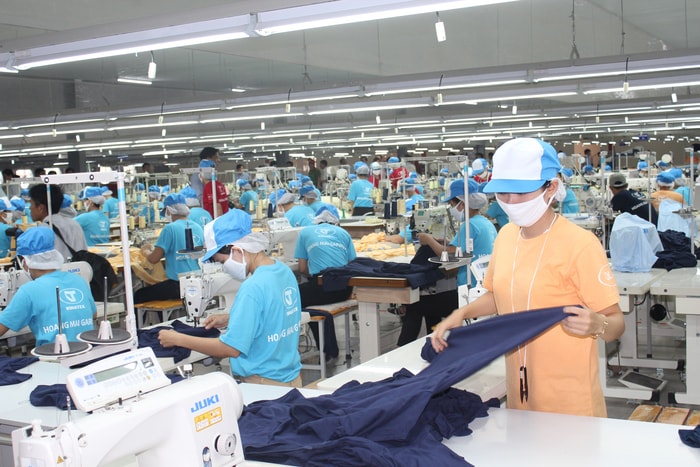 |
| Activities at Vinatex Hoang Mai Textile Factory. Photo: Nguyen Son |
Fortunately, during the implementation of tariff reduction and elimination mechanisms under the AFTA (ASEAN Free Trade Area) framework, textile and garment businesses in the province have demonstrated proactiveness.
Representatives from several businesses in this sector argue that ASEAN countries essentially have many textile and garment businesses from Asian and European countries investing in modern production lines to process goods for domestic consumption and take advantage of cheap labor to "re-export" their products. Therefore, textile and garment businesses in Vietnam in general, and in Nghe An province in particular, have no other option but to seek markets outside ASEAN.
Mr. Nguyen To Canh, General Director of Hoang Thi Loan Textile and Garment Joint Stock Company, shared: “Joining AFTA, textile and garment businesses have to compete fiercely with many partners. Even within the Vietnam Textile and Garment Group (Vinatex), member units have faced competitive pressure from each other, not to mention strong competition from some FDI enterprises or large-scale companies.”
Therefore, in addition to traditional markets such as China, Taiwan, Egypt, Malaysia, Thailand, South Korea, etc., we must prioritize developing new markets and seeking to expand into other countries such as Peru, Sudan, the United States, Turkey, and others.
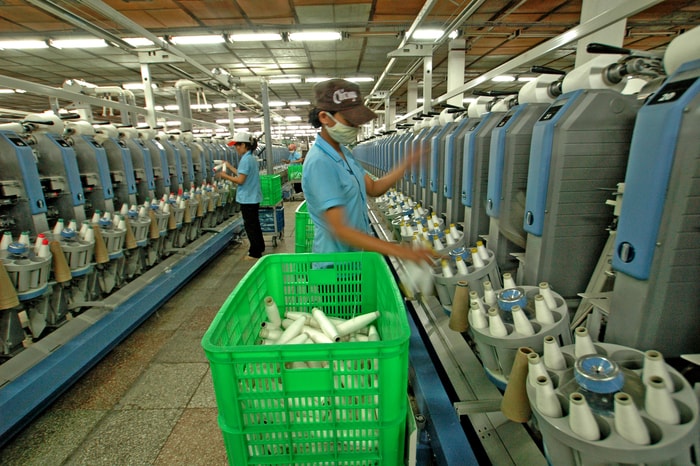 |
| Yarn production line at Hoang Thi Loan Textile and Garment Joint Stock Company. Photo: An Vinh |
Data from the first six months of 2017 shows that most textile and garment businesses experienced a significant increase in export value, up 113.2% compared to the same period in 2016. This figure does not include some units that reported export results based on the quantity of goods without converting them to value, or, for example, the Vinatex Hoang Mai garment factory exporting goods to Japan and other countries through the corporation's partners, which were not included in the reported items in Nghe An.
To ensure growth momentum, in addition to focusing on the domestic market and maintaining traditional trading partners, textile and garment businesses are actively seeking and expanding markets in the Middle East, the Americas, and Africa. This is how many businesses have shifted away from relying solely on the Chinese market, as it is a potential market but its import regulations are constantly changing in ways that are unfavorable to Vietnamese businesses.
The textile and garment industry has a large number of participating businesses, with over 5,000 enterprises nationwide employing more than 2.5 million workers. It is also a major export sector for Vietnam.
In Nghe An province, according to Ms. Vo Thi An, Deputy Director of the Department of Industry and Trade, the textile and garment sector has 15 enterprises regularly involved in production and export. In addition, there are several private establishments that produce goods on a contract basis for domestic businesses.
In recent years, the textile and garment industry has consistently ranked among the top export items of Nghe An province in terms of both production volume and value. This result reflects the efforts of businesses investing in the province, contributing to job creation for tens of thousands of workers in rural areas. Although the income of textile and garment workers is not yet high, this sector has a multifaceted impact on socio-economic development.
Nguyen Nguyen