

Why did Nghe An drop 17 places in the administrative reform ranking?
(Baonghean.vn) - In his explanation at the Provincial People's Council meeting, Director of the Department of Internal Affairs Dau Van Thanh clearly outlined the reasons for the low administrative reform index of Nghe An.year2016 dropRanked 17th, 38th out of 63 provinces and cities.
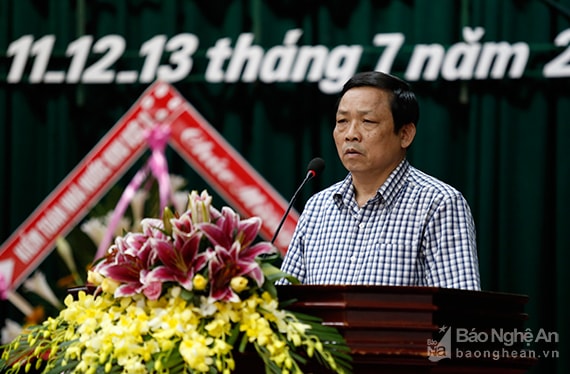 |
| Mr. Dau Van Thanh - Director of the Department of Internal Affairs, speaking at the 4th session of the 17th Provincial People's Council. Photo: Duc Anh |
Looking back at the administrative reform rankings over the past years, Nghe An ranked 31st nationwide in 2012, 46th in 2013, 44th in 2014, jumped to 21st in 2015, and then dropped 17 places to 38th in 2016.
"I believe that, if assessed accurately, Nghe An's administrative reform index is currently in the 30th-35th position nationwide. Jumping to 21st and maintaining that ranking is very difficult and doesn't reflect the pace of administrative reform efforts by our entire political system," Mr. Thanh stated as the first reason.
The second reason, according to the head of the Department of Internal Affairs, is that the Ministry of Internal Affairs' new criteria in 2016 are more demanding and require a more absolute assessment: "Most criteria must be achieved at 100% to receive the maximum score. Many people ask why, while the PCI index increased by 7 ranks, the administrative reform index decreased by 17 ranks? This is a very small criterion in the Ministry of Internal Affairs' scoring system; they don't assess based on the increase or decrease in the PCI index, but rather on the actual quality of investment attraction."
The third reason mentioned by Mr. Dau Van Thanh is the scoring channel regarding the impact of administrative reform on 8 administrative reform indicators, which is independently assessed by the Ministry of Interior and sends 500 questionnaires to leaders at all levels from the province to the grassroots. "This channel is too strict in its assessment, so the information collected on the overall administrative reform in Nghe An is only at an average level," he commented.
In addition, the leaders of the Department of Internal Affairs also provided further analysis of PAPI, the Provincial Public Administration and Governance Performance Index, which is implemented by three agencies in collaboration, based on six evaluation criteria and four levels of assessment: highest, upper-medium, lower-medium, and lowest.
“The channel for citizen participation at the grassroots level is rated the highest, showing that the people of Nghe An are very concerned about this issue. The channel for openness and transparency is rated 'low-medium,' accountability to the people is rated 'high-medium,' control of corruption in the public sector is rated 'low-medium,' public administrative procedures are rated 'high-medium,' and public service delivery is rated the lowest. Overall, we are rated 'low-medium,' ranking around 33rd,” Mr. Dau Van Thanh explained, adding that this is a very objective channel.
Finally, according to information from the sociological survey of the Center for Social Sciences and Humanities of the Department of Science and Technology, the satisfaction rate with administrative reform in Nghe An reached 36.1%, acceptable at 50.5%, and dissatisfied at 13.4%.
Based on the above analysis, the head of the Department of Internal Affairs proposed six important solutions for the coming period to promote administrative reform in Nghe An in the remaining months of the year. Firstly, directing the implementation of the Provincial People's Committee's directive on strengthening administrative reform solutions in the province. Secondly, reviewing and comparing weaknesses and shortcomings to rectify and strengthen implementation.
Third, update information and evaluate administrative reform work quarterly and monthly to fully inform each agency and unit of the implementation results; strengthen inspection of the implementation of Government Directive 26 and Provincial Party Committee Standing Committee Directive 17. Fourth, issue criteria for ranking administrative reform in 2017 to ensure accurate and transparent evaluation.
Fifth, the standing agencies comprising the Department of Internal Affairs, the Department of Justice, and the Department of Information and Communications should coordinate more closely to advise the Provincial People's Committee on implementing administrative reform more decisively. Finally, the entire political system must truly get involved in doing a good job of administrative reform.
Reporters' Team
| RELATED NEWS |
|---|