

Don't let international air travel become a 'premature death'.
(Baonghean) - Mr. Nguyen Manh Cuong, Director of the Nghe An Department of Tourism, said that a survey will be conducted in July to open a direct flight route from Vinh to China. This will be the third international flight route operated at Vinh International Airport, after the Vinh - Vientiane and Vinh - Bangkok routes ceased operation.
According to information from the Nghe An Department of Tourism, the direct flight route to China is one of the notable results of the Nghe An tourism promotion program in China, which took place from May 10th, 2017 to May 20th, 2017.
The flight route will be to one of two cities: Kunming in Yunnan or Chengdu in Sichuan. The planned flight will be a charter flight. This route is identified as one of the foundational steps in the strategy to attract tourists from the Chinese market and develop the province's tourism industry.
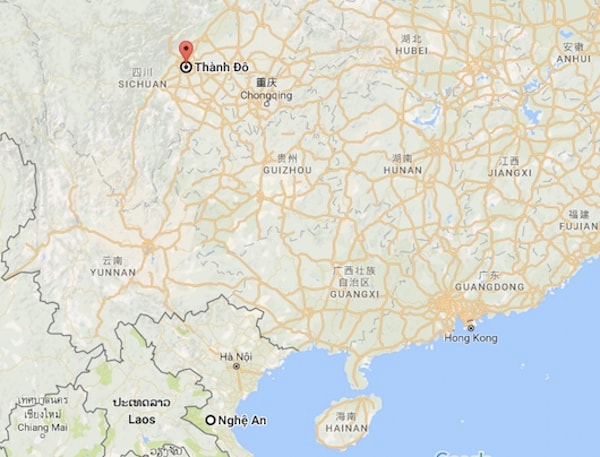 |
| Chengdu on Google Maps. |
This is also the general direction of tourism nationwide, aiming to boost the exploitation of the large neighboring market. In 2016, Chinese tourists accounted for 27% of the international tourist market to Vietnam, a significant increase compared to 2015, and are currently the number one source market for tourists to Vietnam.
Is it possible to avoid this 'curse'?
Previously, there were two direct international flights operated from Vinh International Airport.
First is the Vinh - Vientiane route, launched by Vietnam Airlines on January 12, 2014. Survey results show that an average of nearly 180,000 passengers travel from Vietnam to Vientiane annually via border crossings in Nghe An, Ha Tinh, and Thanh Hoa provinces. This route is expected to be effective, becoming an air link between the North Central region of Vietnam and Laos and Thailand.
Despite the promising market outlook, the route consistently suffered from low passenger numbers after its launch. In 2014, Vietnam Airlines offered over 10,000 seats, but passenger numbers didn't even reach 50%. Nearly 50 flights that year had to be canceled due to insufficient passenger numbers.
According to Vietnam Airlines' calculations, the airline incurred a loss of nearly $750,000 from the Vinh - Vientiane route in 2014. On October 25, 2015, Vietnam Airlines officially ceased operating the Vinh - Vientiane route.
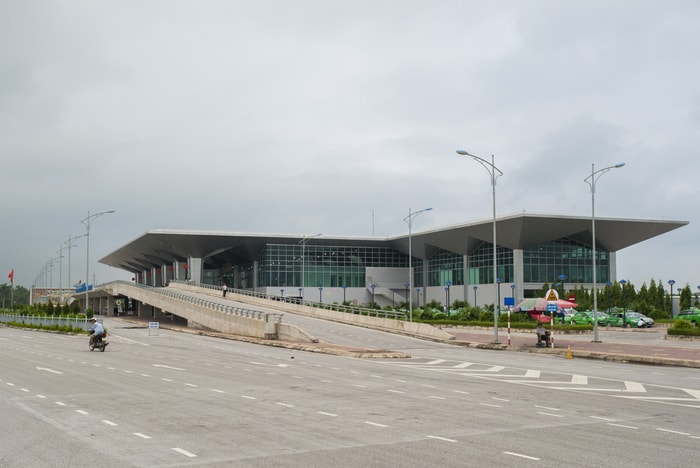 |
| Vinh International Airport. Photo: Thanh Cuong |
In June 2016, Vietravel launched a direct charter flight between Vinh and Bangkok. This was a product that the company had successfully offered in other locations such as Can Tho, Nha Trang, Hue, and Da Nang. Unlike the Vinh-Vientiane route, the Vinh-Bangkok route was integrated with package tours and catered to the prevailing travel preferences of the local population, resulting in relatively effective operation.
However, this route has now been discontinued, with Vietravel citing the following reason: “The infrastructure of Vinh Airport is not yet suitable for international flights. The aircraft we use is an Airbus A320 with a capacity of 180 people, much larger than the aircraft used for the previous Vinh - Vientiane route. The airport infrastructure, such as waiting areas, baggage conveyors, and personnel, is insufficient to provide the best service for international passengers.”
We are currently suspending operations on this route, firstly to wait for airport infrastructure upgrades. Secondly, after a trial period where we see positive results, we will work with airlines to have them officially open the route instead of charter flights.”
Thus, for various reasons, both of the aforementioned routes "died prematurely" after a short period of operation. This has led many to worry whether the direct flight from Vinh to China will avoid the "third time's the charm" curse.
It's worth noting that Vinh Airport is currently the fastest-growing airport in Vietnam, but considering the less-than-stellar results of international routes operated from this airport, perhaps we need to re-evaluate which market segments are truly promising and should be prioritized.
Domestic or international tourists?
According to statistics from the Department of Tourism, in the first five months of 2017, the number of tourists staying in Nghe An was approximately 1.4 million, of which international tourists accounted for just over 29,000, or about 2%. The number of tourists served by travel agencies in the first five months reached over 18,000, with international tourists accounting for over 2,600, or about 14%.
While the number of international visitors increased compared to the same period in 2016, it still only accounts for a small fraction of the number of domestic visitors.
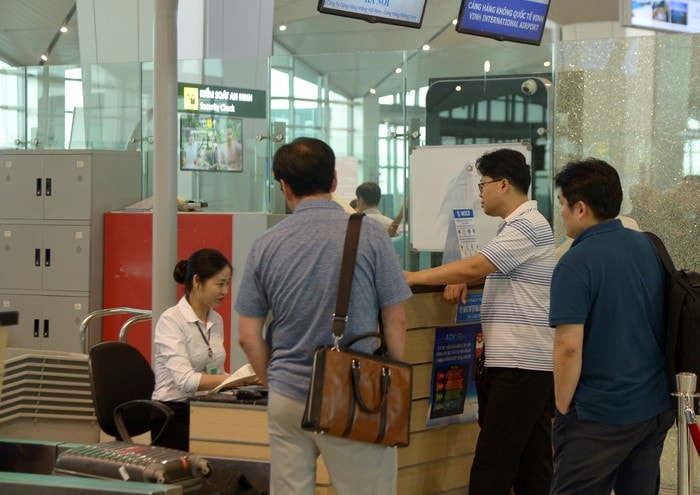 |
| Chinese passengers go through check-in procedures at Vinh International Airport. Photo: Thanh Cuong. |
Ms. Vo Thi Thu Hoai, Director of Vietravel's branch in Nghe An, commented: "For the majority of foreign tourists, Nghe An is a transit point rather than a destination. If they do stay overnight, it's usually only for one night as part of a trip through many other places and provinces. If we only do tours in Nghe An, it's very difficult to sell them."
Previously, Laos and Thailand were two fairly good markets, but now they are showing signs of saturation. China is, of course, a very large market, but Chinese tourists have their own unique characteristics, different from those of Laos and Thailand. They often like going to the beach and eating seafood – because mainland China is vast and landlocked, seafood is expensive. Chinese tourists also like shopping at large shopping malls.
Considering these characteristics, if Nghe An wants to attract tourists from China, Cua Lo remains the most promising destination. However, Cua Lo is already operating at full capacity serving domestic tourists during the summer. If they want to attract Chinese tourists in the winter, they will have to compete with tourist beaches in the South.
Furthermore, according to Ms. Hoai, Nghe An currently has a significant shortage of tourism workers capable of serving Chinese tourists. To effectively exploit this market, thorough training and preparation are necessary before launching new tourism products.
China was a key market for Vietnamese tourism in 2017, but is this also relevant for tourism in Nghe An? In reality, tourism infrastructure in Nghe An has only begun to flourish in the last few short years.
The types of tourism that are commensurate with our current infrastructure are only exploratory tourism and spiritual tourism - and even in these two areas, we are still lagging behind provinces in the region such as Quang Binh, Ha Tinh, or even Ninh Binh further afield.
Nghe An's resort tourism is almost entirely dependent on Cua Lo beach, but it wasn't until the summer of 2017 that Cua Lo had a high-end resort (Vinpearl Cua Hoi by Vingroup) come into operation. On weekends – unless the weather is bad – Cua Lo is always packed with tourists from the northern provinces. Even tourists from coastal provinces like Quang Ninh and Hai Phong still come to Nghe An to enjoy Cua Lo beach.
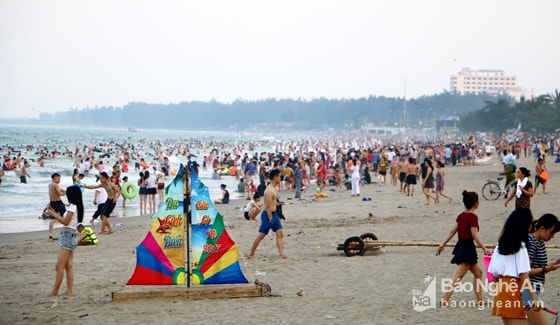 |
| Cua Lo beach was packed with people during the April 30th and May 1st holiday in 2017. Photo: Lam Tung |
Nghe An tourism may still be new to international visitors, but it's clearly a good choice for domestic tourists. Although infrastructure and services are not yet fully developed, it boasts a convenient geographical location, reasonable prices, and decent quality.
The question is: Have we fully exploited the domestic market? If not, there's no reason why we shouldn't firmly grasp this easier "piece of the pie" before investing too much in the demanding and uncertain international market.
Thuc Anh