

The story of the hero who fed his troops.
(Baonghean)The road to the battlefield stretched for kilometers, riddled with bomb craters and bullet holes, with enemy planes occasionally roaring overhead, yet Nguyen Van Mao, the foster brother, nimbly carried two heavy pots of rice on his shoulders to supply his comrades. Throughout 10 years of fighting, he couldn't remember how many times he had been wounded.
Despite being a Hero of the People's Armed Forces and retired for 30 years, Mr. Nguyen Van Mao from Hamlet 5, Xuan Hoa Commune, Nam Dan District, still works tirelessly even at the age of 78. His family owns a small farm next to the fields, and early in the morning, he rides his old bicycle, loaded with farming tools, to the fields to work.
It seems that the work he did during his military years has become ingrained in this veteran's blood. "I get exercise while I work," Mr. Mao said cheerfully.
Sitting beside the lush green vegetable patch, Mr. Mao recounted that in early 1965, he enlisted in the army. At that time, his young wife was pregnant with their first child. He was assigned to the Anti-Aircraft Artillery Company, part of the 214th Regiment, which was then fighting in the Binh-Tri-Thien battlefield. The company's nhiệm vụ was to protect key transportation infrastructure and supply shipments.
He had only been at the unit for two days, and hadn't even had time to get used to military life, when Private Nguyen Van Mao had to directly confront American aircraft. The squad leader assigned him the task of transporting ammunition.
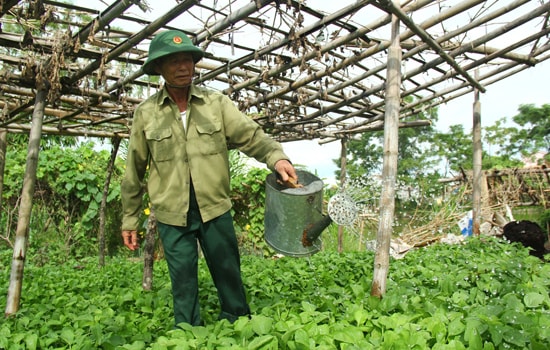 |
| Despite being 78 years old, Mr. Mao still works diligently every day. Photo: Tien Hung |
Nguyen Van Mao ran swiftly, ensuring his comrades weren't short a single bullet. When his bullets got dirty, Mao took off his shirt to wipe them clean. He supplied enough ammunition for his own gun crew, then transferred more to other crews... In just the first few months of combat, Private Nguyen Van Mao impressed the entire unit with his agility, enthusiasm, and bravery.
“Towards the end of that year, my company received a new type of artillery and was deployed to a position at the top of the pass. The unit's rations were significantly reduced, and the health of the artillerymen visibly deteriorated. The unit realized that it was necessary to select a comrade from among the Party members who had a high sense of responsibility and sufficient health to deliver meals to the battlefield on the hilltop every day,” Mr. Mão recounted.
After deliberation, the unit's leadership decided to entrust this important responsibility to Private Nguyen Van Mao. From then on, Nguyen Van Mao began to achieve victories on the "logistics front." Looking back now, Mr. Mao says it's still interesting because at the time he received his logistics assignment, he didn't know how to cook at all. So, during his rare moments of rest, he often had to ask his comrades to teach him how to cook.
Mr. Mão recounted that initially, his main task was transporting food and water for his comrades. Along the 3km road to the battlefield, riddled with bomb craters and bullet holes, on many days, with enemy planes roaring overhead and steep slopes, he still nimbly carried heavy loads of food, striding briskly up the hill. “Every day I carried food three times: morning, noon, and night. As for water, I had to carry it continuously for the men because it was hot and sunny at the battlefield. Each trip I carried four buckets of water, weighing almost 100 kilograms.”
"I'm blessed with good health," Mr. Mao said with a smile. After working as a cook for half a month, Private Mao had discovered many new food sources. He often pushed his boat along the riverbank searching for delicious vegetables and fresh fish. As a result, the quality of the unit's meals improved day by day. Each time he went to resupply, he also tried to learn how to cook a local dish from other units. Out of compassion for his comrades, Mr. Mao often thought of ways to share the workload.
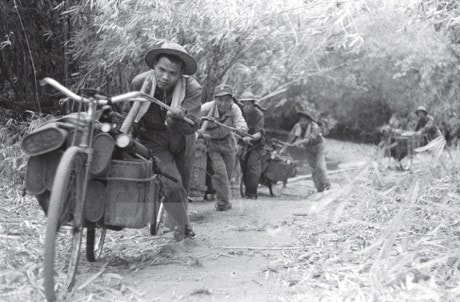 |
| The battlefield cannot do without heroes who support the troops. Photo: Internet. |
He kept track of how much firewood the kitchen consumed each day, and, assessing his own strength, he could carry an extra few dozen kilograms of firewood each time he carried dishes down the mountain to wash them. Each day, he managed to bring nearly a hundred kilograms of firewood from the high hills down to the kitchen. Many nights, cook Nguyen Van Mao would forget to sleep, striving to provide the unit with delicious meals. Although he was a cook, he would also take over the duties of the artillerymen when they were injured.
Recounting his injuries, Mr. Mao said he couldn't count how many times he'd been buried under bombs and bullets, but "being alive was a great blessing." In late 1966, during a battle to defend the Gianh River ferry crossing, a bomb exploded near the artillery bunker, burying Mr. Mao and his comrades. Before his remaining comrades could rush to their rescue, he himself pushed through the earth. Without delay, he used his hands to dig out the remaining survivors. When other artillerymen ran to his aid, Mao waved them away: "Comrades, return to your positions and fire harder. I alone can handle the medical rescue." After rescuing his comrades from the battlefield, he was wounded a second time upon returning to his fighting position.
This time, his left ear was deafened, and the pressure from the bombs had stiffened his limbs, so he was immediately transferred to the hospital. “Even while in the hospital, my mind was still preoccupied with matters at the unit. Seeing artillery shells flying everywhere made my heart race, and I begged to be discharged early. After much pleading, the doctor finally agreed,” Mr. Mão recounted. That time, the company commander read out Mão’s discharge papers, which included a doctor’s instruction: “Although discharged, Mão must be given at least 10 days of leave from duty.”
Therefore, the unit decided to send Mao to the battalion so he could rest and, incidentally, attend the medal awarding ceremony. However, when he received the order from the company commander, Mao's ear was injured, and he couldn't hear clearly, mistaking the commander for someone instructing him to return to his old duties. So, this devoted caretaker ran down to the kitchen, carried a load of rice up to the battlefield for his comrades…
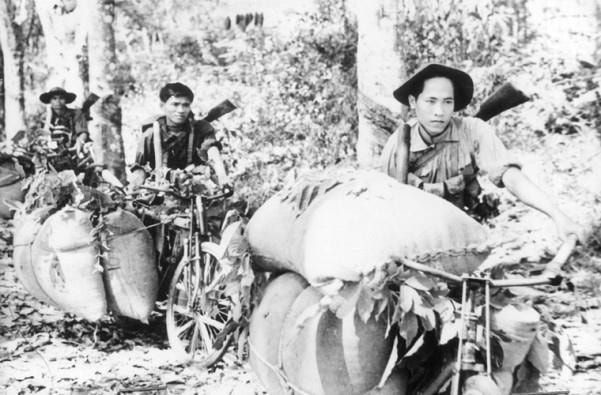 |
| Soldiers transporting food supplies to the battlefield. Archival photo. |
During the battle in April 1968, Mr. Mao was appointed as the squad leader. While commanding, he was thrown far away by the blast, buried under rocks and earth. One leg was trapped between the ammunition box and the gun carriage. The entire squad rushed to his aid, some digging, some carrying the gun carriage. After many hours of strenuous effort, they finally managed to free him from the ammunition box. However, by then his leg was bruised, numb, and immobile.
However, Mr. Mao refused to use a stretcher and insisted on crawling to the wounded soldiers' assembly area on his own. "That time I was hospitalized for three months; besides my leg, I lost five teeth, and my lungs were also injured," Mr. Mao recounted. However, just like before, even while hospitalized, his heart burned with anxiety upon receiving news from the battlefield. To recover quickly, just a few days after being admitted, he made his own stretcher and practiced walking again, hoping to return to the battlefield soon.
For his achievements, in August 1970, Mr. Nguyen Van Mao, then a sergeant, was awarded the title of Hero of the People's Armed Forces. After the reunification of the country, he was sent to the North to study, and then returned to work at his old unit.
In 1987, Mr. Mao was discharged from the army after more than 22 years of service, having received dozens of Certificates of Merit, 10 Commendations, and 2 Third-Class Resistance Medals.
Tien Hung
| RELATED NEWS |
|---|