

The challenge that the Chinese submarine fleet poses to the United States.
China's development of modern, low-noise submarines will pose a strategic challenge to the United States and its allies.
The submarine fleet of the Chinese navy.
The navy has been a major focus in China's military modernization process, which has lasted for over a decade. The emergence of modern submarines with increasingly low noise levels is the biggest threat to the US Navy and its allies in Asia, according to National Interest.
The development of China's surface fleet has attracted global attention due to the enormous number of newly built warships and the advanced weapon systems on each vessel. While receiving less attention, its submarine fleet represents a strategic shift for the navy, especially as Beijing is researching numerous new technologies and weapons for them.
Most of China's submarines were previously old and very noisy, making them easy targets for US attack submarines to detect, track, and destroy. But this force is being upgraded and modernized with new submarines equipped with cruise missiles and ballistic missiles carrying nuclear warheads.
"China's long-term goal is to replace the United States as the country with the world's largest and most powerful submarine force," said U.S. Navy Colonel Jim Fanell, former director of intelligence for the Pacific Fleet.
Beijing currently possesses 63 submarines, including 5 nuclear-powered attack submarines, 4 ballistic missile submarines, and 54 diesel-electric submarines. However, within the next three years, this number could increase to 69-78 submarines of various types.
The number of submarines carrying anti-ship cruise missiles has also increased significantly. Since the 1990s, Beijing has built 13 Type-039 attack submarines and 17 Type-039A submarines equipped with air-independent propulsion (AIP). China plans to commission three more Type-039A submarines before 2021. The navy also possesses 12 Project 877 and 636 submarines (Kilo and improved Kilo classes), eight of which can be equipped with cruise missiles.
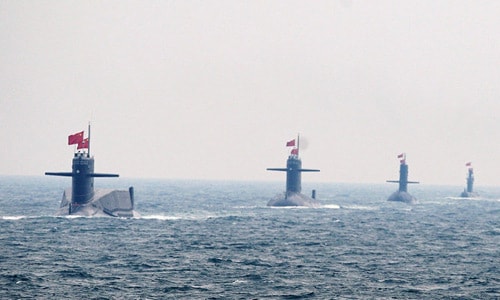 |
China possesses a fleet of submarines of various types. Photo: Sputnik. |
Nuclear submarines can conduct missions far from China's naval bases. The country has built two Type-093 attack submarines and four Type-093G submarines, along with four Type-094 strategic ballistic missile submarines. "The Type-094 submarines represent Beijing's first effective sea-based nuclear deterrence platform," the Pentagon report stated.
The Chinese Navy will soon possess the advanced Type-096 class, expected to be built in the 2020s. They will be equipped with the JL-3 ballistic missile, which is significantly more powerful than the current JL-2.
Beijing is also researching a new class of nuclear-powered attack submarines called the Type-093B. These will not only improve the Chinese navy's anti-ship warfare capabilities but also provide an additional option for attacking land targets. The new submarines will be equipped with the YJ-18 hypersonic missile, considered by the Pentagon to be one of the most dangerous anti-ship weapons currently available.
The U.S. Office of Naval Intelligence (ONI) views the Chinese submarine fleet as a crucial component of "non-contact warfare," which focuses on weapon systems capable of long-range, high-precision attacks beyond the enemy's defensive capabilities.
Chinese submarines still lag behind the US and Russia in terms of combat capabilities and noise suppression. However, technological advancements are allowing Beijing to close this gap very rapidly.
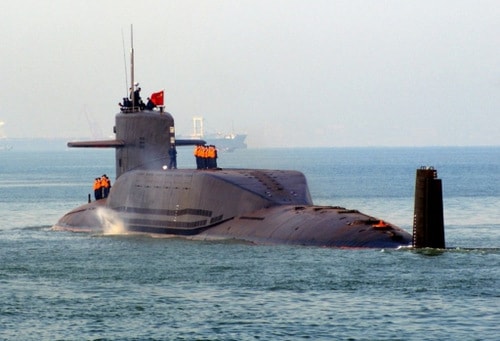 |
Beijing could close the submarine technology gap with major powers in a short period of time. Photo: Blogspot. |
Along with the development of submarines comes a need for support systems. Military expert Abhijit Singh believes that Beijing is seeking to build a network of logistics ports to support its nuclear submarine force in the Indian Ocean, with proposals to build bases in Sri Lanka, Pakistan, Myanmar, and Bangladesh.
With its current rate of development, the Chinese navy will soon possess a fleet of 20 nuclear attack submarines capable of confronting US warships, putting immense pressure on US submarine forces in the Pacific, analyst Rick Fisher asserts.
According to VNE
| RELATED NEWS |
|---|