

Drought-resistant 'dragon tree' provides high income in Anh Son.
(Baonghean.vn) - Many households in the mountainous areas of Nghe An province still consider the red-fleshed dragon fruit to be a "dragon plant" because of its ability to withstand drought and harsh weather conditions in western Nghe An.
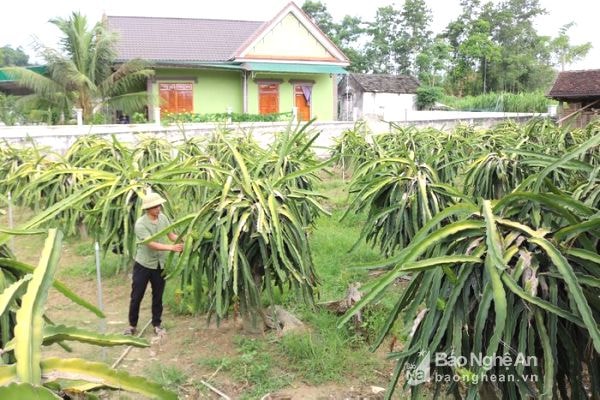 |
| The red-fleshed dragon fruit orchard of Mr. Nguyen Van Binh's family in Hamlet 1, Hoa Son Commune. Photo: Huyen Trang |
Due to its resilience and adaptability to mountainous environments and terrain, many households in Anh Son district have been experimenting with growing red-fleshed dragon fruit in recent years. Compared to other dragon fruit varieties, red-fleshed dragon fruit has higher weight, quality, and price.
Mr. Nguyen Van Binh's family in Hamlet 1 is one of the first households in Hoa Son to cultivate red-fleshed dragon fruit on a large scale. Leading us on a tour of his orchard, Mr. Binh explained: In 2007, he and his wife traveled to Ba Ria Vung Tau province to visit and learn from successful dragon fruit farming models.
Through his research, he learned that the red-fleshed dragon fruit variety originating from Thailand has higher yield and quality than the white-fleshed variety, producing 7-8 harvests per year. Mr. Binh brought 40 cuttings of red-fleshed dragon fruit to plant on 3 acres of his garden. Thanks to proper care, after only 2 years, the dragon fruit yielded a harvest of large, abundant, and very sweet fruit…
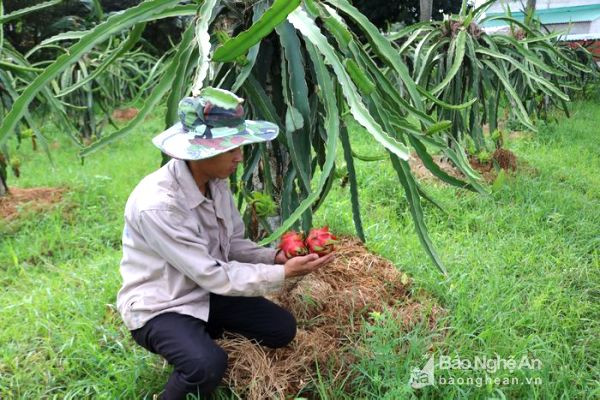 |
| The second-year dragon fruit orchard of Mr. Nguyen Van Thuy's family in Hoa Son commune has begun yielding its harvest. Photo: Huyen Trang |
Currently, Mr. Binh has propagated 200 red-fleshed dragon fruit plants, earning an average income of 30 million VND per harvest. Mr. Binh shared his experience: Dragon fruit is easy to grow, however, attention should be paid to ensuring good drainage and preventing water stagnation during heavy rains; during hot, dry seasons, water appropriately and use grass or straw to mulch to retain moisture at the base of the plant. Pruning branches so that the canopy spreads evenly will result in high-quality dragon fruit.
Not far from there is the red-fleshed dragon fruit orchard of Mr. Nguyen Van Thuy's family in Hamlet 5, Hoa Son Commune, which is also blooming and bearing abundant fruit.
In a conversation with us, Mr. Thuy shared: Following the policy of transforming unproductive gardens into fruit orchards, he boldly invested in planting red-fleshed dragon fruit. Initially, due to lack of experience, the fruit setting rate was low. Undeterred, he continued to learn about dragon fruit cultivation and care techniques. The plants did not disappoint him; over 70 dragon fruit plants began to yield income. In addition to dragon fruit, he also renovated a portion of his unproductive garden to maintain traditional crops such as pomelo, apple, and star apple... to increase his family's income.
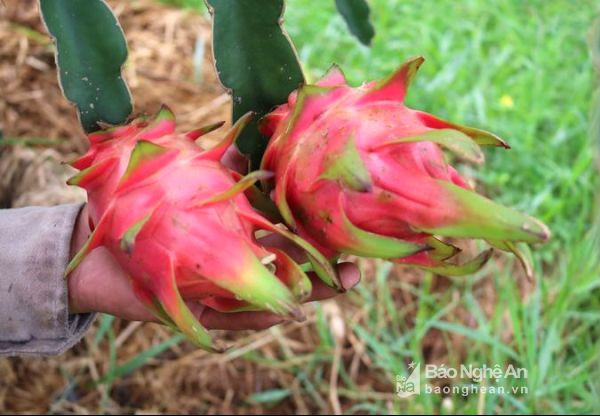 |
| The suitable soil and climate mean that the yield and quality of red dragon fruit grown in Anh Son are comparable to those grown elsewhere. Photo: Huyen Trang |
According to experienced dragon fruit growers here, the advantage of red-fleshed dragon fruit is that it is easy to care for and resistant to pests and diseases. However, achieving high yields requires growers to have a thorough understanding of cultivation techniques, especially regarding varieties, fertilizers, irrigation, and methods to ensure year-round flowering. During cultivation, growers must regularly prune and shape the trees.
Dragon fruit grown with organic fertilizer has a richer flavor. To provide support and support for the plant, concrete posts about 2 meters high should be built or poured, spaced 1.5-2 meters apart. When planting, create a 20 cm high mound of soil and tie the base with string to prevent the plant from falling over. The older the dragon fruit plant, the higher its yield. Red-fleshed dragon fruit is a perennial plant, requiring replanting after about 10-15 years. It's not picky about soil and doesn't require much water. On average, one plot of land (approximately 1000 square meters) of dragon fruit can yield an income of 8-10 million VND per year.
Currently, Hoa Son commune has 3 hectares of red dragon fruit cultivation with over 15 households participating, mainly planting in their gardens. Red-fleshed dragon fruit has proven to be a drought-resistant crop with high economic efficiency, and the local government is focusing on expanding this model.
Huyen Trang
| RELATED NEWS |
|---|