

Key new policies effective from July 2017
(Baonghean.vn) - From July 2017, many new policies on labor, wages, insurance, taxes, and investment began to take effect.
1. The Vietnamese Maritime Code 2015 officially came into effect in July 2017.
The Vietnamese Maritime Code of 2015 was passed by the 13th National Assembly at the end of 2015, but will officially come into effect on July 1, 2017. The Code comprises 20 chapters and 341 articles regulating issues related to the maritime sector, such as maritime activities, state management of maritime affairs, and other activities related to the use of ships.
 |
| Illustrative image. |
Vietnamese ships must fly the Vietnamese flag.
The Maritime Code clearly stipulates two types of entities that must fly the Vietnamese national flag: Vietnamese seagoing vessels; and other vessels operating in Vietnamese seaports.
Furthermore, foreign military vessels entering Vietnamese territorial waters to reach seaports (submarines and other underwater vehicles) must operate in a surfaced state and must fly the Vietnamese national flag at the same level as the national flag of the ship's flag state.
Ships must have names, and those names must be unique.
Vietnamese ships must be named and comply with the following principles:
The name of a ship is chosen by the ship owner but must not be identical to the name of a ship already registered in the Vietnamese National Register of Ships;
The names of state agencies, armed forces units, political organizations, or socio-political organizations shall not be used as the whole or part of the name of a ship, except with the approval of that agency, unit, or organization;
Do not use words or symbols that violate the historical traditions, culture, ethics, and customs of the nation.
Choosing the appropriate legal method to resolve conflicts of law.
In the event of a conflict of laws in a legal relationship, the following principles shall apply:
In disputes relating to general average losses, the law of the place where the vessel terminates its voyage immediately after the general average loss occurs shall apply.
Conflicts related to collisions, salvage fees, and the recovery of sunken property occurring within the inland waters or territorial sea of a country shall be governed by the laws of that country.
In disputes relating to contracts for the carriage of goods, the law of the country where the goods are delivered under the contract shall apply.
2. The Law on Auctioning Assets 2016 is in effect.
The Law on Auctioning Assets 2016 was passed by the 14th National Assembly on November 17, 2016, with 8 chapters and 81 articles regulating the principles, procedures, and processes of asset auctions; auctioneers, asset auction organizations, etc.
 |
| Illustrative image. |
State-owned securities and assets abroad will not be auctioned.
According to regulations, assets that are legally required to be sold through auction must undergo the auction procedures as stipulated in the Law on Auction of Assets 2016, with the exception of two categories: auctions of securities and state-owned assets abroad.
Assets that are legally required to be sold through auction include: State-owned assets as stipulated by the law on the management and use of state assets; Assets whose ownership is established as belonging to the entire people as stipulated by law; Assets that are land use rights as stipulated by the law on land; and Secured assets as stipulated by the law on secured transactions.
Standards for becoming an auctioneer
To become an auctioneer, one must meet the following criteria: Be a Vietnamese citizen residing in Vietnam, abide by the Constitution and laws, and possess good moral character; Hold a university degree or higher in one of the following fields: law, economics, accounting, finance, or banking; Complete a professional auctioneer training course, except for those exempted from such training.
Individuals who have been lawyers, notaries, bailiffs, receivers, or arbitrators with at least two years of professional experience; individuals who have been judges, prosecutors, or enforcement officers; and who have met the requirements of the auctioneer apprenticeship examination.
3. Increase in basic salary effective July 1, 2017
 |
| Illustrative image. |
According to Decree 47/2017/ND-CP, the basic salary will increase from VND 1,210,000/month to VND 1,300,000/month effective from July 1, 2017.
This base salary will be used as the basis for calculating:
- Salaries in salary scales, allowances, and other benefits as prescribed by law for the subjects specified in Article 2 of this Decree;
- Operating expenses and living expenses are subject to the regulations of the law;
- Deductions and benefits are based on the base salary.
4. Guidelines for calculating salaries of officials and civil servants based on the new base salary level.
To facilitate the implementation of the new basic salary level for those receiving salaries and allowances in public agencies and units of the Party, State, political-social organizations, and associations, the Ministry of Interior has issued Circular 02/2017/TT-BNV (effective from July 1, 2017).
Accordingly, the guidelines provide detailed instructions on how to calculate salaries, allowances, and operating expenses for officials, civil servants, public employees, and workers; People's Council representatives; and part-time workers at the commune, village, and neighborhood levels…
5. Reallocate the working time of vocational teachers.
 |
| Illustrative image. |
This is a notable regulation in Circular 07/2017/TT-BLDTBXH on the working regime of vocational education teachers.
Accordingly, the working time for teachers in vocational colleges/secondary schools remains at 44 weeks/year based on a 40-hour work week, however, the specific allocation of working time is as follows:
- Carrying out teaching/educational duties for students/learners/graduates:
+ 32 weeks for teachers teaching at the college level;
+ 36 weeks for teachers teaching at the intermediate level.
- Learning, standardized/advanced training, scientific research:
+ 8 weeks for teachers teaching at the college level instead of 12 weeks as before;
+ 4 weeks for teachers teaching at the intermediate level instead of 8 weeks as before.
- Internship at a company/professional organization: 4 weeks.
If the allocated time for study, training, or scientific research is not fully utilized, the remaining time may be converted to teaching duties or other tasks assigned by the Rector/Director.
This Circular repeals Section II of Circular 09/2008/TT-BLDTBXH dated June 27, 2008 and Chapter III of Circular 40/2015/TT-BLDTBXH dated October 20, 2015.
6. New guidance on insurance agent commission rates
 |
| Illustrative image. |
This is a key provision stipulated in Circular 50/2017/TT-BTC guiding Decree 73/2016/ND-CP detailing the 2000 Insurance Business Law and the 2010 amended Insurance Business Law. Accordingly:
Insurance companies and their foreign branches pay insurance agents a maximum commission rate based on the actual premiums collected for each contract.
Maximum commission rates for some popular insurance lines:
- Non-life insurance: Property and casualty insurance: 5%; Motorbike and scooter owner's civil liability insurance: 20%
For bundled insurance contracts, the commission is calculated as the sum of the commissions for each insured line of insurance.
- Life insurance with a one-time premium payment: Term life insurance: 15%; Endowment insurance: 5%
For group life insurance policies, the maximum commission rate is 50% of the corresponding rates applied to individual life insurance policies of the same type.
- Health insurance contracts: 20%.
7. Adjusting the tax rate framework for natural resources.
 |
| Illustrative image. |
Circular 44/2017/TT-BTC stipulates the tax base price framework for resource tax on groups and types of resources with similar physical and chemical properties as specified in Point b, Clause 5, Article 4 of Decree 12/2015/ND-CP. The specific tax base price framework for metallic and non-metallic minerals, products of natural forests, natural seafood, water, and natural bird's nests is regulated in the appendices attached to Circular 44.
The above price range will be adjusted when:
- The prevailing market price of resources increases by 20% or more compared to the maximum price or decreases by 20% or more compared to the minimum price within the price range.
- New types of resources have emerged that are not yet regulated.
The specific resource tax rates are issued by the Provincial People's Committee in accordance with the price framework of the Ministry of Finance.
8. Applying new regulations on fees for asset auction services.
 |
| Illustrative image. |
Circular 45/2017/TT-BTC specifies the maximum service fee for asset valuation (currently the asset valuation fee) corresponding to the asset value range based on the starting price for assets as stipulated in Clause 1, Article 4 of the 2016 Asset Valuation Law. For example:
- For assets valued at a starting price/contract under 50 million VND, the maximum service fee for asset valuation is 8% of the value of the sold asset;
- For asset values based on the starting price/contract ranging from 50 million to 100 million VND, the maximum service fee for asset valuation is 3.64 million VND + 5% on the difference between the winning bid price and the starting price.
See details in Circular 45/2017/TT-BTC (replacing Circular 335/2016/TT-BTC dated December 27, 2016 and repealing Article 13 of Circular 48/2012/TT-BTC dated March 16, 2012).
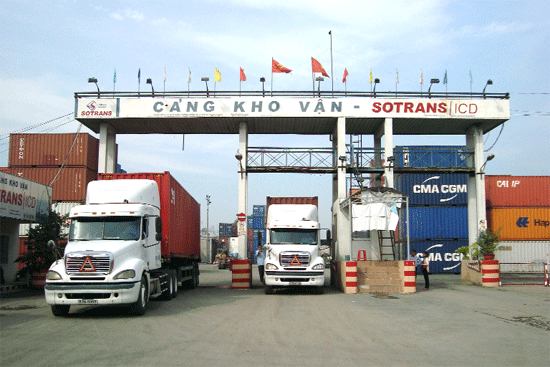
9. Allow the conversion of import and export customs clearance points into inland ports.
 |
| Illustrative image. |
This is a notable new provision stipulated in Decree 38/2017/ND-CP on investment in the construction of inland ports.
Accordingly, when a conversion is required, the investor shall submit one set of documents directly or send them through other appropriate means to the Vietnam Maritime Administration. The documents include:
- Document requesting approval for the conversion of import and export customs clearance points into inland ports.
- The overall drawing shows the location of the customs clearance point and the proposed connection plan for the functional zoning.
No later than two working days from the date of receipt, if the application is incomplete, the Maritime Administration will send a written instruction to the investor to complete the application.
If the application is valid, the Maritime Department will seek opinions from the Ministry of Finance and the People's Committee of the province where the port is to be built; appraise the application and report to the Ministry of Transport.
No later than three working days from the date of receiving the report, the Ministry of Transport must issue a written response approving or rejecting the conversion (stating the reasons).
For detailed information on sample documents for inland port investment management, please refer to the Appendix attached to Decree 38.
Peace
(Synthetic)
| RELATED NEWS |
|---|