

An invisible energy source off the coast of England.
Britain's giant offshore wind turbines provide the country with an invisible source of clean and inexpensive energy.
In early June,Chris Barani,reporterBBCnextThe Burbo Bank wind farm is located about 7 km off the coast of Liverpool, offering a glimpse into some of the world's largest wind turbines.
"At 195 meters tall, this wind turbine is almost twice as tall as Big Ben. Even more impressive is that when these giant blades descend, tearing through the wind, they only make a gentle noise," Barani remarked.
The UK is currently a world leader in wind energy. The largest wind farm on Earth is the London Array, a complex of 175 large turbines located at the mouth of the River Thames. Approximately 5.2 GW of UK electricity is generated by wind turbines, nearly equal to the total energy output of all other wind farms in Europe.
According to a December 2016 report by the World Economic Forum, the cost of producing wind turbines has decreased by more than 30% in the past three years, with the average cost of wind power falling to $50 per megawatt-hour, half the cost of coal-fired power and significantly cheaper than nuclear power.
Burbo Bank is an example of how rapidly offshore wind energy has developed. Built 10 years ago, this wind farm comprises 25 turbines with a capacity of 3.6 MW, providing electricity to approximately 80,000 households. Currently, Burbo Bank has expanded to 32 turbines with a capacity of 8 MW.
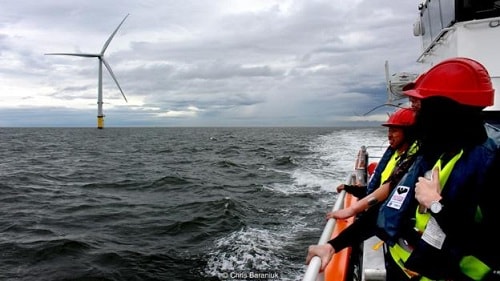 |
| A group of journalists traveled by train to visit Burbo Bank. Photo: BBC. |
"That's a huge difference," said Benj Sykes, vice president and managing director of assets at Dong Energy (Denmark), the company that installed the Burbo Bank wind farm. "I think it's a testament to the technological progress over the last 10 years."
He explained that a single rotation of a giant turbine blade is enough to power a household for 29 hours. At their fastest speed, the blades rotate nearly 30 times per minute. However, the potential of these giant blades is limited. If they rotate too quickly, the movement can damage the turbine, so the blades are designed to lock in place during storms.
In addition, turbines require regular maintenance. This is very difficult far from shore. In Liverpool, technical teams are responsible for closely monitoring each turbine.
"This job is similar to car maintenance. When there's a problem, you have to go deep and find the issue," qManager Justin Monaghan commented.
Monaghan and his team are tasked with repairing or replacing electrical, hydraulic, or moving parts. Each turbine has its own food and water storage area in case of sudden weather changes, requiring technicians to wait inside.
Nowadays, maintenance work is much easier thanks to close monitoring of weather forecasts. However, at projects located far offshore, technical staff still have to remain at sea.
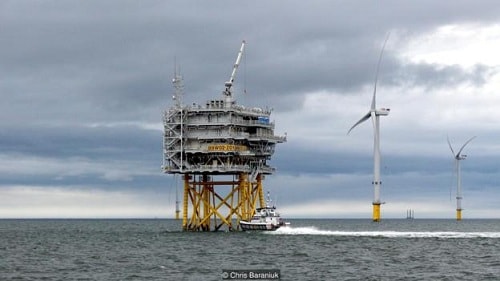 |
| Offshore turbines are often located too far from land, making maintenance very difficult. Photo: BBC. |
The industry's next major project is Hornsea, located offshore.120 km off the northwest coast of England. In this project, 150 technicians will live at sea, similar to engineers on oil rigs.
Upon completion of Phase I in 2021, Hornsea will become the world's largest wind farm with a capacity of up to 1.2 GW. Depending on the plans for the final phase, the entire farm could have a capacity of 4-6 GW upon completion in the mid-2020s, enough to power over 4 million households, equivalent to 15% of households in the UK.
However, offshore wind power also has drawbacks. Besides the high cost of installation and maintenance, the turbines can have adverse impacts on wildlife. Wildlife conservationists say they threaten species such as falcons and sea lions.Others suggest that the sound from the turbine vibrations could disorient the whales.
Many people complain that wind farms spoil the view of the sea; however, a 2016 poll showed that 73% of respondents still supported the construction of offshore wind farms.
Even more distant projects have been considered by developers, such as building an artificial island in the middle of the North Sea with hundreds of turbines surrounding it and installing power lines from the Netherlands, Germany, Denmark, Norway, Belgium, and the UK to bring electricity to the mainland.
According to VNE
| RELATED NEWS |
|---|