

Shortcomings in business models and vocational training.
(Baonghean) - Besides investing in infrastructure, supporting health insurance, waiving or reducing tuition fees, and assisting with other learning expenses, creating jobs to provide the poor with stable incomes through production support, economic models, and vocational training is considered a key pillar for sustainable poverty reduction. However, the effectiveness of these policies in practice still needs further discussion.
Difficult to replicate the economic model
Through monitoring the implementation of the National Target Program for Sustainable Poverty Reduction in several localities including Ky Son, Que Phong, Yen Thanh, and Dien Chau, and working with a number of provincial departments and agencies in recent months, the Standing Committee of the Provincial People's Council has pointed out many shortcomings in the construction and development of economic models, including too few poverty reduction economic models and a scattered scale of implementation.
For example, besides the economic models under programs 135 and 30a, during the period 2012-2016, the entire province only invested in building 13 more poverty reduction models in 13 communes across 11 districts, with 681 poor households participating, and a total implementation cost of 4.5 billion VND; including 11 models of raising Sindhi crossbred cattle in the communes of Luc Da (Con Cuong), Chau Tien (Quy Chau), Chau Dinh (Quy Hop)...; 1 model of raising black chickens in Phuc Son commune (Anh Son); and 1 model of growing passion fruit in Tri Le commune (Que Phong).
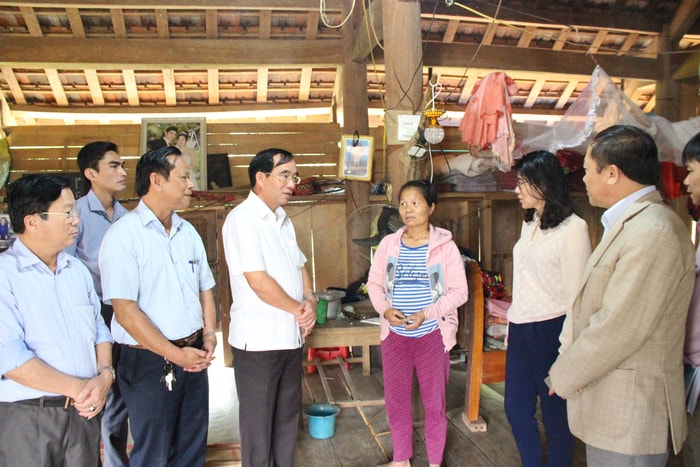 |
| The delegation from the Provincial People's Council visited and encouraged poor people in Tien Phong commune (Que Phong district) to strive to escape poverty. Photo: Mai Hoa |
As for Program 135, the 2012-2016 period had a total investment of over 140 billion VND, but only 13 models were implemented with a total investment of over 4 billion VND in 2012 and 2014 in Tuong Duong and Que Phong districts. Explaining the low number of models built under this program, Nguyen Van Lap, Deputy Director of the Department of Agriculture and Rural Development - the unit assigned to implement the production development support project under Program 135 - said: "For a long time, the communes have been gathering opinions from the people and then agreeing on the content of the model to submit for approval; unlike other programs where specific models are assigned for implementation."
Therefore, if the commune doesn't register the model, it can't be implemented. That's a drawback! Another reason is that funding is always slow each year; for example, in 2017, it hadn't arrived by the end of May. Therefore, proactively developing models is difficult, especially since agriculture is seasonal. Consequently, funding for production support is mainly focused on supporting the purchase of livestock.
Regarding the sustainability of the models, according to Mr. Nguyen Van Lap, in mountainous areas, when a model has proven effective, the State withdraws from it to allow the people to continue implementing it, which creates difficulties. Taking the example of cutting the policy supporting hybrid rice seeds, Mr. Lap cited: When the Provincial People's Council removed it from the subsidy list, the localities under Program 30a disagreed. Therefore, the province had to balance funds from Programs 30a and 135 to continue providing support.
To improve the effectiveness of building and replicating economic models, the Department of Agriculture and Rural Development advised and the Provincial Party Committee issued the Project "Developing economic components, craft villages, villages with crafts, and high-quality economic models to transform the growth model in agriculture and rural areas associated with building new rural areas in Nghe An province in the period 2017 - 2020". The project includes a list of models to be built and replicated from now until 2020. In the future, localities that build or replicate any model will base their plans on that list; except for some new models that require consultation with relevant sectors for inclusion.
At the district level, according to the assessment of the Provincial People's Council's supervisory team, some localities have not yet implemented breakthrough solutions to build and replicate effective economic models, mainly focusing on supporting the improvement of production and livestock farming techniques through training courses. Some economic models in these localities have not been effective, leading to wasted investment, such as the Sind crossbred cattle model and forest planting in Ky Son district; and the pig farming model in some localities...
Even in Que Phong, one of the districts recognized as having many successful economic models under the 30a program, scaling them up is difficult. Mr. Nguyen Dau Long, Head of the Labor, War Invalids and Social Affairs Department of Que Phong district, stated: "In the past five years, the district has implemented 25 economic projects and models, such as passion fruit cultivation, bamboo cultivation, golden flower tea medicinal plants, pig farming in Sao Va, cage fish farming, and cucumber cultivation... However, due to the fact that over 90% of the population are ethnic minorities, with outdated farming methods and customs, mainly for self-sufficiency, coupled with the limited will of the people to overcome poverty, scaling up is challenging."
Also related to building economic models, the Director of the Department of Labor, War Invalids and Social Affairs, Nguyen Bang Toan, pointed out a paradox: according to Decision No. 1722/QD-TTg approving the National Target Program for Sustainable Poverty Reduction giai đoạn 2016 - 2020, it stipulates: “The Department of Agriculture and Rural Development directly directs activities to support production development and diversify livelihoods, while the Department of Labor, War Invalids and Social Affairs directly directs activities to replicate poverty reduction models.” This is unreasonable and impractical because the agricultural sector directs the model building, while the labor, war invalids and social affairs sector is responsible for replicating the model. “It is through practical experience and guidance that replication can be achieved. Assigning the labor, war invalids and social affairs sector to replicate the model is inappropriate, and therefore, negative consequences are inevitable,” Mr. Toan stated.
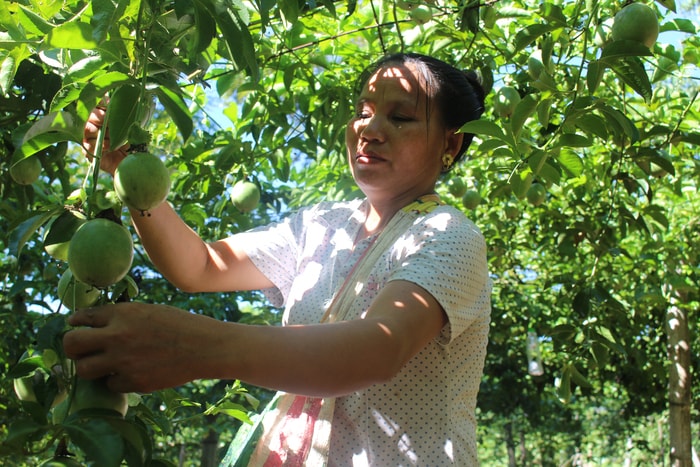 |
| The passion fruit cultivation model in Que Phong has been successfully replicated. Photo: Thanh Duy |
Vocational training has not yet become truly effective.
Vocational training is considered a crucial pillar in addressing employment issues for workers in rural and mountainous areas, especially for poor households, when the training is linked to practical local needs or equips workers with skills for employment in factories and enterprises, or for overseas labor export. Dien Chau district has approached vocational training in this direction. Mr. Truong Cong Suu, Head of the Labor, War Invalids and Social Affairs Department of Dien Chau district, said that on average, the district opens 20-30 vocational training classes each year in fields such as crop cultivation, animal husbandry, and veterinary medicine.
In particular, taking advantage of the fact that the district has 4 garment factories, the district's vocational training center has partnered with these businesses to provide garment making training, after which all trainees find employment. However, the number of poor households receiving vocational training remains very modest. According to statistics from the Dien Chau District People's Committee, from 2012 to 2016, the entire district had 306 poor people supported with vocational training, with a total budget of over 210 million VND.
Meanwhile, in Que Phong district, despite investing over 14 billion VND in building a vocational training center, it remains difficult to enroll workers. For a long time, the center has had to coordinate with communes to open classes in villages and hamlets, mainly focusing on animal husbandry and veterinary medicine. The only successful course offered is a mid-level cooking class with 35 students serving in restaurants within the district. Furthermore, collaboration with businesses to train workers for employment in factories and industrial zones has yet to be achieved.
In Khanh Thanh commune (Yen Thanh district), on average, the locality organizes 3-4 vocational training courses each year, mainly in agricultural and forestry extension, and machinery repair; with a focus on prioritizing the poor and near-poor. However, according to Mr. Tran Ngoc Chau - Secretary of the Party Committee of the commune, poor farmers often have limited access to and application of the knowledge gained after training, so the training effectiveness is not high.
Regarding this issue, the Director of the Department of Labor, War Invalids and Social Affairs of the province, Nguyen Bang Toan, said that vocational training for rural laborers contributes to structural transformation and increased productivity in agriculture and small-scale industries, but further effort is needed to achieve the desired results. “The investment capital for this work is still limited. We are mostly prioritizing investment in infrastructure, while the allocation to training costs remains modest. For a long time, this work has been carried out in a hands-on, practical manner, lasting less than three months, so it is mainly focused on guidance,” Mr. Toan explained the reason.
| According to a report from the Department of Labor, War Invalids and Social Affairs, from 2012 to 2016, the entire province provided vocational training support to 13,136 poor people, with a total budget of over 51.84 billion VND. This included 602 college-level courses; 1,401 intermediate-level courses; training and certification for 9,127 people; and 2,006 people receiving vocational training certificates. |
(to be continued)
Mai Hoa - Thanh Duy
| RELATED NEWS |
|---|