

50,000-year-old cypress forest at the bottom of the sea.
A pristine ice age forest discovered off the coast of Alabama, USA, reveals glimpses of prehistoric Earth.
The underwater cypress forest dates back to the Ice Age, more than 50,000 years ago, when sea levels were 120 meters lower than they are today, according to the documentary "The Underwater Forest" by environmental journalist and filmmaker Ben Raines. The forest lies on the seabed off the coast of Gulf Shores, Alabama, in the Gulf of Mexico, Live Science reported on July 19.
Raines learned about the forest from Chas Broughton, the owner of a local dive shop. Several years ago, Broughton was the first to discover the forest off the coast of Mobile, Alabama, more than 20 kilometers from the surface, about 18 meters below sea level. When he dived down to get a closer look, Broughton saw massive tree trunks reaching high into the ancient riverbed that extended deep into the ocean. Like coral reefs, these tree trunks provided a home for thousands of different marine creatures.
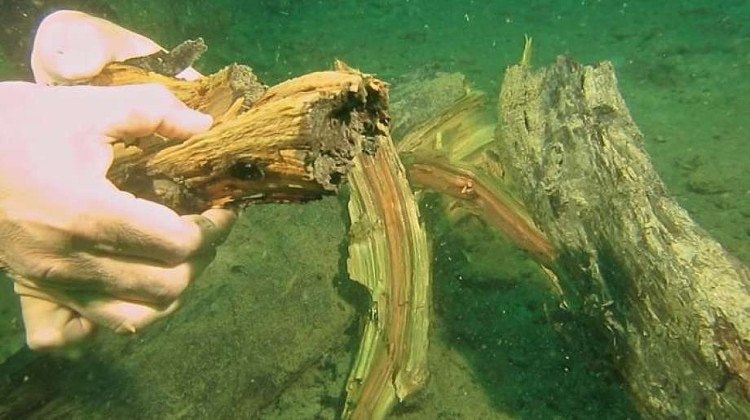 |
| The tree trunk still oozed sap when cut. (Photo: YouTube) |
Raines collaborated with paleometeorologist Kristine DeLong at Louisiana State University to study the forest and try to preserve this natural wonder. The first scientific expedition to the area took place in 2012. Afterward, DeLong and her colleagues continued to explore the forest's secrets. Unique conditions have helped preserve the forest in perfect condition. It is believed to be the only preserved coastal ice age forest in the world, hidden deep beneath the sea.
Cypress trees typically decompose after about 10,000 years. But in this area, the cypress trees have survived much longer thanks to sediments consisting of mud and sand with low oxygen concentrations, which prevent bacteria from decomposing the wood, DeLong explained. The ancient giant cypress forest is so fresh that many trunks still ooze sap when cut. Much of the trunk is covered with sea anemones and schools of fish. The most recent trees date back 50,000 years, making the forest the oldest underwater forest in the world.
While analyzing the area, experts determined tree ring dates, and geologists and paleontologists from the DeLong group gathered rare information about the ice age climate, rainfall, insects, and plants, contributing to a new perspective on Earth before human settlement.
The research team quickly identified the samples as freshwater swamp cypress trees with numerous knots that helped them stay upright in the mud, similar to those found along the Gulf Coast today. They took samples of the tree's core for analysis by Grant Harley, a tree ring expert at the University of Southern Mississippi. All the growth rings, resin, and wood fibers were still clearly visible on the trunk. "When you run a saw through the sample, you can smell the resin, just like cutting a fresh log today," Harley said.
Initially, scientists estimated the forest to be about 10,000 years old based on the depth of the area, but carbon dating of surrounding sediments indicated the forest dates back to the Ice Age, more than 50,000 years ago.
Under a microscope, the growth rings on modern bald cypress trees are thinner, indicating that the trees are subjected to higher environmental stress. Trees today, with more stable growing conditions, typically have thicker and more regular growth rings.
Tree ring data revealed that all the cypress trees in the forest grew and died over a period of 500 years, with many periods experiencing stress. They died at the same time. The research team also attempted to analyze pollen from sediments near the trees and found that the environment changed quite abruptly.
At its peak, the river delta was formed from grasslands, which later gave way to cypress forests. As sea levels rose, the grasslands gradually encroached inland. The grassy slopes at the water's edge receded towards the shore, before rising sea levels swallowed up the entire forest.
The research team is still delving deeper into the ancient climate of this ice age. But like everything under the ocean, the underwater forest's lifespan is not long. If storms and tides continue to expose the forest, it will gradually be eroded by barnacles and bacteria, Raines said.
Researchers are working with federal agencies such as the Bureau of Marine Energy Management and the National Oceanic and Atmospheric Administration (NOAA) to designate this area as a marine protected area.
According to Khoahoc.tv
| RELATED NEWS |
|---|