

Investing heavily in vocational training facilities that are not being utilized is a waste.
(Baonghean.vn) - This is one of the shortcomings acknowledged by the Director of the Department of Labor, War Invalids and Social Affairs during the questioning session on vocational training and job placement.
On the afternoon of July 12th, the questioning session with the Director of the Department of Labor, War Invalids and Social Affairs was truly heated, addressing many issues related to vocational training and job placement. Among these, the issue that attracted the most attention from delegates was labor export, the existence of "brokers," and the responsibility of the Department of Labor, War Invalids and Social Affairs when vocational training and job placement have not met expectations.
Still uneasy because the costs of labor export vary greatly.
This opinion was shared by delegate Hoang Nghia Hung from Nam Dan district at the beginning of the questioning session. According to Mr. Hung, the province's labor export activities have achieved certain results in recent times. However, in reality, this work still has many shortcomings, leading to significant differences in the cost of going abroad for work within the same industry and country. This "affects the morale of workers."
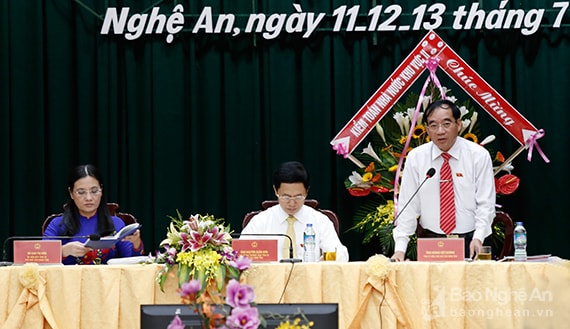 |
| Comrade Hoang Viet Duong - Vice Chairman of the Provincial People's Council, speaks at the questioning session. Photo: Duc Anh |
In addition, there is also the issue of businesses "abandoning" workers. Specifically, when advising and introducing workers, labor supply and export agencies pay great attention. However, in many cases, after workers have gone abroad, they are "abandoned" by the businesses.
Responding to this issue, Mr. Nguyen Bang Toan, Director of the Department of Labor, War Invalids and Social Affairs, said: Currently, there are about 50 labor export consulting units in the province, and each year they send about 12,000 Nghe An workers to work abroad. The Department has done a fairly good job of management in the past. However, there are still some businesses that act improperly, causing a loss of public trust. Most recently, there have been cases of workers being scammed in Thanh Chuong and Que Phong districts. Currently, the labor sector has directly worked with the businesses and requested them to return the money to the people. If they cannot return the money within the shortest possible time, the case will be transferred to the legal authorities for handling.
 |
| Mr. Nguyen Bang Toan, Member of the Provincial Party Committee, Director of the Department of Labor, War Invalids and Social Affairs, answers questions from delegates. Photo: Duc Anh. |
The Director of the Department of Labor, War Invalids and Social Affairs also noted that the management of recruitment consulting units for overseas employment is currently quite strict. However, there are still fraudulent units recruiting workers without the permission of the authorities. Based on the situation in Que Phong district, he hopes that localities will increase vigilance and not arbitrarily grant permission for recruitment in their localities to avoid fraud.
Regarding the question of whether or not there is a situation involving "brokers" who inflate intermediary costs during the process of applying for overseas employment, Mr. Toan said that he had "only heard about it" and would have it investigated.
Following the trend limits the consequences.
During the questioning session, many opinions were also raised regarding the results of training and job placement. Most of these opinions focused on the following issues: why vocational training for highly skilled workers is achieving low results, the results of vocational training for workers whose land has been confiscated, and vocational training for poor households and ethnic minorities.
Coming from Quy Chau district, delegate Luc Thi Lien asked: In the past two years, Nghe An's vocational training program has consistently exceeded targets. However, among these trainees, what is the proportion of poor and ethnic minority workers, and what is the effectiveness and quality of vocational training?
 |
| Representative Lục Thị Liên raised a question about vocational training for the poor and ethnic minorities. Photo: Đức Anh |
The Director of the Department of Labor, War Invalids and Social Affairs responded to delegate Luc Thi Lien.
Representative Dinh Thi An Phong (Nghi Loc district) also expressed her concerns, stating: Although the number of trained workers in Nghe An province is quite high, most of the training is short-term, resulting in students completing their courses without being skilled, and training not being linked to job placement, leading to waste. How does the Department of Labor, War Invalids and Social Affairs view this issue, what are the solutions, and what are their plans for the future?
Delegate Tran Thi Thanh Thuy (Vinh City) focused on the issue of labor market forecasting and expressed her wish for the Department to implement practical solutions to improve the quality of market forecasting. Meanwhile, Delegate Nguyen Thi Lan (Do Luong District) argued that one of the limitations of vocational training is the "not-yet-planned allocation and implementation of targets." Based on her analysis of the data, Ms. Lan requested that the Department of Labor, War Invalids and Social Affairs explain "the basis on which the Department proposes targets, as well as the direction and evaluation of the results of the assigned targets."
Representative Nguyen Thi Lan also requested the head of the sector to answer the question of why, after 3 years (since the 13th session of the 16th Provincial People's Council), 6 out of 9 outstanding issues remain unresolved, such as providing employment for specific groups and laborers whose land has been confiscated...
 |
| Delegate Nguyen Thi Lan's opinion received attention from the council. Photo: Duc Anh |
In response to this issue, the Director of the Department of Labor, War Invalids and Social Affairs provided several figures. Specifically, in the two years 2015-2016, the entire province organized vocational training for 155,196 out of 155,000 people, exceeding the target set by the Provincial People's Committee. In addition, 75,360 workers found employment. However, vocational training still has many limitations, as the number of workers trained at the college and intermediate vocational levels remains low compared to the total number of workers trained annually. The quality of training and the structure of some vocational fields at some training institutions do not yet meet the high-tech requirements of businesses and the labor market.
The Director of the Department of Labor, War Invalids and Social Affairs responded to delegate Nguyen Thi Lan.
Mr. Toan also stated that the province conducts annual labor market forecasts because "if we don't do this, we can't forecast the market or set targets." However, the accuracy is not "spot-on" and stems from the grassroots level: "Data must be collected from communes and districts before being sent to the province and becoming part of the overall plan for the entire province." Regarding this issue, Mr. Toan also said that, while objective, the Department strictly acknowledges its shortcomings: "Responsibility is not to blame, but the labor sector must bear the consequences."
 |
| Representative Tran Thi Thanh Thuy called for increased accountability in linking training with the recruitment needs of businesses. Photo: Duc Anh |
The Director of the Department of Labor, War Invalids and Social Affairs also explained many questions related to why vocational training for rural laborers has yielded low results. According to Mr. Toan, vocational training for rural laborers used to be jointly managed by six agencies. In recent years, funding for rural laborers has been transferred to the Department of Agriculture and Rural Development under the New Rural Development program. Specifically in 2016, due to insufficient funding, the results did not meet expectations.
Mr. Toan acknowledged that vocational training for rural laborers faced many shortcomings during the 2011-2015 period: At that time, when implementing Project 1956, the goals were very ambitious, and with a subjective mindset, all districts opened vocational training centers. The consequence is that many centers are now ineffective, leading to waste. “At that time, we didn't recognize that vocational training must be linked to production, the training programs were not aligned with reality, were inconsistent, and the nature of vocational training was not properly assessed. It was done based on trends, resulting in many limitations. Large investments in infrastructure were inevitably wasteful.”
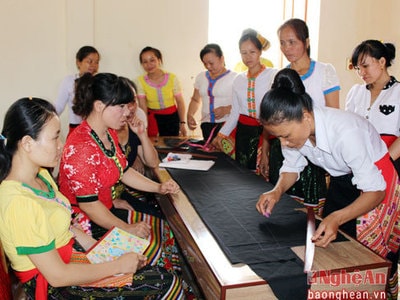 |
| Vocational training for rural workers in Quy Chau district. Photo: archival material. |
During the questioning session, Mr. Toan also stated that the Department of Labor, War Invalids and Social Affairs had not yet categorized trained workers, and therefore did not have specific figures for specialized workers, ethnic minority workers, and poor households. He "promised" to provide a written response after a complete compilation was available.
Concluding the questioning session, Mr. Nguyen Xuan Son - Standing Deputy Secretary of the Provincial Party Committee and Chairman of the Provincial People's Council - highly appreciated the explanation provided by the Director of the Department of Labor, War Invalids and Social Affairs. He also requested the department to continue researching the legitimate recommendations of voters and delegates to further advise the Provincial People's Committee on developing the employment information system, better connecting vocational training and employment; reorganizing public education institutions in the spirit of modernization; and promptly completing the merger of vocational training centers with continuing education centers, etc. In addition, actively promote the socialization of vocational training and job placement by creating favorable conditions for vocational training facilities, promoting vocational training linkages with businesses, especially foreign businesses, and providing foreign language training for workers to integrate into the global workforce; review the quality of teachers, the list of occupations, and supplement and strengthen training facilities and equipment. The Provincial People's Council also proposed: strengthening vocational training at the intermediate and college levels to target high-quality labor; paying attention to improving the quality of basic training to increase productivity and income; seriously implementing inspection, examination, and certification work, promptly handling errors, and strictly detecting and dealing with fraudulent acts. |
My Ha
| RELATED NEWS |
|---|