

How the people of Hoc village preserve the forest.
(Baonghean) - To preserve the pristine forest surrounding their village, for hundreds of years, the people of Hoc village in Dien Lam (Quy Chau) have established a village charter to protect the forest together. The charter stipulates that households regularly patrol and monitor the forest, and households needing to build houses must obtain permission from the village management board before they can enter to cut down trees.
A few months ago, when he needed to build a house after moving out on his own, Quang Van Son (33 years old, Hoc village, Dien Lam commune, Quy Chau district) had to write a petition to the village management board.
After receiving approval, Son's family was allowed to enter the forest to cut wood. This was because the forest was classified as a community forest, and the forestry department had assigned Hoc village to manage it.
During the logging and transportation of timber for house construction, members of the Hoc Village Management Board closely monitored the process. "We have to keep a close eye on things to prevent people from exploiting the construction process to illegally harvest and sell timber."
"Although this has never happened in our village before, we still need to be strict," said Quang Van Dong, Secretary of the Party Branch of Hoc village, adding that among the remote communes of Quy Chau district, only Hoc village still retains a rare and valuable primary forest for use when needed.
The neighboring villages, despite being located right on the edge of the forest, no longer have wood. Whenever they build houses, they often steal individual logs from the conservation area, resulting in penalties from the authorities. Therefore, many households now have to build concrete houses because they lack wood for stilt houses. Only in Hoc village do 100% of the households live in impressive stilt houses.
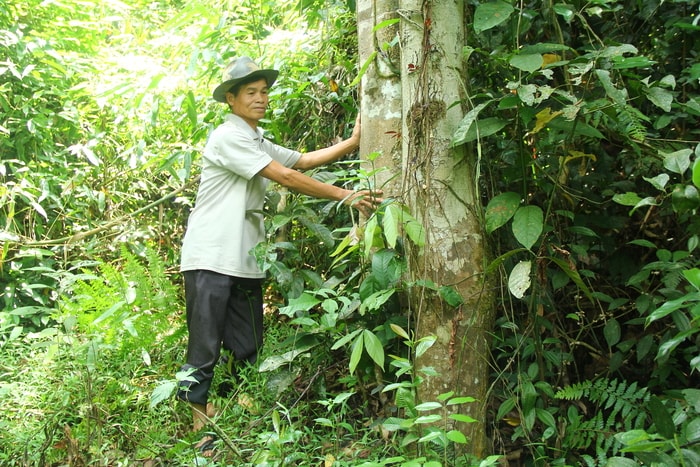 |
| Mr. Quang Van Dong - Secretary of the Party Branch of Hoc village (Dien Lam commune, Quy Chau district) next to the protected forest. Photo: Tien Hung. |
Mr. Dong recounted that over 300 years ago, two men, surnamed Luong and Quang, brought their families to clear and settle this land. Ban Hoc is a small valley, surrounded on all sides by the Pu Hoc mountain range. Elderly villagers say that, since time immemorial, their ancestors had a customary law restricting the exploitation of timber from the forest.
The village regulations were not recorded in any written document, but were passed down orally from generation to generation. "Since childhood, we only heard our elders instruct us not to cut down trees in the forest for exchange or sale, only to harvest them when necessary for building houses. We must all work together to strictly protect the forest," said Mr. Quang Van Hanh (60 years old).
It's a forest spanning approximately 500 hectares, spread across the Pù Hốc mountain range. The edge of the forest is only a few minutes' walk from the village, extending all the way to the border with Châu Phong and Châu Hoàn communes. As soon as we entered the forest, which the villagers of Hốc call the forbidden forest, the sight that greeted us was towering trees, nearly a meter in diameter, standing majestically...
Through generations of oral traditions, the people of Hoc village realized that their village regulations had not been strictly enforced for a long time. The practice of exploiting land for house construction to illegally harvest and sell timber to relatives in other villages continued. Therefore, in 2005, the people of Hoc village decided to create a written set of regulations, specifically outlining prohibited activities and penalties. The regulations were entrusted to the village head and signed by every household in the village.
The village regulations clearly state that only residents of Hoc village are allowed to enter this forest to cut wood, and only for building houses; the wood is not permitted for exchange or sale. Before building a house, the homeowner must submit an application to the village management board for consideration, which will determine the number of trees allowed to be cut depending on the size of the house. Hunting all animals in the forest is prohibited. Residents are only allowed to exploit non-timber forest products such as bamboo shoots, firewood, and medicinal plants under the forest canopy.
“Around here, in communes like Chau Hoan and Chau Phong, the forests have been completely cleared, leaving only barren hills, so many animals have moved into these forests to live. Mostly weasels, muntjacs, wild boars… Regarding honey harvesting, people are allowed to light fires but must commit to preventing forest fires,” said the Party Secretary of Hoc village.
This village agreement also stipulates that the 56 households in the village are divided into 6 groups. One group is responsible for patrolling and monitoring the forest for one month. If this group fails to patrol and timber is stolen, they will be fined.
Mr. Quang Van Dong recounted that one day in mid-2015, Mr. Lo Van Phong (residing in Chau Hoan commune) and two young men secretly entered the protected forest area of Hoc village to illegally log timber. Mr. Phong was the owner of a large timber workshop in Chau Hoan commune. Hearing the sound of chainsaws, villagers patrolling the forest immediately ran back to the village to report the incident.
The management team of Hoc village, including the village head, the Party branch secretary, and a few other villagers, immediately dropped everything and rushed into the forest. “At that time, Mr. Phong had already managed to cut down three trees with a diameter of about 30cm. Seeing us, he apologized and promised not to repeat the offense, so the village only fined him 200,000 dong,” Mr. Dong recounted.
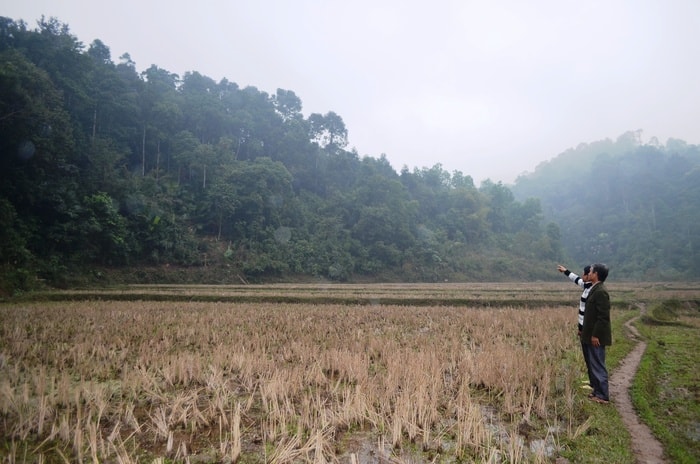 |
| A 500-hectare forest lies right behind Hoc village. Photo: Tien Hung |
The second violation occurred a year later. At that time, a family from Chau Hoan commune brought buffaloes and a chainsaw to illegally log six trees. The villagers of Hoc hamlet discovered the violation and fined them 600,000 VND, requiring them to sign a commitment not to repeat the offense. These are the only two violations since the village regulations were established in 2005. “Only two incidents have occurred, and the violators are from other communes. No one in Hoc hamlet has violated the regulations,” Mr. Dong added.
Upon arriving at Hoc village, captivated by its "forest preservation culture," we were also fortunate to learn that, in addition to regulations on forest exploitation, the village's customary laws also include provisions related to weddings and funerals. According to Mr. Quang Van Dong, in the past, like many other Thai villages, the people of Hoc village often held funerals with many superstitious customs.
The family would often slaughter buffaloes and cows for a feast lasting five days. After the funeral, many families fell into debt. The village regulations later stipulated that when someone died in the village, each household was responsible for contributing 4 kilograms of rice and appointing one main laborer to help the bereaved family and be present at the funeral. If a family was busy, they had to pay to hire someone else.
At funerals, people are not allowed to eat or drink at the bereaved family's house; they must eat at home to save money for the family. Families with a deceased person are only allowed to keep the body for a maximum of two days before burial. If the children live far away and cannot return in time, the authorities may consider this, but not exceeding three days. Regarding weddings, eating and drinking at night is prohibited as it disrupts public order and security. Weddings should not be held for many days...
(To be continued)
Tien Hung
| RELATED NEWS |
|---|