

The military ceded land to Da Nang for development.
To create the modern and prosperous Da Nang we see today, the city government conducted extensive "negotiations," and the military agreed to cede over 2,000 hectares of military land to the city.
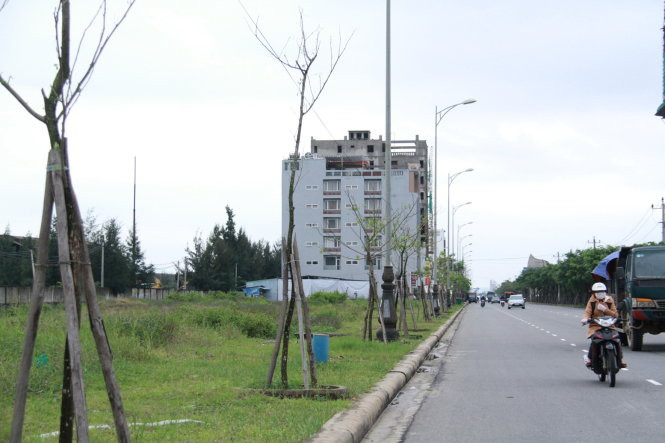 |
| The Son Tra - Dien Ngoc road (Da Nang City) was formerly a military airport. Photo: Huu Kha |
Among these locations were those considered sensitive in relation to national security and defense. But thinking about the greater good for the prosperity of a coastal city in Central Vietnam, and for the future of its people, everything was arranged smoothly and harmoniously.
Give up land to serve the people.
Mr. Nguyen Dieu, former director of the Department of Natural Resources and Environment of Da Nang City, recounted that during his 23 years as director, he spent nearly 20 years contacting the military with a persistent goal: to persuade the military to cede land for the city's development and to serve the lives of its people.
Today, traveling along the wide coastal road from Son Tra - Dien Ngoc, stretching from Da Nang to Hoi An, few would imagine that behind it lies a persistent negotiation between the Da Nang government and the military.
Many locations were considered quite sensitive in terms of defense, such as the land of Nuoc Man Airport, Nguyen Tat Thanh Street, and 2-9 Street. But without these vital routes, Da Nang would forever remain a fragmented city, lacking the well-planned infrastructure it has today.
Mr. Dieu stated that in order to relocate a military unit to a new "settlement" location, Da Nang City had a responsibility to the Ministry of National Defense. The view of Da Nang City's leaders at the time was to coordinate and provide support so that the military unit, upon arriving at the new location, would have more spacious and solid facilities and infrastructure.
"To accomplish this, I had to meet with many military experts, who also said that in modern warfare, military positions and bases located in strategically important areas are unsuitable and need to be relocated. The American bomb depots in Da Nang were previously near the airport, but now they can be completely moved out of the city to a better, safer location in peacetime," Mr. Dieu recounted.
The result of perseverance
Mr. Dieu recounted that when building the Thuan Phuoc bridge, Mr. Nguyen Ba Thanh didn't dare imagine that Le Duc Tho road would run through a military barracks area considered extremely important, impossible to relocate, and the military also refused to move it. But after several years of negotiations, the military agreed to relocate the barracks area so that the city could build the road.
Mr. Dieu also emphasized that if the city had not persevered, the Son Tra - Dien Ngoc road would not be as straight as it is now, but would have to curve down close to the sea, because the military claims that the land the city wants the military to cede for this road is a defensive weapons depot.
“At that time, it was almost a dead end. But Mr. Thanh told me I had to find out how important that depot really was and prove that it was less important in order to get the government's opinion. In the end, I had to work for two months to find out, and the truth was that its scale wasn't as large as people said. And having the ammunition depot near the sea and near the city wasn't ideal either,” Mr. Dieu recounted.
Architect Hoang Quang Huy, chairman of the Da Nang Planning Association, said that when Da Nang became a centrally-governed city in 1997, its infrastructure was very poor, with narrow roads, while there was a considerable amount of land allocated for national defense purposes.
“It was thanks to the determination of the city's leaders in good-faith meetings with the Ministry of National Defense that a large plot of land was handed over. Once we had the land, Da Nang City established a systematic urban plan, expanded roads, and built residential and tourist areas,” Mr. Huy recalled.
Relocating hundreds of military barracks. According to Mr. Nguyen Dieu, when constructing the Son Tra - Dien Ngoc road, as many as 30 military barracks had to be relocated. Similarly, when constructing the Lien Chieu - Thuan Phuoc road, approximately 30 military units also had to be relocated. Including Da Nang City, no fewer than 100 military units will have to relocate to make way for the city's development. |
According to Tuoi Tre newspaper
| RELATED NEWS |
|---|