

Hyundai's SUVs will feature a completely new design language.
Hyundai is in the process of making an effort to penetrate the SUV segment, and the new Kona is paving the way for a new design language that the South Korean automaker will apply to similar models.
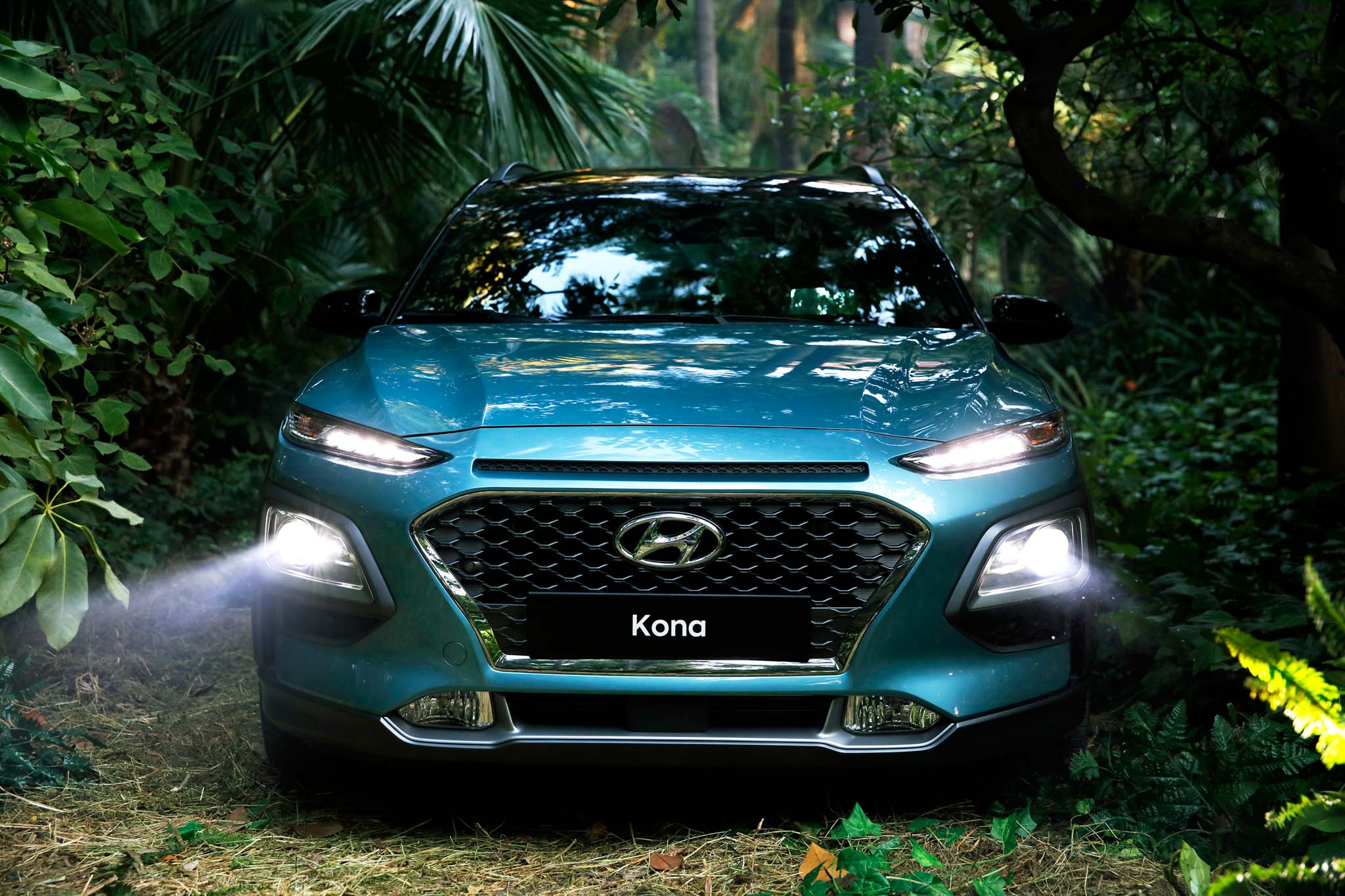 |
| The design of the Hyundai Kona will be applied to many other crossover models in its family. |
When the Kona was launched, many only knew it as Hyundai's all-new compact SUV, but few knew that it was also a pioneer of a new design language that would be applied to similar models later on. This is seen as one of the South Korean automaker's efforts in the increasingly fierce SUV segment, where even a slight lapse in attention could lead to being left far behind by competitors.
Dubbed the “Cascading Grille,” Hyundai’s new design language features a rather unusual look with low-mounted headlights, while the razor-thin LED daytime running lights are positioned above, almost seamlessly connected to the small air vents above the large polygonal grille below. The fog lights continue to be separate, positioned closer to the front bumper and more centrally.
Although the daytime running LED light layout borrows from the Nissan Juke or Jeep Cherokee, there's no denying that the overall front end of the Kona looks cooler. The Nissan Juke is known to be very successful in Europe, and the Jeep Cherokee is also selling quite well in the US. This could be good news for a newcomer like the Kona, especially since Hyundai has already made some decent improvements.
The 2019 Santa Fe Sport may be the next model to adopt the same design language as the Kona. |

The 2019 Santa Fe Sport, expected to launch next year, will be the second model to adopt Hyundai's new design language. Information suggests it may feature a similar headlight layout and honeycomb grille to the Kona. Perhaps after more than a decade of developing compact urban SUVs, it's time for the South Korean automaker to refresh its design in a more unique way.
Luc Donckerwolke, Hyundai's design director, stated that they will avoid the "Russian doll" phenomenon in design, where cars only differ in size. Therefore, despite sharing a common design language, each model will have its own distinct identity. Donckerwolke himself said he was very enthusiastic about doing this because following the beaten path is boring, something a designer like him doesn't want to do.
By 2020, Hyundai is expected to launch a new crossover model that is smaller than the Kona, and a larger one with 8 seats to replace the SantaFe. The Korean automaker is also trying to widen the gap between the Tucson and SantaFe Sport in terms of both size and target customer base to avoid internal competition.
According to TNO
| RELATED NEWS |
|---|