

Amazing and incredibly simple trick for growing vegetables hydroponically.
(Baonghean.vn) - Growing vegetables hydroponically saves land and helps isolate them from pests, diseases, and polluted water, avoiding toxins.
Leafy vegetables are all very suitable for growing in a hydroponic environment, such as lettuce, tomatoes, cruciferous vegetables, spinach, water spinach, mint, scallions, garlic, sprouts, etc.
Advantages of growing vegetables hydroponically
No tilling required, no weeds. No pesticides or herbicides needed.
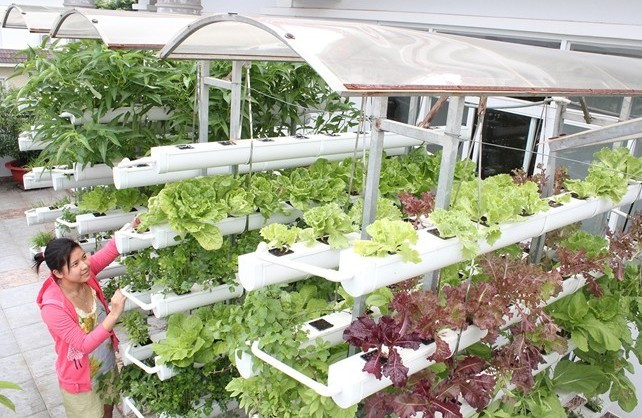
It can be grown in multiple seasons, even out of season, without irrigation; yields are 25% to 50% higher. The product is completely clean and uniform; it does not accumulate toxins and does not pollute the environment.
 |
Conditions necessary for growing hydroponic vegetables
A covered rooftop is the most suitable place for growing hydroponic vegetables, as vegetables need at least 6-7 hours of sunlight per day for photosynthesis, but they must also be protected from rain, which can dilute the hydroponic solution, causing the vegetables to lack essential nutrients.
How to install a hydroponic system
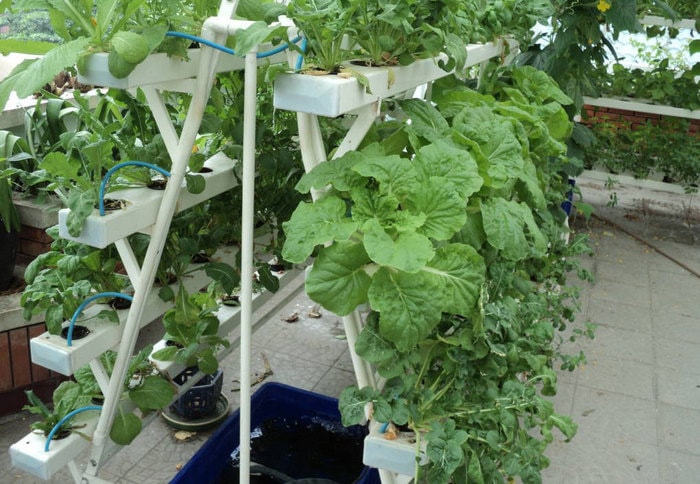
- A-shaped shelf:This type of shelving is sturdy and easy to move; an 8-tube shelving unit requires a steel frame measuring 1.55 x 1.45m; 8, 10, or 12-tube shelving units can be made depending on needs.
 |
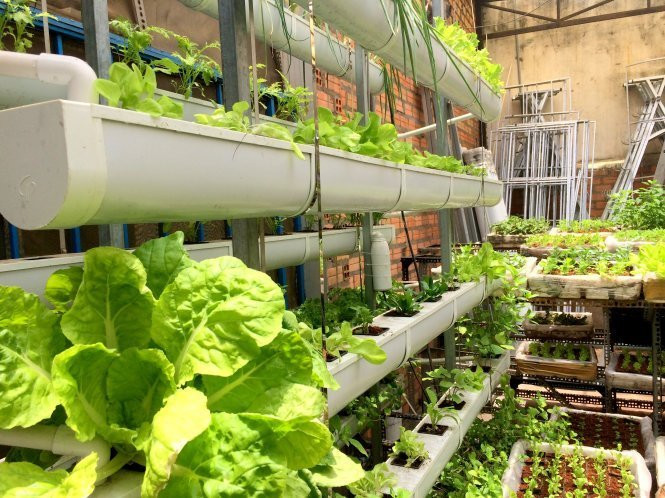
- Horizontal truss type:Suitable for large rooftop areas; the system consists of an iron frame, growing tubes, a pump, and a reservoir. The tubes are placed on horizontal supports, and hydroponic nutrient solution is pumped up and supplied to each tube; just 8 tubes, each 6m long, are needed for rotational planting to provide a continuous supply of fresh vegetables.
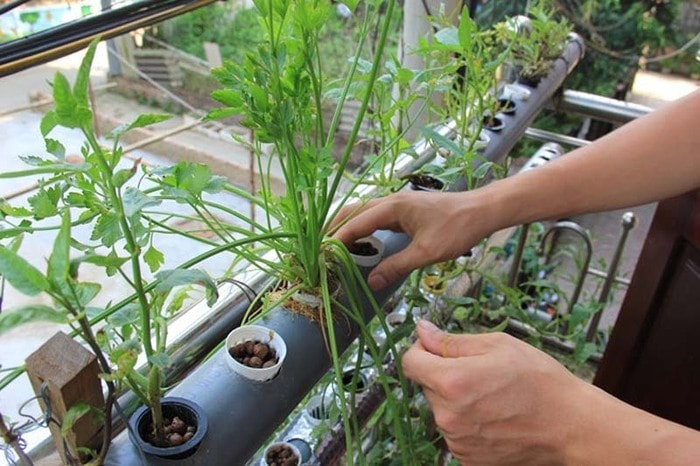
- Hanging frame type:This type of system is suitable for homes with "modest" space; it requires a system about 2 meters high and of similar length, pipes with pre-drilled holes of sufficient size to hold plastic cups (or plastic baskets), water pipes, and a cable system to hang the pipes.
 |
Prepare the tools and seedlings.
- Plastic cups:The best plastic cups (or containers) are dark or opaque to prevent light from penetrating, creating a dark environment for root growth and preventing moss from growing inside. Punch holes around the plastic cup so the roots can penetrate the nutrient solution.
- Growing medium:The growing medium can be coconut coir, boiled straw, burnt rice husk, corn silk, etc. A combination of straw and burnt rice husk can be used. The black burnt rice husk is spread over the surface of the cup to ensure that the roots receive sufficient shade for optimal root development.
- Seedlings:The seedlings are sown in seed trays (each tray contains approximately 130-200 small seedlings, depending on the variety).
Soak the seeds until they crack open, then sow them in seed trays; each tray can yield approximately 200 seedlings.
While the seedlings are still dormant, keep the trays in a shaded area; once the seedlings are about 2 cm tall, move them to a sunny location. When the seedlings have a few true leaves, transplant them into the nutrient solution.
Prepare the hydroponic solution.
Nutrient solutions are solutions mixed in appropriate proportions, containing the elements necessary for plant growth. They come in various forms such as liquid solutions (AB), powders, etc., each with different preparation methods and dosages depending on the type of plant being grown.
There are many formulas for preparing hydroponic solutions. To ensure even distribution, prepare the stock solution as follows: Add the nutrient powder sachet to 6 liters of tap water and stir well. Then, add 0.5 liters of the stock solution to each styrofoam box and fill with water to a total of 12 liters per box. Stir well.
 |
Sow seeds
Depending on the type of vegetable, you can sow the seeds sparsely. After sowing, place a lid on top to prevent the seeds from being disturbed, and spray some water on the seeds.
Take care of
During growth, the plants will absorb the solution from the styrofoam container, so it is necessary to replenish the solution regularly (once a week) to ensure sufficient nutrients for the plants.
Add clean water until harvest for vegetables that are harvested once; if the vegetables are harvested multiple times, add 30% of the initial nutrient solution after each harvest.
Monitor daily, removing pests mechanically if present; replace weak, unhealthy, or dead plants; relocate vegetables to ensure sufficient sunlight and nutrients; remove yellow leaves, trim root branches, and clean the container after each harvest for perennial crops (water spinach, mint, etc.).
In the summer, shade the area with black netting from 10 AM to 4 PM.
Harvest
For leafy vegetables like water spinach, cabbage, jute mallow, and Vietnamese coriander, the first harvest can be done after 2-3 weeks. Cut or trim the vegetables, then add more fertilizer to encourage continued growth for subsequent harvests. Typically, each harvest is spaced about one week apart.
Ngoc Anh
(Synthetic)
| RELATED NEWS |
|---|